

How to Write a Research Proposal Outline
Introduction
Writing a research proposal outline is often harder than writing the full proposal. Many medical students, doctors, and researchers know their topic, but struggle to organize the essay into a clear, fundable, and journal-ready structure. A weak outline leads to vague aims, scattered methods, and poor logic. A strong research proposal outline solves this problem before drafting begins. It helps you define the gap, frame the proposed statement, and build a paper that is easier to write and easier to defend.
1. Start with the Research Problem
1.1 Define the clinical or scientific need
A good outline begins with a precise problem. In medical writing, the problem should not be broad. It should identify a real knowledge gap, a practical need, or an unresolved mechanism.
For example, instead of saying “cancer treatment is important,” specify what is unknown. Is it drug penetration in tissue, biomarker function, or treatment resistance? The more specific the problem, the stronger the essay.
A useful rule is this. If your topic cannot be explained in one focused sentence, your outline is too vague.
1.2 Turn the gap into a proposed statement
In scientific writing, the proposed statement is often used when a rigid hypothesis is not appropriate. It is similar to a hypothesis statement, but more flexible. It is common in resource articles, short notes, and exploratory studies.
A simple structure is:
- The purpose of the study is to...
- This study aims to...
- We propose to investigate...
The key is to state the critical need clearly. A proposed statement should show why the study must be done now.
2. Choose the Right Article Type
2.1 Match the outline to the manuscript type
Different manuscript types need different outlines. A research article usually follows a hypothesis-driven structure. A resource paper may focus on a new database or technology. A brief communication or technical note may use a shorter purpose-driven format.
Before writing the essay, ask one question. What kind of paper am I actually preparing?
Common types include:
- Research articles
- Brief communications
- Technical notes
- Resource papers
- Case reports
- Reviews
This choice affects the outline, the depth of methods, and the order of results. A mismatch between article type and outline often weakens the entire submission.
2.2 Consider the target journal early
Target journal selection should happen before the final outline, not after. Journals differ in novelty expectations, audience, and data completeness requirements.
Ask yourself:
- Is the study novel enough?
- Is the dataset complete?
- Is the audience clinical or methodological?
- Does the journal prefer hypothesis-driven work?
This step saves time. It also reduces rewriting later. A proposal aligned with the journal is more likely to become a publishable essay.
3. Build the Core Sections of the Outline
3.1 Introduction should show the logic
The introduction in your outline should contain four elements:
- Background
- Knowledge gap
- Proposed statement or hypothesis
- Brief strategy
Do not write a long literature review here. Instead, focus on the logic chain. Start from the known facts, move to the missing point, and end with the study aim.
A strong introduction outline answers one question: why does this study deserve to exist?
3.2 Methods should be specific and realistic
The methods section in the outline must show how the study will be done. This is where many essays fail. They sound ambitious, but the methods are too vague or impossible.
Include:
- Study design
- Materials or data source
- Key experiments or clinical measurements
- Statistical analysis
- Inclusion and exclusion criteria if relevant
If your proposal lacks enough preliminary data, the outline should not force a full hypothesis. In that case, a proposed-driven study may be more appropriate.
Precision matters. A clear methods outline improves credibility more than broad promises.
3.3 Results should follow figure logic
When outlining results, do not write random bullet points. Organize them in the same order as the figures or tables.
A practical structure is:
- Figure 1: baseline description
- Figure 2: primary outcome
- Figure 3: subgroup or mechanism analysis
- Table 1: clinical or experimental characteristics
This helps the final essay read smoothly. It also keeps the discussion anchored to evidence rather than speculation.
4. Use Evidence, Not Decoration
4.1 Distinguish correlation from mechanism
In medical research, many proposals stop at correlation. They show that A and B change together, but they do not explain whether A causes B, or how the process works.
That is not enough for strong scientific writing. A good outline should identify whether the study is descriptive, associative, or mechanistic.
Use the right level of ambition:
- Descriptive studies observe patterns
- Associative studies identify relationships
- Mechanistic studies explain causality
Mechanistic depth is often what makes an essay credible in competitive research settings.
4.2 Use preliminary data when available
If you already have pilot data, place it in the outline. Even a small amount of early evidence improves trust. It shows that the question is grounded in real work.
If data are incomplete, be honest. You may need to revise the design instead of forcing a weak story. This is especially important for grant applications and formal proposals.
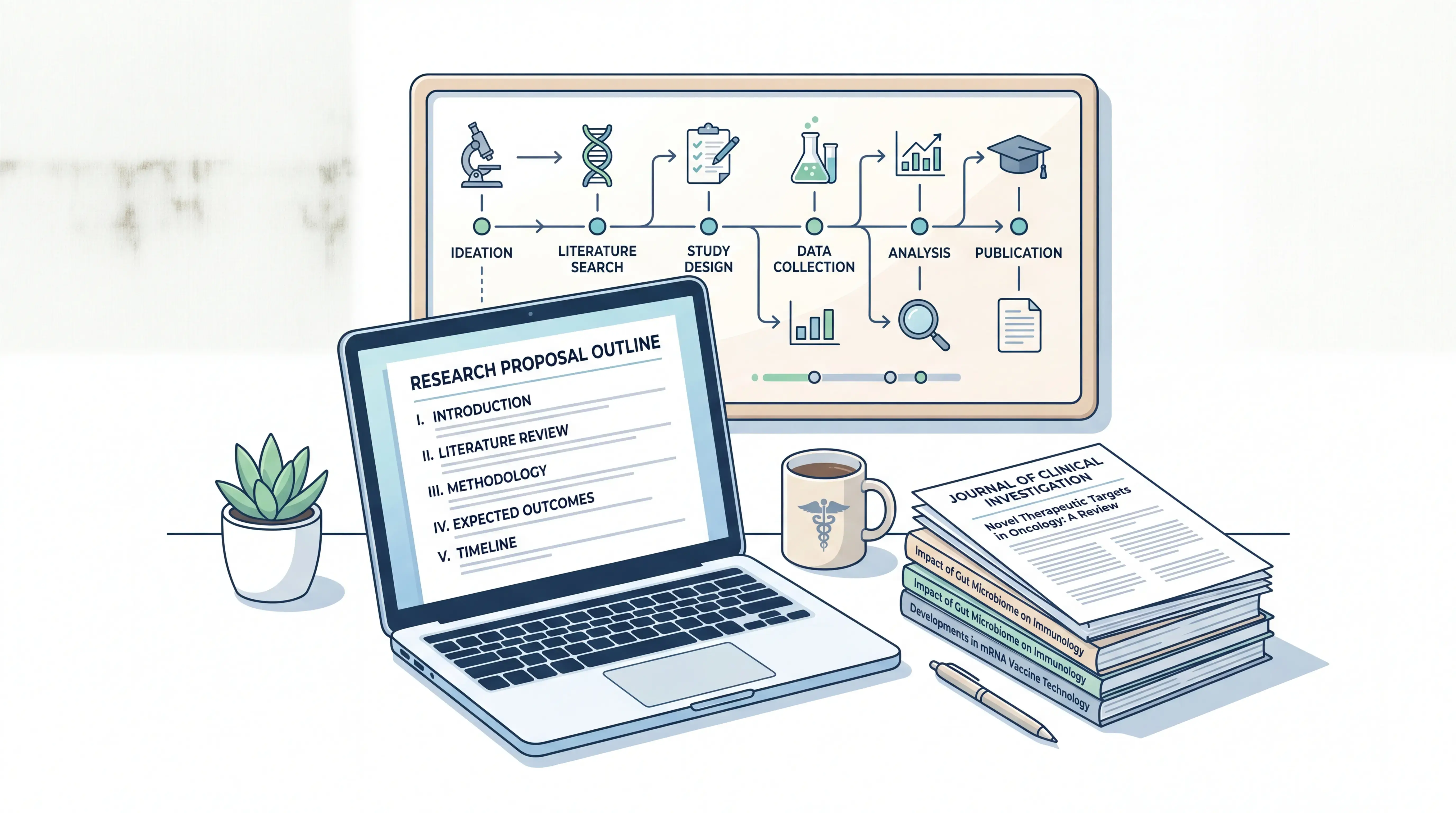
5. Draft the Proposal Outline Step by Step
5.1 Use a simple writing workflow
A reliable workflow prevents confusion. Start with the topic, then build outward.
- Define the research problem
- Write the proposed statement
- Choose the article type
- List the main methods
- Arrange the expected results
- Draft the discussion points
- Revise for clarity and precision
This order works because it follows the actual research logic. It also keeps the essay focused on one central question.
5.2 Refine wording carefully
Good academic writing depends on exact language. Watch your verb tense, modifiers, and claims. Avoid overstatement. Avoid unnecessary certainty.
Examples of stronger wording:
- “We propose to evaluate”
- “This study aims to determine”
- “The data suggest”
- “These findings may indicate”
Avoid weak, empty phrases such as “very important” or “extremely significant” unless you can support them.
The best outline language is precise, restrained, and evidence-based.
6. Select Data That Supports the Story
6.1 Choose only relevant data
A proposal outline should not include every available dataset. Include only what supports the research question. Too much irrelevant information makes the study look unfocused.
Use this decision rule:
- If the data support the hypothesis, keep them
- If the data are exploratory, label them clearly
- If the data do not support the aim, remove or redesign the study
This keeps the essay coherent and scientifically honest.
6.2 Make the clinical significance explicit
For medical audiences, significance matters. The final outline should show why the research matters for diagnosis, treatment, mechanism, or future intervention.
Ask yourself:
- Will this study change practice?
- Will it clarify a disease mechanism?
- Will it provide a new target or method?
- Will it improve future research design?
Clinical relevance is not optional. It is part of scientific value.
7. A Practical Outline Template
7.1 Use this structure for most proposals
A clear proposal outline can follow this format:
- Title
- Background and gap
- Proposed statement or hypothesis
- Objectives
- Methods
- Expected results
- Discussion and significance
- Limitations
- References
This template is simple, but effective. It works for many scientific essays, especially in medicine and life sciences.
7.2 Adjust for your journal and study type
Do not treat the template as fixed. A case report, resource paper, or short technical note may need a shorter outline. A full research article may need more detail in methods and results.
The goal is not to fill sections. The goal is to build a logical argument that can survive peer review.
8. Use Tools That Reduce Writing Friction
8.1 Speed up planning with structured support
Many researchers know what they want to study, but lose time turning ideas into a polished outline. That is where writing support tools can help.
Platforms such as scifocus.ai can assist with structure, clarity, and section planning. For busy medical professionals, that means less time fighting formatting and more time refining the science.
8.2 Support, not replacement
A tool should not replace critical thinking. It should reduce friction. Use it to organize your essay, improve section flow, and stay aligned with journal expectations.
The best workflow combines expert judgment with smart writing support.
Conclusion
A strong research proposal outline is not a formality. It is the backbone of the entire essay. It defines the problem, frames the proposed statement, structures the methods, and guides the results and discussion. For medical students, doctors, and researchers, this step can determine whether a project feels scattered or scientifically convincing.
If you want to write faster without losing rigor, use a structured system and supporting tools. scifocus.ai can help you turn a rough idea into a clearer, more publishable outline with less effort. Build your proposal with logic first, then refine it into a polished academic essay.

Did you like this article? Explore a few more related posts.
Start Your Research Journey With Scifocus Today
Create your free Scifocus account today and take your research to the next level. Experience the difference firsthand—your journey to academic excellence starts here.