

How to Write a Discussion Section for a Research Paper
Introduction
Writing the discussion section in an essay or research paper is often the hardest part for medical students, doctors, and researchers. Many drafts fail because they repeat results, overstate significance, or miss the real message of the study. A strong discussion does more than summarize. It explains why the findings matter, how they fit with prior work, and what they mean for future research and practice. In this guide, you will learn how to write a discussion section for a research paper with a clear structure, precise language, and a professional academic tone.
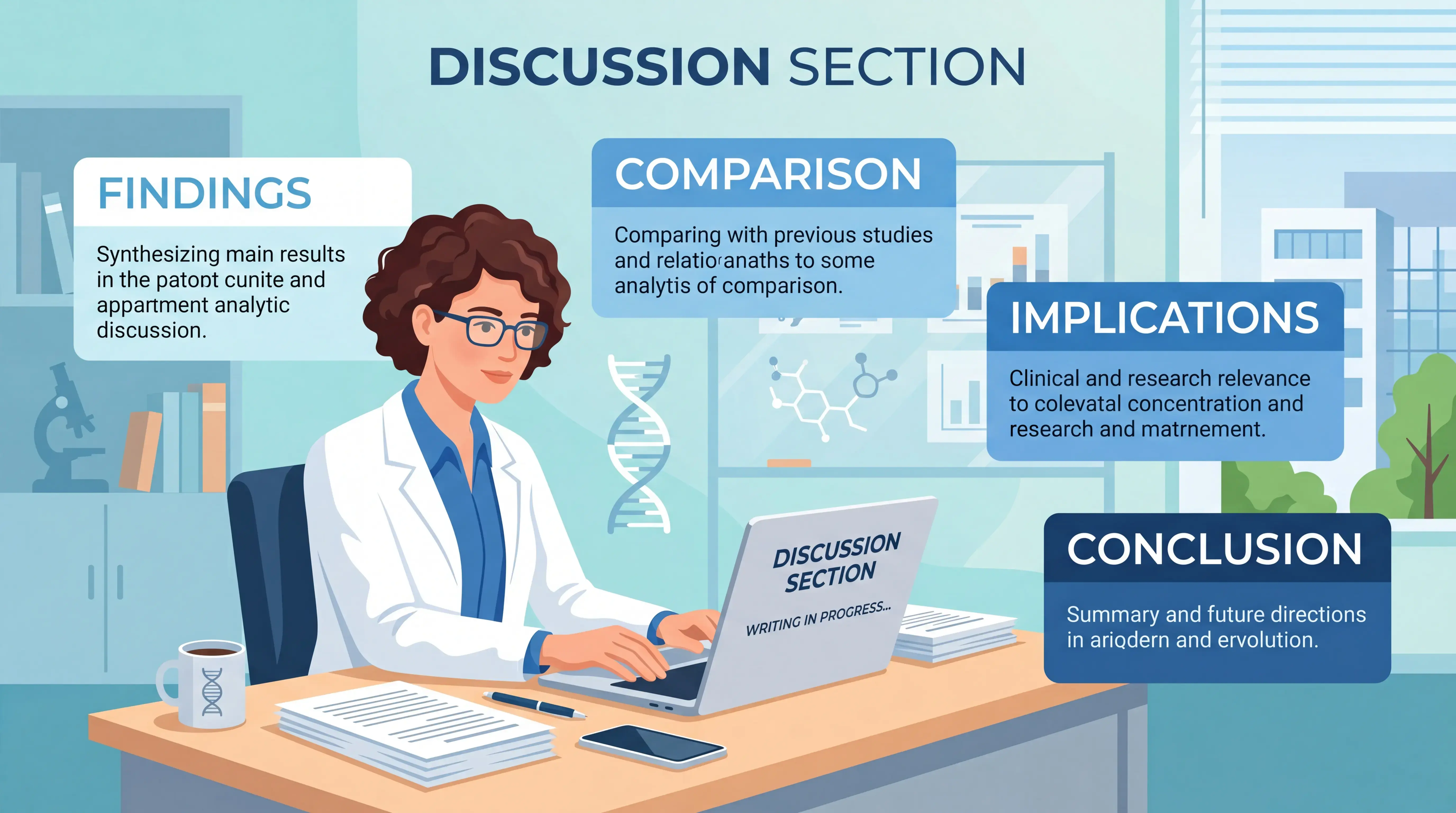
1. Understand the Purpose of the Discussion Section
1.1 What the discussion section must do
The discussion section is where you interpret your findings. It is not a second results section. It is the place to explain the meaning of the data and to show how the study contributes to the field.
A strong discussion answers the question posed in the introduction, explains the findings, and shows the broader value of the work.
For medical and scientific papers, this section matters greatly. Editors and reviewers often judge the paper’s quality by the strength of the discussion. If the logic is weak, the paper may be rejected even when the data are solid.
1.2 Why many discussions fail
Common problems are easy to spot:
- Repeating numerical results without interpretation.
- Describing significance too vaguely.
- Writing too long without a clear structure.
- Ignoring prior studies.
- Overclaiming clinical or scientific impact.
These errors weaken the essay and make the paper feel unfinished. The best discussion sections are focused, concise, and evidence-based.
1.3 A useful mindset before writing
Before drafting, ask three questions:
- What is the main conclusion?
- Why do these results matter?
- How do they compare with existing studies?
If you can answer these clearly, your discussion already has a strong foundation.
2. Build a Clear Discussion Framework
2.1 Start with the main conclusion
The first sentence should present the major finding in a direct way. In academic writing, the conclusion is usually stated in the present tense because it reflects a general scientific interpretation.
For example:
- “These results suggest that DNMT3A is not responsible for DNA methylation in the Oct4 promoter.”
This is stronger than restating data. It immediately tells the reader what the study means.
2.2 Use a logical paragraph order
A practical structure is:
- State the main finding.
- Compare it with previous research.
- Explain the result.
- Highlight novelty or strength.
- Discuss limitations.
- End with implications and future directions.
This structure helps you avoid a fragmented essay. It also makes the paper easier to follow for reviewers and readers.
2.3 Think from specific to general
A good discussion moves from your specific study to the wider field. This is the reverse of the introduction. The introduction moves from broad background to the research question. The discussion moves from your data back to the larger meaning.
This shift from specific evidence to general implication is one of the clearest signs of mature academic writing.
3. Explain the Findings, Not Just the Numbers
3.1 Interpret the results in context
Do not simply list data again. Instead, explain what the results mean.
For example, if a biomarker is elevated in a disease group, do not stop at the value. Explain whether this supports a diagnostic role, a mechanistic link, or a prognostic hypothesis.
A useful pattern is:
- Result.
- Interpretation.
- Why it matters.
This keeps the essay focused and analytical.
3.2 Compare your findings with published studies
A strong discussion shows that you know the literature. Compare your results with other papers in a precise way.
Use phrases such as:
- “This finding is consistent with previous reports.”
- “These results differ from earlier studies.”
- “One possible explanation for this discrepancy is...”
Be careful with wording. If another group published the observation, use formal verbs like reported, demonstrated, showed, or suggested. Avoid informal choices like “thought” or “considered.”
3.3 Explain agreement and disagreement carefully
If your findings match earlier work, explain why. If they differ, do not ignore the difference. Consider:
- Sample size.
- Patient population.
- Experimental design.
- Detection methods.
- Disease stage or treatment status.
This kind of analysis makes the essay more credible and shows critical thinking.
4. Highlight Significance, Novelty, and Limitations
4.1 State the scientific value clearly
A discussion should “sell” the importance of the study, but in an evidence-based way. That means you need to explain the significance without exaggeration.
You can focus on:
- Clinical relevance.
- Mechanistic insight.
- Methodological improvement.
- Knowledge gap filled.
The key is to show value, not to claim more than the data support.
4.2 Show novelty without overstatement
If the study offers a new angle, explain it directly. Novelty may come from a new cohort, a new marker, a new method, or a new interpretation.
Good novelty statements are specific. For example:
- The study identifies a potential pathway not previously examined in this disease.
- The analysis extends earlier work by testing the hypothesis in a different population.
This is much stronger than vague claims like “our results are very important.”
4.3 Discuss limitations strategically
Limitations should not weaken your essay. They should show maturity and honesty.
Common limitations include:
- Small sample size.
- Single-center design.
- Retrospective analysis.
- Short follow-up.
- Lack of functional validation.
Do not apologize excessively. State the limitation, explain its possible effect, and mention how future work can address it.
For example:
“Because this was a single-center study, external validation in independent cohorts is needed.”
5. Use Precise Language and Academic Tense
5.1 Keep tense consistent
A frequent mistake in the discussion section is tense confusion.
- Use past tense to describe what your study did.
- Use present tense for general conclusions and established interpretations.
For example:
- “We observed increased expression of p16.”
- “These findings suggest a possible role in cervical carcinogenesis.”
This distinction improves clarity and professionalism.
5.2 Avoid repetitive wording
Redundancy makes the essay feel longer without adding value.
For example, do not write:
“Besides our study, Nehls et al. also confirmed...”
This is repetitive. A cleaner version is:
“Nehls et al. also confirmed that p16 was strongly expressed in patients with cervical cancer.”
5.3 Prefer clear and direct sentences
Short sentences are often stronger than long, overloaded ones. This is especially important for medical readers who want fast, accurate interpretation.
Use:
- Direct claims.
- Simple transitions.
- Specific evidence.
- Measured conclusions.
Clarity is more persuasive than complexity.
6. A Practical Writing Template for Your Essay
6.1 Paragraph 1: State the core conclusion
Begin with the main takeaway. This should be concise and aligned with the study objective.
6.2 Paragraph 2: Link to prior literature
Compare your findings with relevant studies. Explain agreement, difference, or extension.
6.3 Paragraph 3: Explain why the findings matter
Discuss mechanism, clinical use, or theoretical impact.
6.4 Paragraph 4: Address limitations and future work
Be honest about constraints. Then show how future studies can improve the evidence.
6.5 Final paragraph: Close with significance
End with a balanced summary of the paper’s contribution. Avoid generic statements. Focus on what the field now knows that it did not know before.
This template works well for an essay because it gives the discussion a clear path from evidence to implication.
7. How SciFocus.ai Can Help You Write Faster and Better
7.1 Why structured support matters
Many researchers can generate data, but struggle to turn results into a polished discussion. The challenge is not only language. It is also logic, flow, and academic positioning.
That is where a structured writing tool becomes useful.
7.2 A smarter workflow with SciFocus.ai
SciFocus.ai can support the writing process by helping you organize ideas, refine language, and turn scattered notes into a coherent academic essay. For busy medical students, physicians, and researchers, that saves time and reduces revision cycles.
A practical workflow is:
- Draft the main findings.
- Compare them with literature.
- Refine the interpretation.
- Check tone and clarity.
- Finalize the conclusion and implications.
A tool like SciFocus.ai is most valuable when you already know your data and need a faster path to a strong academic draft.
Conclusion
Writing the discussion section of a research paper requires more than summary. It requires interpretation, comparison, and disciplined judgment. Start with the main conclusion. Explain the findings in context. Compare them with prior studies. State the significance clearly. Then discuss limitations and future directions with honesty.

If you follow this structure, your essay will read with more authority and precision. And if you want help turning complex research notes into a clear, publication-ready discussion, SciFocus.ai can streamline the process and support better academic writing.
Did you like this article? Explore a few more related posts.
Start Your Research Journey With Scifocus Today
Create your free Scifocus account today and take your research to the next level. Experience the difference firsthand—your journey to academic excellence starts here.