

How to Write a Clinical Research Paper
Introduction
Writing a clinical essay is not only about presenting data. It is about proving that the data are reliable, relevant, and clinically meaningful. Many medical students, physicians, and researchers struggle with the same problem: they have cases, tables, and statistics, but the paper still feels weak. A strong clinical research paper needs structure, accuracy, and clear interpretation.

1. Start With a Clear Clinical Question
1.1 Define the research purpose
Before writing, identify the exact question your study answers. A clinical paper should be built around one focused objective. In clinical research, this usually means a question about diagnosis, treatment, prognosis, or risk factors.
A practical way to frame the question is through PICOS:
- Population
- Intervention or exposure
- Comparison
- Outcome
- Study design
This framework helps you avoid vague writing. It also keeps your essay aligned with the real study aim. If the research question is unclear, the introduction, methods, and discussion will also become unclear.
1.2 Match the study type to the question
Different questions require different designs. A randomized controlled trial fits treatment effects. A cohort study fits prognosis or risk evaluation. A retrospective study works when existing records are the main data source.
The paper should reflect the study design from the first paragraph to the final conclusion. Do not force a case series, cohort study, and trial structure into one paper. Consistency improves readability and trust.
2. Build the Methods Section With Precision
2.1 Use structured reporting
The methods section is the backbone of a clinical research paper. It should answer six basic questions:
- Who was studied
- What was measured
- When data were collected
- Where the study was done
- How the study was conducted
- Why the design was chosen
This is often called the Who, What, When, Where, and How approach. It makes the section easier to reproduce and easier to review.
You should clearly describe inclusion and exclusion criteria, sample source, recruitment process, and follow-up period. If the study involves treatment, specify dose, frequency, route, and control condition. If outcomes are measured, define primary and secondary endpoints.
2.2 Report statistics honestly
Clinical writing depends heavily on statistical clarity. For larger datasets, especially in clinical medicine, statistics are not optional. They are part of the argument.
Include:
- Sample size and how it was determined
- Statistical software and version
- Statistical tests used
- Threshold for significance
- How missing data were handled
Do not mix methods with results. The methods section should explain what you planned and how you analyzed it, not what you found. This separation is one of the most common weaknesses in a clinical essay.
2.3 Include ethics and consent
Ethical approval and informed consent must be stated when applicable. This is essential for credibility. It also signals that the research followed accepted clinical standards.
If the study was retrospective and consent was waived, say so clearly and explain the reason according to institutional policy. Readers and editors expect transparency here.
3. Present Results in a Clean, Logical Order
3.1 Let the data speak first
The results section should be concise and direct. Start with baseline characteristics, then move to primary outcomes, then secondary outcomes or subgroup findings.
A good order is:
- Demographics
- Clinical features
- Main outcome data
- Statistical analysis
- Adverse events or follow-up findings
This structure mirrors the methods and makes the paper easier to follow. Every result should connect back to the research question.
3.2 Use tables and figures wisely
Good tables and figures reduce text clutter. They should be self-explanatory. A reader should understand the main message without reading the full paragraph.
Use text to highlight the most important findings. Do not repeat every number from the table. Instead, summarize the pattern. For example, report whether the intervention improved the primary endpoint, whether the difference was statistically significant, and whether the effect was clinically relevant.
3.3 Report statistics correctly
Many manuscripts lose credibility because of poor statistical reporting. Avoid incomplete p-value reporting. If relevant, include confidence intervals, test statistics, and effect sizes.
Clinical readers care about both statistical significance and clinical significance. A paper that only lists p-values without context feels weak. Explain what the number means for patient care or study interpretation.
4. Write the Discussion Like an Expert
4.1 Start with the main finding
The discussion should begin with a short summary of the key result. Do not repeat the full results section. Instead, state what the study showed and why it matters.
A strong opening paragraph usually answers three things:
- What was found
- Why it matters
- How it fits the broader clinical question
This is where the scientific value of the paper becomes visible. A clinical research essay should not feel like a data dump. It should feel like an interpretation grounded in evidence.
4.2 Explain clinical and academic value
Next, explain the value of the study. Did it support a treatment strategy? Clarify a risk factor? Improve diagnostic understanding? Show local data from a population that had not been studied well?
If your study is confirmatory rather than novel, that is still valuable. In clinical science, replication matters. Results from different regions or patient groups can refine medical understanding and support stronger conclusions.
4.3 Address limitations directly
A trustworthy discussion includes limitations. This is not a weakness. It is a sign of maturity.
Common limitations include:
- Retrospective design
- Small sample size
- Single-center data
- Missing variables
- Short follow-up
- Possible confounding factors
Do not overclaim. Be specific, balanced, and honest. Reviewers respect papers that clearly state what the study can and cannot prove.
4.4 End with future directions
The final discussion paragraph should explain what should happen next. This may include larger multicenter studies, longer follow-up, better control of confounders, or mechanistic validation.
A good ending connects the current findings to future clinical research. That makes the paper feel complete and forward-looking.
5. Revise for Clarity, Accuracy, and Publication Readiness
5.1 Edit for concise medical language
Clinical writing should be precise, not decorative. Short sentences improve clarity. Use direct medical language and avoid repetition.
Check whether each paragraph serves one purpose. Remove background sentences that do not support the argument. In a clinical research paper, every line should earn its place.
5.2 Check consistency across sections
The title, abstract, methods, results, and discussion should all match. A common problem in manuscript drafting is inconsistency between the stated objective and the actual analysis.
Review these points:
- Is the objective the same in the introduction and methods?
- Do the results answer the stated question?
- Does the discussion interpret the actual findings, not a different issue?
- Are outcome definitions consistent throughout?
Consistency improves both scientific trust and editorial efficiency.
5.3 Use tools to improve workflow
For many medical writers, the hardest part is not knowing what to say. It is organizing the paper efficiently. This is where writing support tools can help.
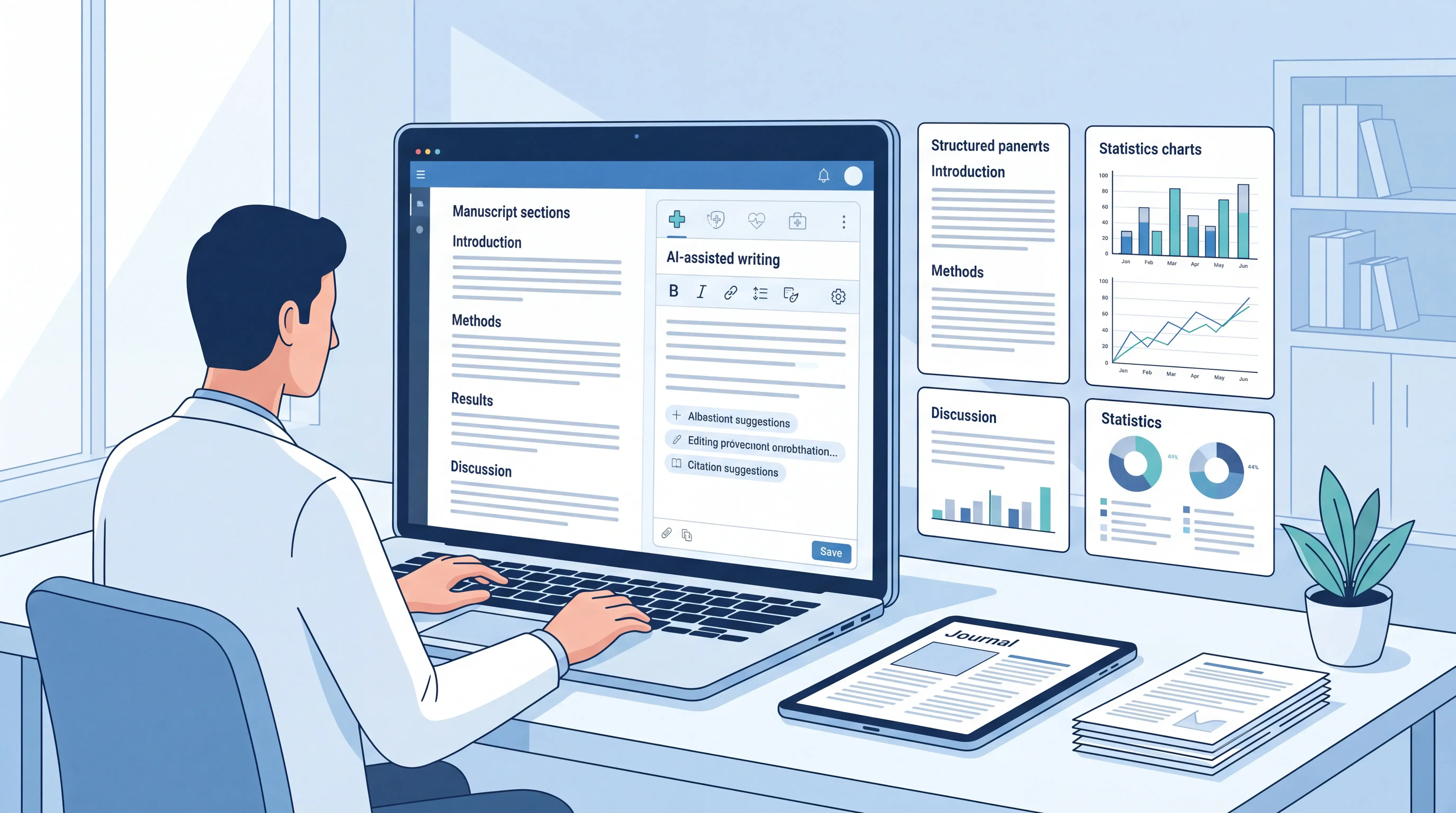
Platforms like scifocus.ai can help you structure a manuscript, refine section logic, and keep the clinical essay aligned with journal expectations. For busy clinicians and researchers, that can save time and reduce drafting errors while preserving scientific rigor.
6. Conclusion
Writing a clinical research paper requires more than reporting findings. It requires a clear question, structured methods, accurate results, and a discussion that explains the real clinical meaning. If you follow a disciplined structure, your manuscript becomes easier to read, easier to review, and easier to publish.
The best clinical paper is not the longest one. It is the one that is clear, accurate, and clinically useful. If you want to turn raw clinical data into a publishable manuscript faster, consider using scifocus.ai to streamline your writing process and support stronger scientific output.
Did you like this article? Explore a few more related posts.
Start Your Research Journey With Scifocus Today
Create your free Scifocus account today and take your research to the next level. Experience the difference firsthand—your journey to academic excellence starts here.