
How to Use Google Scholar Effectively
Introduction
Google Scholar can save hours of searching, but only if you use it with a clear system. For medical students, doctors, and researchers, the real challenge is not finding papers. It is finding the right ones fast, reading them efficiently, and turning them into an actionable essay, review, or research draft. This guide shows a practical workflow for using Google Scholar effectively, based on proven literature-search habits and structured reading methods.
1. Understand What Google Scholar Is Best For
1.1 Broad coverage, fast discovery
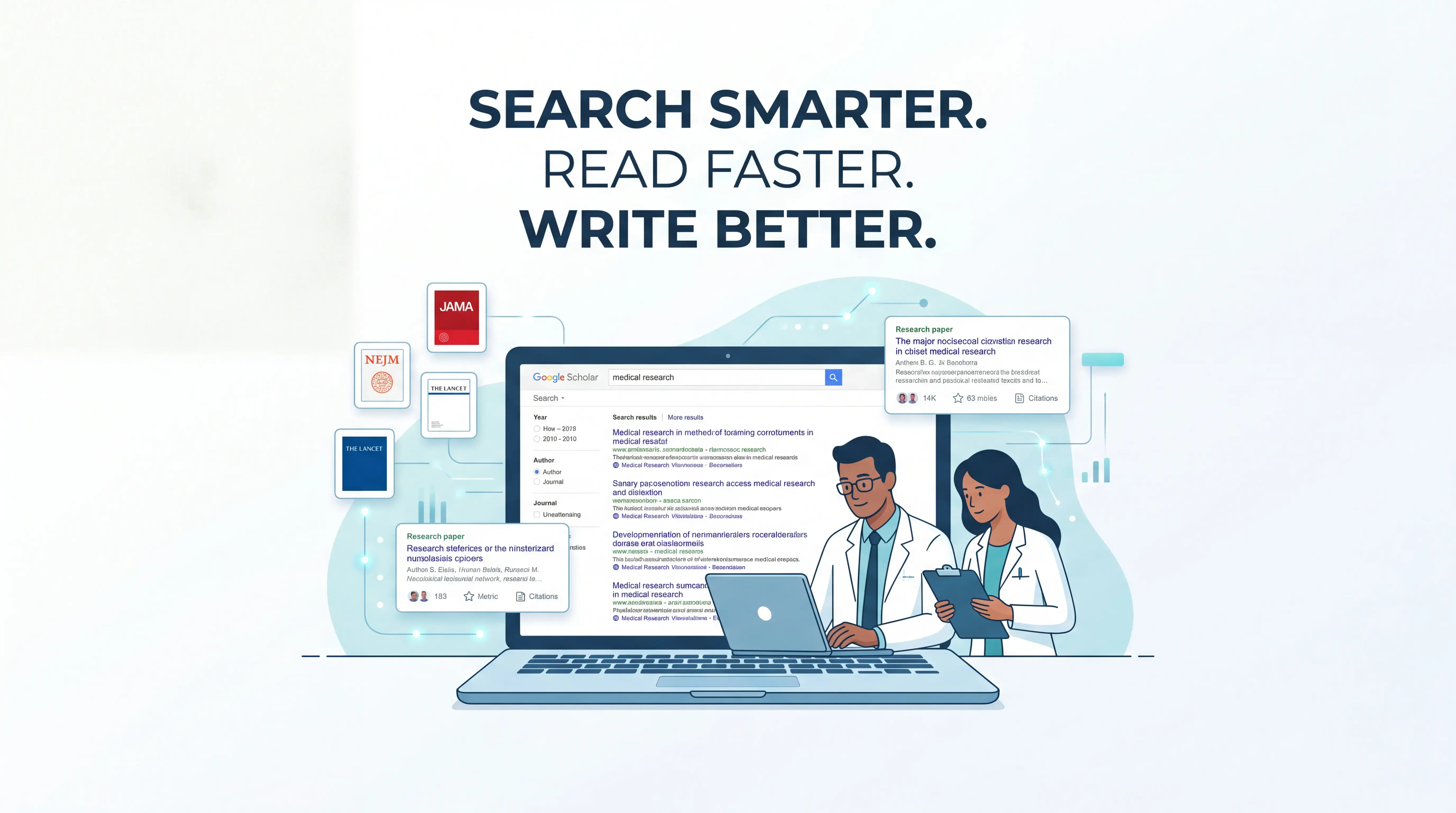
Google Scholar is useful because it indexes a very wide range of academic content. Compared with narrow databases, it often returns far more results for the same topic. For example, a simple query can produce hundreds of thousands of items, which makes it stronger for discovery than for final screening.
That breadth is its advantage and its risk. You can find papers, theses, conference abstracts, citations, and related documents quickly. But without a method, you can also waste time on irrelevant results.
1.2 Use it as a discovery tool, not a final answer
For clinical and biomedical work, Google Scholar should not replace PubMed or specialty databases. It works best as the first stop for mapping a topic, identifying key authors, and finding review trails.
A strong workflow is simple:
- Search broadly in Google Scholar.
- Identify the most cited and most recent papers.
- Verify core studies in PubMed or publisher sites.
- Build your reading list before writing your essay or review.
2. Build Better Search Queries
2.1 Start with precise keywords
A common mistake is typing only one general term. That creates noise. Instead, combine disease, method, population, or outcome terms.
Examples:
stroke prognosis nomogrambreast cancer survival analysismachine learning sepsis prediction
The more specific your query, the faster you get useful papers. For academic writing, this matters because your essay depends on relevance, not volume.
2.2 Use quotation marks and exclusions
Google Scholar supports simple but powerful search logic.
Use these tactics:
- Quotation marks for exact phrases:
"survival analysis" - Minus sign to exclude terms:
diabetes -review - Author search when needed:
author:"Wang" - Title focus when appropriate:
intitle:"systematic review"
These small changes often cut irrelevant results dramatically.
2.3 Search by concept, then narrow
Do not overbuild the first query. Start broad enough to capture the field, then refine.
A practical sequence:
- Step 1:
depression biomarkers - Step 2:
depression biomarkers cohort - Step 3:
depression biomarkers cohort prognosis
This approach helps you see how the literature is organized. It also reveals whether a topic is dominated by clinical studies, preclinical studies, or methodology papers.
3. Read the Literature More Efficiently
3.1 Do not read every paper line by line
One of the strongest habits in expert researchers is selective reading. A useful method is to inspect many papers quickly by focusing on their figures, tables, abstracts, and conclusions first.
This is especially useful when you are preparing an essay under time pressure. You do not need to read 200 papers in full. You need to recognize patterns, methods, and common argument structures.
A fast reading sequence:
- Title
- Abstract
- Figures and tables
- Discussion
- Full text only for key papers
3.2 Look for patterns across papers
When you review multiple papers in the same area, patterns become visible. For example, a nomogram study often follows a familiar set of supporting analyses, such as calibration, C-index, and decision curve analysis. You may not see every analysis in every paper, but repeated reading shows what is typical and what is optional.
Pattern recognition is what turns literature searching into research judgment.
3.3 Check what authors chose not to show
Not every result is displayed. Sometimes weak analyses are omitted. Sometimes a paper highlights only the strongest evidence.
That is why reading only one article can be misleading. Reading a cluster of related studies gives you a more realistic view of the field, the methods, and the publication standards.
4. Use Citations to Expand Your Search
4.1 Follow the citation trail
Google Scholar is powerful because it links papers through citations. A good paper does not just answer your question. It also points to the next ten papers you should read.
Use:
- “Cited by” to find newer studies
- “Related articles” to locate similar work
- Reference lists to trace the original method or dataset
This is one of the fastest ways to find a strong foundation for an essay or research proposal.
4.2 Identify landmark papers and recent updates
Do not rely only on the newest papers. Start with the most cited or most influential work in the area. Then move forward in time to see how the field has changed.
A simple rule:
- Landmark paper: establishes the method or concept
- Recent paper: shows the current direction
- Review paper: summarizes the field efficiently
That three-layer reading strategy reduces blind spots.
4.3 Use citation history to avoid weak evidence
High citation count does not automatically mean high quality. It means influence. You still need to evaluate study design, sample size, methods, and clinical relevance.
For medical readers, this matters. A highly cited paper with weak methodology can distort your interpretation if you do not verify it carefully.
5. Organize Results So You Can Actually Use Them
5.1 Save papers with a system
Search is only useful if retrieval is easy later. Create a simple system to save, label, and group papers by topic.
A practical structure:
- Background
- Methods
- Clinical evidence
- Review papers
- Key figures
- Papers to cite
This makes writing much faster when you start drafting your essay.
5.2 Track what each paper contributes
Do not save a paper without recording why it matters. Write a one-line note such as:
- Provides cohort data
- Defines the method
- Supports the rationale
- Gives a figure template
- Offers a limitation section
This saves time when you return weeks later. It also helps you avoid duplicating ideas already used in the field.
5.3 Build a mini evidence map
For a medical topic, create a small map of:
- Main question
- Key variables
- Common methods
- Repeated findings
- Open gaps
That map becomes the skeleton of your writing. It helps you move from literature search to argument building.
6. Common Mistakes to Avoid
6.1 Relying on the first page only
The first page is not the whole field. Many useful papers appear beyond the initial results, especially when your query is broad.
6.2 Confusing popularity with quality
A paper can be highly visible and still be methodologically weak. Always inspect design, sample, controls, and limitations.
6.3 Searching without a goal
If you do not know whether you are collecting background, methods, or evidence for a claim, you will collect too much and use too little.
Search with a purpose. Read with a purpose. Write with a purpose.
7. Turn Search into Writing Workflow
7.1 Use reading to support your essay
A strong essay is not built from one paper. It is built from patterns across many papers. Google Scholar helps you find those patterns quickly if you search and read systematically.
A practical writing workflow is:
- Define the question.
- Search broadly.
- Screen for relevance.
- Group papers by theme.
- Extract common arguments.
- Draft the outline.
- Support each claim with evidence.
7.2 Combine search with AI-assisted drafting
If you already have the literature but struggle to structure the text, a writing tool can help you organize notes, compare themes, and draft outlines faster. This is where scifocus.ai can add value.
It can support:
- Literature organization
- Draft structure building
- Faster synthesis of notes
- Cleaner academic writing flow
The goal is not to replace your judgment. The goal is to reduce manual friction so you can focus on analysis.
7.3 Build a repeatable SOP
Researchers who search efficiently usually follow a repeatable process. They do not start from zero every time.
A simple SOP can include:
- Core search terms
- Inclusion rules
- Exclusion rules
- Save tags
- Reading order
- Writing template
This is especially useful for medical students, physicians, and researchers who need to produce high-quality writing under time constraints.
Conclusion
Google Scholar is effective when you use it with structure. Search broadly, refine precisely, read in layers, follow citations, and organize what you find. That is how you turn scattered papers into usable evidence for a strong essay, review, or research draft. If you want a faster way to move from literature collection to organized writing, try scifocus.ai to streamline your workflow and reduce writing friction.
Did you like this article? Explore a few more related posts.
Start Your Research Journey With Scifocus Today
Create your free Scifocus account today and take your research to the next level. Experience the difference firsthand—your journey to academic excellence starts here.