

How to Respond to Reviewer Comments
Introduction
Receiving reviewer comments can feel stressful, especially when your manuscript has been marked for major revision. Yet this stage is often a good sign. It means the journal sees potential in your paper, and your next essay must prove that you can revise with precision, respect, and evidence. For medical students, doctors, and researchers, the real challenge is not only improving the manuscript, but also writing a response that is clear, complete, and persuasive.
1. Understand What Reviewer Comments Really Mean
1.1 Major revision is not rejection
A major revision usually means the paper still has a real chance of acceptance. In many cases, the editor is inviting you to fix the weaknesses. The right mindset is simple: revise thoroughly, not defensively.
This is why a strong essay on response strategy starts with the basic rule of revision. Good papers are rarely “written once.” They are improved through several rounds of careful editing. If the reviewers asked for more data, additional analysis, or a clearer discussion, treat those requests as part of the publication process.
If new experiments are possible, do them. If they are not possible because of time, resources, or career stage, support your position with high-quality literature. Do not ignore the scientific gap. Explain it honestly and back your conclusion with evidence.
1.2 Read every comment before you write
Do not reply immediately. First, read all reviewer comments carefully. Then group them into issues such as methods, statistics, results, interpretation, and language. This helps you avoid missing anything.
A useful habit is to identify:
- what the reviewer is asking,
- whether the comment is a factual error, a suggestion, or a criticism,
- what evidence is needed to respond well.
This step matters because editors often judge the response letter more carefully than the revised manuscript itself. A clear response shows that you understand the paper, the criticism, and the field.
2. Build a Professional Response Letter
2.1 Use proper email and letter etiquette
A response letter should follow formal academic etiquette. That means a clear subject line, correct title and name for the editor, a polite greeting, and a professional closing. These details may look small, but they signal respect and care.
A good opening line should also remind the editor that the review was helpful. Use a tone that is calm and constructive. For example, say that the comments were positive and encouraging, even if the review was tough. That wording helps reset the tone of the correspondence.
A polished response letter is not just polite. It also makes your revision easier to evaluate.
2.2 Keep the structure simple and readable
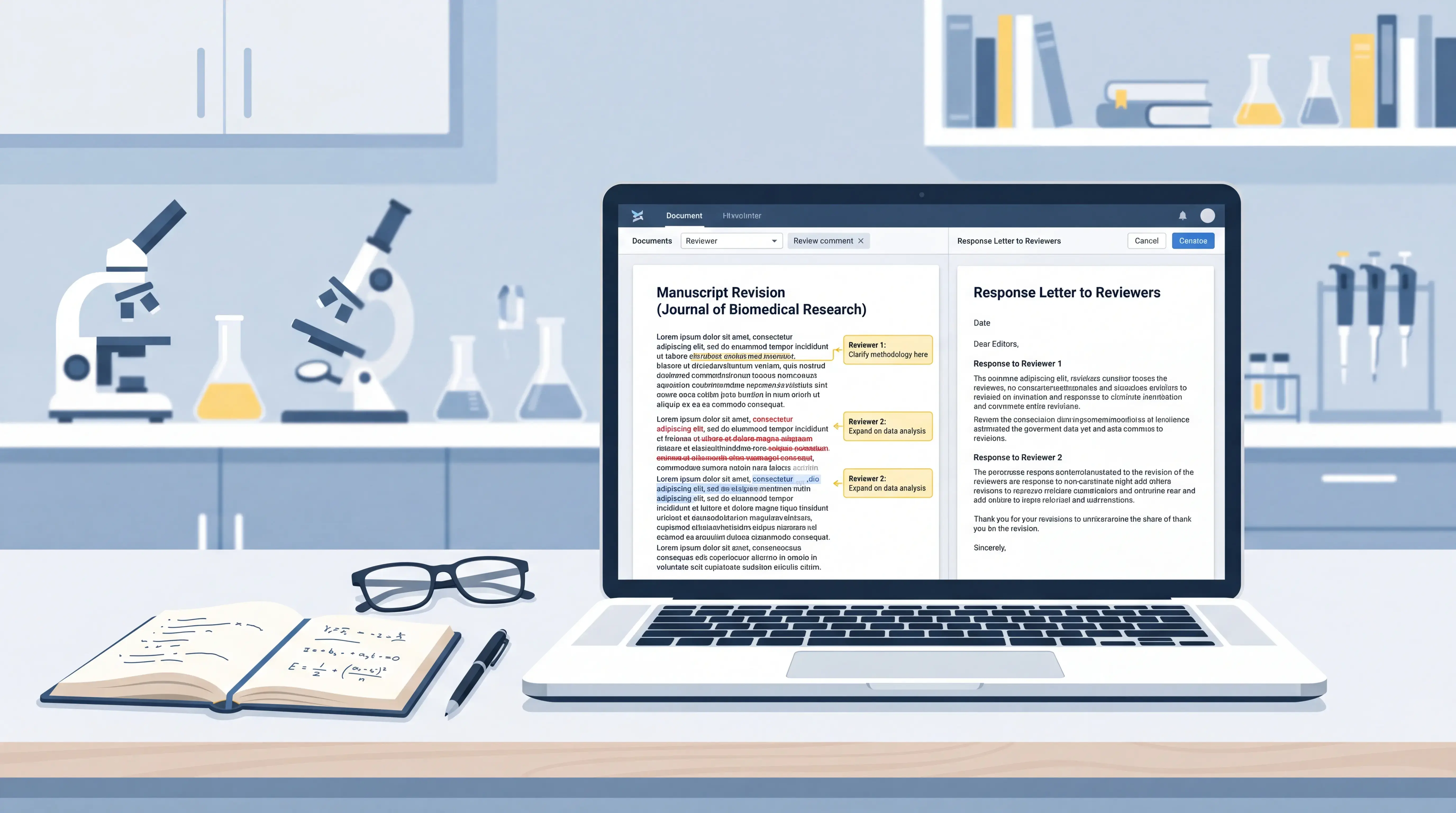
Use a point-to-point format. This is the most important rule.
For each reviewer:
- Copy the comment.
- Number each point.
- Reply directly under each point.
- Show exactly what you changed.
A clean structure should look like this:
- Reviewer #1, Comment 1, Response
- Reviewer #1, Comment 2, Response
- Reviewer #2, Comment 1, Response
If one reviewer writes a long paragraph, split it into separate issues before answering. This makes each scientific concern visible and avoids confusion.
2.3 Make your revisions easy to find
Mark changes clearly in the revised manuscript. If edits are small, track changes in Word is usually enough. If edits are extensive, submit a clean version with color-marked changes or another clear revision signal.
Never say you changed something if you did not. Editors can compare the revised file with the original submission. Accuracy and transparency are essential for trust.
3. Answer Reviewer Comments Strategically
3.1 Accept what is reasonable
In most cases, if a request is reasonable and does not violate scientific standards, you should make the change. This includes:
- correcting wording,
- clarifying methods,
- adding missing references,
- reworking a confusing figure,
- improving statistical explanation.
When reviewers ask for data or analysis that strengthens the paper, it is usually wise to comply. A revision that makes the manuscript stronger is more likely to survive final editorial review.
The best response is often the one that solves the reviewer’s concern directly.
3.2 Disagree only with evidence
Sometimes you may disagree with a comment. That is acceptable, but the reply must be professional. Do not argue emotionally. Do not dismiss the reviewer.
Instead, do three things:
- acknowledge the point,
- explain your reasoning,
- support your position with data or references.
If a reviewer misunderstood a section, the problem may be unclear writing, not reviewer error. In that case, revise the text to prevent future misunderstanding. If the issue is truly unsupported, explain it with facts and citations.
3.3 If you cannot do the requested experiment
This is common in clinical and laboratory research. You may not have time, funding, or access to samples. If you cannot add a new experiment, then do the following:
- explain the limitation clearly,
- show why the conclusion still stands,
- cite strong, relevant literature,
- discuss the limitation openly in the manuscript.
A scientific limitation is acceptable when it is handled honestly and supported well.
4. Write Responses That Editors Can Trust
4.1 Be complete and precise
Do not miss any reviewer point. A single unanswered comment can weaken your entire revision. Before submission, compare the reviewer letter with your response letter line by line.
A good response should state:
- what the reviewer asked,
- what you changed,
- where the change was made,
- why your answer is justified.
If you added new data, specify the section, figure, table, or supplementary file. Editors should not have to search for the revision.
4.2 Use respectful language
Polite phrases make a real difference. Common examples include:
- “We are very sorry for our negligence.”
- “We have corrected this point according to the reviewer’s suggestion.”
- “Considering the reviewer’s comment, we have rewritten this section.”
- “Special thanks to the reviewer for the valuable suggestion.”
These phrases work best when they are followed by concrete action. Courtesy alone is not enough. Respect plus evidence is what creates a strong revision.
4.3 Keep each answer short but complete
Avoid long, repetitive paragraphs. In an academic essay about revision, clarity is more powerful than decoration. Most answers should be direct:
- state the concern,
- explain the change,
- mention the location in the manuscript.
Short sentences improve readability and make your response easier to verify.
5. Common Mistakes to Avoid
5.1 Do not ignore difficult comments
Some authors focus only on easy revisions and skip the hard ones. This is risky. Editors and reviewers notice omissions quickly. Even if a comment is difficult, it still needs a response.
If you cannot fully satisfy a request, explain why and show what you did instead. Partial solutions are better than silence.
5.2 Do not overstate your changes
Never claim major corrections without real modification. Do not write “we have revised the manuscript” if the text is still unchanged. This can damage credibility fast.
Trust is central in scholarly publishing. Once lost, it is hard to recover.
5.3 Do not sound defensive
A response letter should not sound like a debate transcript. Your goal is not to win an argument. Your goal is to help the editor see that the manuscript is now stronger, cleaner, and more reliable.
Use calm wording. Avoid sarcasm, frustration, or blame. Even when you disagree, keep the tone objective and factual.
6. A Practical Revision Workflow
6.1 Use a three-step method
A simple workflow can save time:
- Read the reviewer comments and categorize them.
- Revise the manuscript first.
- Write the response letter last.
This order works because the manuscript and response letter must match. If you write the reply before finishing the revision, inconsistencies are easy to create.
6.2 Check alignment before submission
Before resubmitting, ask three questions:
- Did I answer every point?
- Did I revise the manuscript in the same direction as the reply?
- Can the editor verify each change quickly?
If the answer to any of these is no, revise again.
6.3 Use tools that reduce friction
This is where a platform like scifocus.ai can help. It can support researchers who need to organize comments, refine academic wording, and build a cleaner response workflow. For busy medical students, clinicians, and investigators, that matters. It saves time and reduces the risk of missing a reviewer point.
If you are preparing a revision under deadline pressure, a structured tool can help you turn scattered comments into a clear point-by-point response. That is exactly the kind of support that makes revision faster and more controlled.
Conclusion
A strong response to reviewer comments is built on four things: completeness, evidence, respect, and clarity. Review every point, revise the manuscript carefully, answer with precision, and keep the tone professional. When necessary, admit limits and support your position with data or high-quality references. If you need help managing the process, scifocus.ai can streamline your revision workflow and help you produce a more organized, persuasive response letter. That can make your next submission stronger and easier to defend.
Did you like this article? Explore a few more related posts.
Start Your Research Journey With Scifocus Today
Create your free Scifocus account today and take your research to the next level. Experience the difference firsthand—your journey to academic excellence starts here.