

How to Report Subgroup Analyses Without Overstating Findings
Introduction
Reporting subgroup analyses can strengthen an essay, but it can also mislead readers if the results are presented as definitive. The main risk is simple. A subgroup result may look exciting, yet it may be fragile, underpowered, or due to chance. For medical students, physicians, and researchers, the key is to report subgroup analyses with precision, restraint, and statistical context. Do not present subgroup findings as proof unless the data support that claim.
1. Why subgroup reporting needs extra caution
1.1 Subgroups can generate useful hypotheses
Subgroup analyses are often used to explore whether a treatment effect differs across patient types, disease severity, or trial settings. In randomized controlled trials, this can help identify potential effect modification. But that is only the first step. A subgroup result is usually exploratory unless it was clearly pre-specified and supported by a strong interaction test.
1.2 The main risk is false confidence
The problem is not subgroup analysis itself. The problem is overstatement. When multiple comparisons are run, the chance of a false-positive result rises. A single significant subgroup result does not mean the treatment truly works differently in that group. It may simply reflect random variation.
A credible essay should separate signal from speculation. That means reporting what was tested, how it was tested, and whether the evidence for interaction was strong enough to justify interpretation.
2. Start with the trial context and analysis plan
2.1 State whether the subgroup was pre-specified
Readers need to know whether the subgroup was planned before data inspection. Pre-specified subgroup analyses carry more credibility than post hoc ones. If the subgroup was added after seeing the results, say so clearly.
A strong report should include:
- The clinical rationale for the subgroup
- Whether it was listed in the protocol or statistical analysis plan
- The exact subgroup definition
- The number of comparisons made
2.2 Explain the population and outcomes
Do not describe a subgroup in isolation. Place it within the broader trial structure. In CONSORT-style reporting, this means clarifying the participant flow, baseline characteristics, intervention details, and primary and secondary outcomes.
If the subgroup analysis is based on missing or incomplete data, say how the data were handled. If imputation was used, identify the method. If the analysis was restricted to complete cases, explain why. Transparency matters more than making the result look cleaner.
3. Report the effect size, not just the P value
3.1 Use estimates with confidence intervals
A subgroup analysis should not rely on a P value alone. Report the effect estimate and its 95% confidence interval. This applies whether the measure is risk ratio, odds ratio, risk difference, mean difference, or hazard ratio.
For example, a statement like “the subgroup was significant” is weak. A better version is:
- “The treatment effect was larger in subgroup A than subgroup B, but the interaction test was not significant.”
- “The confidence interval was wide, indicating imprecision.”
3.2 Distinguish within-group significance from interaction
This is one of the most common errors. A treatment can be statistically significant in one subgroup and not significant in another, yet the difference between subgroups may still be non-significant. That is why the interaction test is essential.
Within-group significance does not prove subgroup differences. The correct question is not “Did one subgroup reach P < 0.05?” but “Is there evidence that the treatment effect differs between subgroups?”
4. How to write subgroup results clearly
4.1 Use a structured reporting format
A precise report usually follows four steps:
- Define the subgroup.
- State whether it was pre-specified.
- Report the effect estimate in each subgroup.
- Report the interaction test.
A concise results sentence might look like this:
- “The treatment effect was numerically greater in patients with severe disease than in those with mild disease, but the interaction test did not support a statistically meaningful subgroup difference.”
4.2 Avoid inflated language
Avoid words that imply certainty when the evidence is limited. Common overstatements include:
- “proves”
- “confirms”
- “demonstrates superior benefit”
- “clearly works only in”
Use safer language instead:
- “suggests”
- “is consistent with”
- “may indicate”
- “was exploratory”
Careful wording protects the scientific value of the essay. It also prevents readers from misunderstanding a hypothesis-generating result as a practice-changing conclusion.
5. Quantify uncertainty and address multiplicity
5.1 Mention the number of tests
If several subgroup analyses were performed, say how many. This is important because multiple testing inflates the chance of spurious findings. If the study did not adjust for multiplicity, acknowledge that limitation.
You do not need to overcomplicate the report, but you should be honest about the analytic burden. A reader should be able to judge whether the subgroup finding is robust or accidental.
5.2 Note sample size limitations
Subgroups are often underpowered. Small numbers lead to wide confidence intervals and unstable estimates. If a subgroup includes only a fraction of the trial population, that should be stated explicitly.
A useful rule is this: the smaller the subgroup, the more cautious the interpretation should be. When the confidence interval is wide, the correct interpretation is uncertainty, not certainty.
6. Present subgroup findings in tables and figures responsibly
6.1 Use tables for clarity
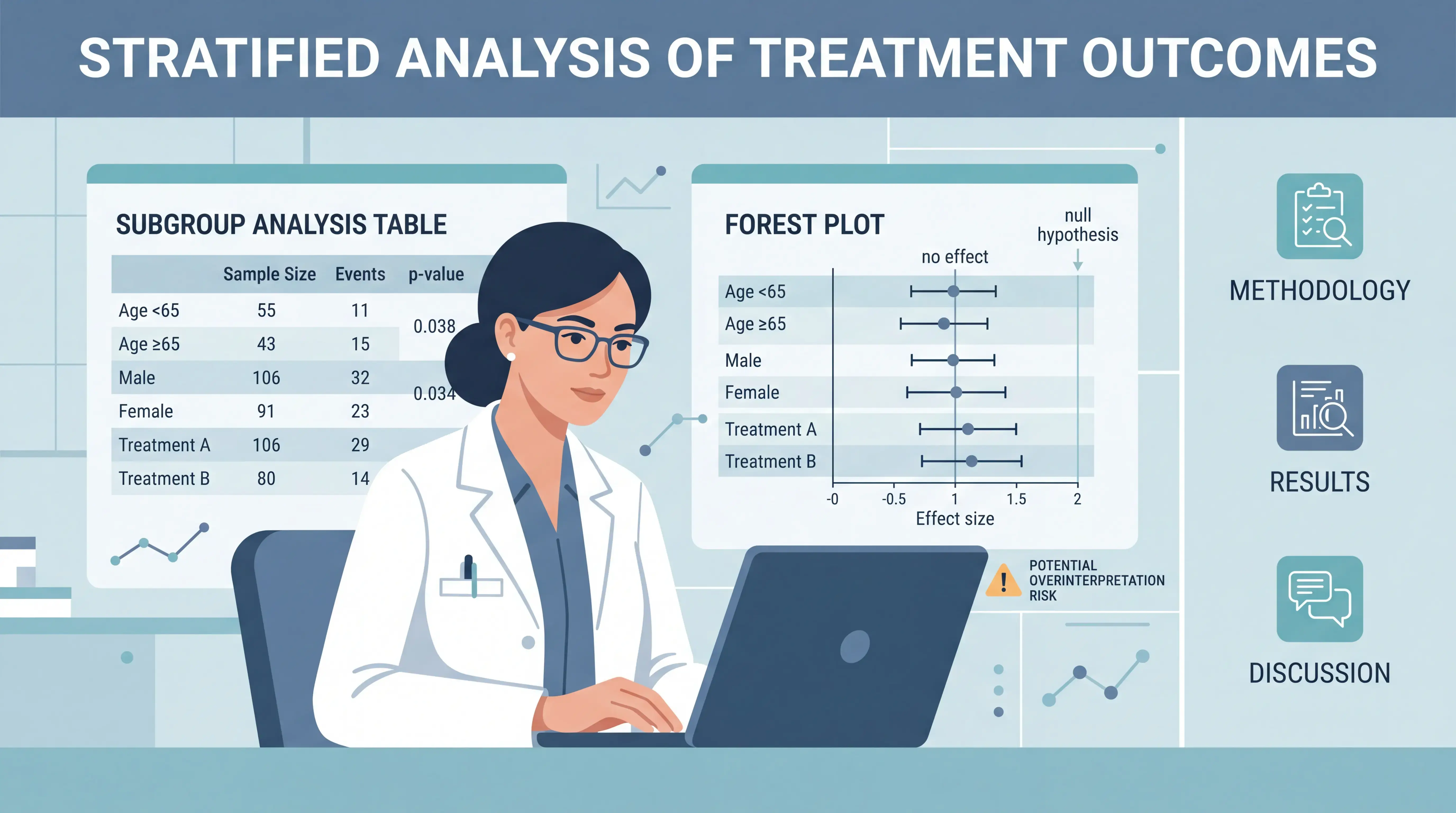
A table is usually the cleanest way to present subgroup data. Include the subgroup definition, sample size, outcome counts or summary values, effect estimate, confidence interval, and interaction P value.
This makes the report easier to check. It also reduces the temptation to highlight only the most favorable numbers.
6.2 Use forest plots carefully
Forest plots are useful, but they can be visually misleading if readers focus only on the point estimates. The plot should show confidence intervals and the overall effect, not just the subgroup-specific effects.
If a forest plot is used, the caption should clearly state whether the analyses were pre-specified, exploratory, or adjusted for multiplicity. That small detail improves interpretability.
7. Common mistakes to avoid
7.1 Do not claim causality from one subgroup
A subgroup finding does not establish a causal mechanism by itself. Even in randomized trials, subgroup differences can arise from chance, confounding within strata, or analytic flexibility.
7.2 Do not ignore null interaction tests
If the interaction test is non-significant, do not frame the subgroup as clinically decisive. The responsible interpretation is usually that the evidence for differential effect is insufficient.
7.3 Do not hide negative findings
Negative or inconsistent subgroup findings are informative. They show the limits of the intervention and reduce publication bias in interpretation. A balanced essay should report both promising and non-promising subgroup signals.
8. A practical writing framework for medical authors
8.1 Use this reporting checklist
When writing subgroup results, verify the following:
- Was the subgroup pre-specified?
- Was the definition exact and reproducible?
- Was the interaction test reported?
- Were effect sizes and confidence intervals included?
- Were multiple comparisons acknowledged?
- Was the language appropriately cautious?
8.2 Align the message with the evidence
The conclusion should match the strength of the analysis. If the subgroup is exploratory, say so. If the result is consistent across several analyses and biologically plausible, say that it is hypothesis-supporting, not definitive, unless stronger evidence exists.
The best essay on subgroup analyses is accurate, restrained, and clinically useful.
9. How scifocus.ai can help you report subgroup analyses better
9.1 Save time and improve structure
For busy clinicians and researchers, scifocus.ai can help turn complex trial outputs into a clearer draft. It can support structured writing, consistent terminology, and cleaner organization of methods, results, and limitations.
9.2 Reduce overstatement in your manuscript
One of the hardest parts of reporting subgroup analyses is wording. Scifocus.ai can help you refine sentences so they stay precise, neutral, and publication-ready. That is especially useful when writing an essay that must balance statistical detail with clinical caution.
If you want stronger draft quality, faster revision, and more disciplined reporting, scifocus.ai can support that workflow without adding noise to the message.
Conclusion
Subgroup analyses can add value, but only when they are reported with discipline. State whether they were pre-specified. Report effect sizes, confidence intervals, and interaction tests. Acknowledge multiplicity and small sample limitations. Most importantly, avoid turning exploratory signals into firm claims. A careful essay protects both scientific credibility and clinical trust.
If you are preparing a manuscript, scifocus.ai can help you structure the report, tighten the language, and avoid overstating the findings.

Did you like this article? Explore a few more related posts.
Start Your Research Journey With Scifocus Today
Create your free Scifocus account today and take your research to the next level. Experience the difference firsthand—your journey to academic excellence starts here.