

How to Report Methods Using the STARD Checklist
Introduction
Writing a strong essay on diagnostic accuracy research is not only about results. It starts with how the methods are reported. For medical students, physicians, and researchers, weak reporting can make a study hard to read, hard to trust, and hard to publish. The STARD checklist helps solve this problem by standardizing how diagnostic test studies are written. Clear methods reporting improves transparency, reproducibility, and review quality.
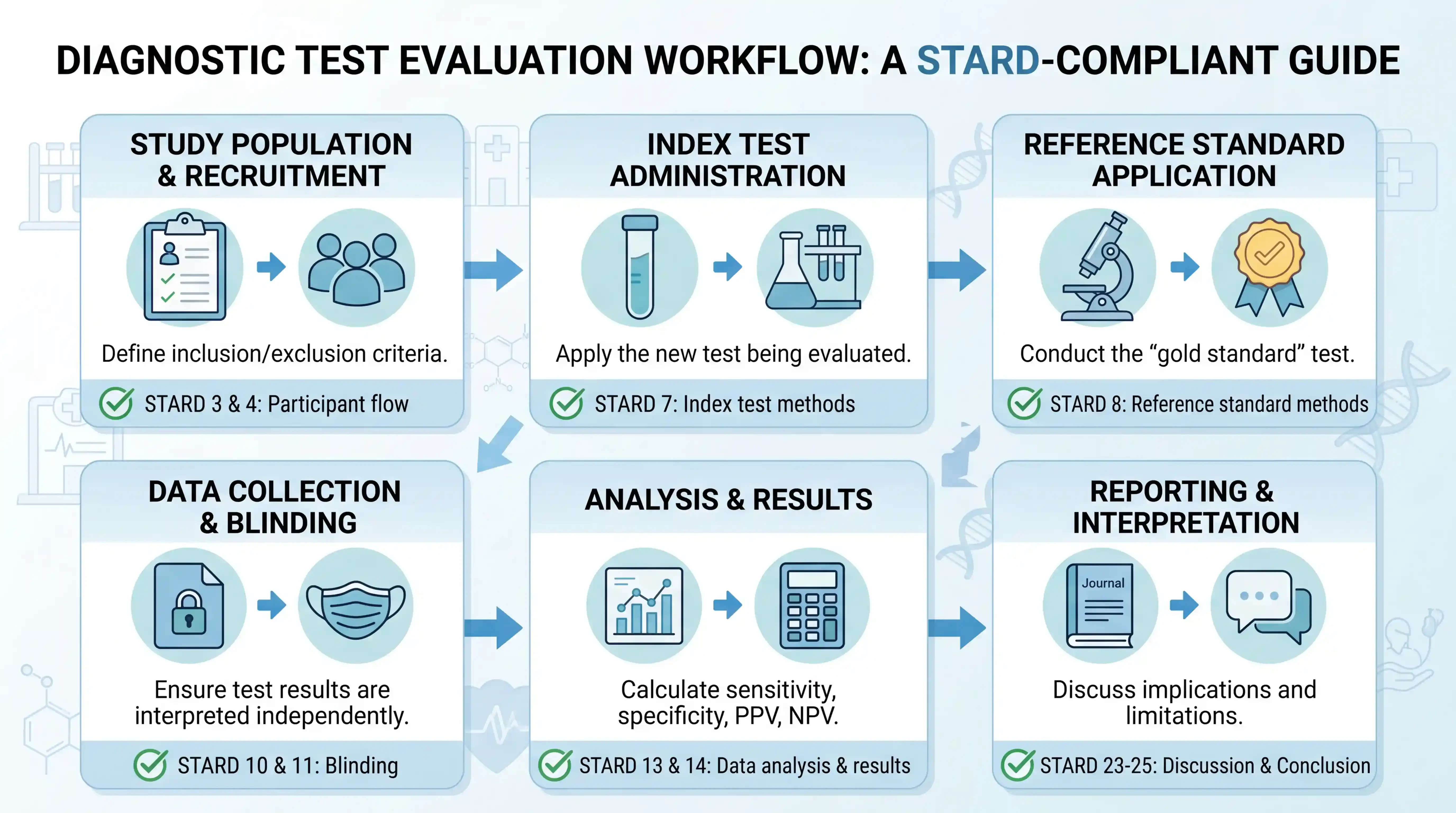
1. Why STARD Matters in Diagnostic Accuracy Research
1.1 The purpose of STARD
STARD stands for Standards for Reporting Diagnostic Accuracy Studies. It is a reporting guideline used for studies that evaluate a diagnostic test against a reference standard. According to the knowledge base, STARD 2003 had 25 items, and STARD 2015 expanded this to 30 items. That expansion reflects a stronger focus on clarity, bias control, and complete reporting.
A well-reported diagnostic study should let readers understand exactly who was studied, how tests were performed, and how accuracy was calculated. That is the core value of STARD. It is not a statistical method. It is a reporting standard.
1.2 Why journals care
Many SCI journals recommend reporting guidelines such as CONSORT, PRISMA, STROBE, and STARD. Some are more strictly enforced than others, but journal expectations are rising. For diagnostic studies, reviewers often look for one thing first: whether the manuscript follows STARD logic.
A paper that follows STARD is easier to assess. It also signals that the authors considered bias, patient selection, and test interpretation carefully. In practice, this improves credibility and may increase the chance of acceptance.
2. Start with the Title, Abstract, and Keywords
2.1 Make the study identifiable
STARD recommends that a diagnostic study be identifiable early. That means the title, abstract, or keywords should clearly show that the paper is about diagnosis or diagnostic accuracy. Useful terms include diagnosis, diagnostic accuracy, sensitivity, specificity, predictive value, AUC, and accuracy.
If readers cannot recognize the study type in the title or abstract, the article loses search visibility and reading efficiency. This is especially important for database retrieval.
A practical rule is simple. Use the title to signal that the paper is diagnostic. Then use a structured abstract. Finally, reinforce the topic through keywords. This gives the article three chances to be recognized correctly.
2.2 Use a structured abstract
The knowledge base recommends a structured abstract with purpose, background, methods, results, and conclusion. This format helps readers quickly find the clinical question and the main findings.
For an essay or manuscript on diagnostic accuracy, the abstract should not be vague. It should state:
- what test was evaluated,
- what reference standard was used,
- what population was studied,
- and what accuracy outcomes were reported.
That structure supports fast appraisal by clinicians and reviewers.
3. Report the Clinical Background Clearly
3.1 Explain the unmet need
The introduction should not just describe the disease. It should explain why the diagnostic test matters. The knowledge base emphasizes that the background should describe the current diagnostic method, its limitations, and the clinical value of the new test.
For example, the reference standard may be accurate but invasive, expensive, time-consuming, or difficult to scale. In that case, the index test may be valuable because it is simpler, cheaper, safer, or more accessible.
A strong diagnostic report states the clinical problem, the expected role of the test, and the study hypothesis. That is what gives the paper direction.
3.2 State the expected use of the test
The introduction should also define whether the test is intended for screening, confirmation, or improvement in efficiency. Some tests aim to raise sensitivity. Others aim to increase specificity. Some achieve similar accuracy but lower cost. These distinctions matter.
When writing the essay, avoid broad claims. Be specific. Say what the test is supposed to improve and why that improvement matters in real practice.
4. Methods: The Most Important Section
4.1 State the study design first
The methods section should begin with the study design. The knowledge base states that design type should be described clearly, such as cross-sectional, prospective, single-blind, or double-blind.
This is not a minor detail. It affects risk of bias. Reviewers need to know whether the index test and reference standard were interpreted independently. They also need to know whether the design was exploratory or confirmatory.
In diagnostic research, methods quality often determines whether the results are believable.
4.2 Define inclusion and exclusion criteria
STARD requires clear inclusion and exclusion criteria. This is basic but essential. The reader must know who could enter the study and who could not.
Good reporting should explain:
- the target population,
- the eligibility criteria,
- and the reasons for exclusion.
If patients were excluded, say why. If only certain subgroups were studied, say so. This is important because selection bias can distort accuracy estimates.
4.3 Describe how participants were identified
The knowledge base stresses that authors should explain how potential participants were identified. That may include symptoms, prior test results, clinical pathways, or registry-based enrollment.
You should also report:
- where the study was conducted,
- when it was conducted,
- and whether participants were enrolled consecutively, randomly, or by convenience.
Setting matters because disease prevalence and spectrum differ across hospitals, community settings, and epidemic periods. A test may perform differently in a tertiary hospital than in a primary care clinic.
5. Report the Index Test and Reference Standard Precisely
5.1 Describe both tests in enough detail
The index test is the test under evaluation. The reference standard is the best available method used to classify disease status. Both must be described well enough for replication.
Report:
- the test principle,
- the procedure,
- the reader or operator,
- and any equipment or assay details that matter.
If there are alternative reference standards, explain them carefully. Multiple reference standards can introduce additional bias, so the choice must be justified.
5.2 Explain the cut-off value
Many diagnostic studies rely on a cut-off value. The knowledge base notes that the cut-off may be conventional or newly determined. Either way, the manuscript should explain how it was chosen.
If ROC analysis was used, say so. If the threshold came from prior studies, state that too. The same applies to both the index test and, when relevant, the reference standard.
Readers should not have to guess how a positive or negative result was defined.
6. Address Blinding, Statistics, and Missing Data
6.1 Report blinding
STARD places strong emphasis on whether the test interpreters were blinded. The index test reader should not know the reference standard result. The reference standard assessor should not know the index test result.
This reduces evaluation bias. If blinding was impossible, the manuscript should say so and explain why.
6.2 Describe the statistical methods
The knowledge base is explicit: statistical methods must be reported in detail. At minimum, explain how you calculated:
- sensitivity,
- specificity,
- predictive values,
- AUC if applicable,
- and accuracy with confidence intervals.
Reporting only point estimates is incomplete. A 95% confidence interval should be included. This is often missing in Chinese-language papers and should be corrected.
If ROC analysis was used to choose the cut-off, describe the method clearly. If subgroup analysis was performed, explain the rationale.
6.3 Handle uncertain and missing results
Uncertain results should not be ignored. The reference standard may occasionally be indeterminate, especially if it is not histopathology. The paper should state how such results were handled.
Missing values also need a plan. The knowledge base suggests that exclusion is usually preferred over imputation in this context, because imputation may introduce bias. Whatever method is chosen, it should be stated in advance and reported honestly.
7. Report the Results in a STARD-Friendly Way
7.1 Use a flow diagram
The knowledge base strongly emphasizes a flow diagram. It should show:
- the target population,
- excluded patients and reasons,
- who received the index test,
- who received the reference standard,
- and who was finally analyzed.
A flow diagram allows reviewers to understand the study design at a glance. In many cases, it makes a stronger impression than text alone.
7.2 Include baseline characteristics
A baseline table is also important. Report the demographic and clinical characteristics of the enrolled participants. Also report the distribution of disease severity and relevant comorbidities.
This helps readers judge spectrum bias. For example, if the study only includes severe cases, accuracy may be overstated. If control patients have other diseases that mimic the target condition, that should also be clear.
7.3 Report the 2-by-2 table
The knowledge base recommends paired four-cell tables for diagnostic data. This is the classic 2-by-2 table comparing the index test against the reference standard.
From this table, readers can verify:
- true positives,
- false positives,
- true negatives,
- and false negatives.
This is the foundation for accuracy reporting. Without it, the statistics are hard to evaluate.
8. Discuss the Study with Precision
8.1 Summarize the main findings
The discussion should begin with the main findings. State what the study found, without overclaiming. Then explain the clinical meaning of those findings.
If the test showed high sensitivity, explain whether it could support screening. If specificity was higher, explain whether it may help confirm disease. If the test offers similar accuracy at lower cost, say that directly.
8.2 Address limitations honestly
No diagnostic study is perfect. Common limitations include small sample size, single-center design, incomplete blinding, spectrum bias, and missing data.
The discussion should state these limitations plainly. It should also explain how they affect interpretation.
8.3 Suggest future directions
The knowledge base recommends closing the discussion with improvement points and future research implications. This could include multicenter validation, larger samples, better standardization, or comparison with alternative reference standards.
9. Final Reporting Items and Practical Workflow
9.1 Add registration and funding information
The STARD 2015 framework also supports reporting of registration status, protocol access, and funding sources. These items improve transparency and trust.
Readers should know whether the study was registered, where the protocol can be found, and who funded the work. If there is sponsorship, disclose it clearly.
9.2 Use tools that support compliance
Preparing a diagnostic study manuscript takes time. Many researchers struggle to keep all STARD items aligned while also writing clearly and avoiding omissions. That is where a workflow tool can help.
scifocus.ai can support structured academic writing, checklist-based drafting, and method organization for diagnostic research manuscripts. For busy clinicians and researchers, this can reduce revision cycles and improve completeness. If your goal is a cleaner, more publishable essay, a guided writing platform can save time and reduce reporting gaps.
Conclusion
STARD is the most practical framework for reporting diagnostic accuracy methods clearly. It helps authors describe the title, abstract, introduction, methods, results, and discussion in a way that supports transparency and reproducibility. For medical students, physicians, and researchers, the key is simple: define the population, explain the index test and reference standard, report blinding and statistics, and present the flow of participants clearly. If you want to write a stronger diagnostic manuscript, follow STARD closely and use scifocus.ai to organize the process more efficiently.

Did you like this article? Explore a few more related posts.
Start Your Research Journey With Scifocus Today
Create your free Scifocus account today and take your research to the next level. Experience the difference firsthand—your journey to academic excellence starts here.