

How to Present Qualitative Data in a Paper
Introduction
Presenting qualitative data in an essay or research paper is often harder than presenting numbers. The challenge is not lack of data, but how to organize themes, quotes, and observations into a clear scientific narrative. For medical students, doctors, and researchers, the goal is simple: make findings readable, credible, and easy to defend. A strong essay on qualitative data should show patterns, support claims with evidence, and stay aligned with your research question.
1. Understand What Qualitative Data Needs to Show
1.1 Focus on meaning, not measurement
Qualitative data does not rely on counts alone. It shows experiences, perceptions, and explanations. In a paper, this means your job is to move from raw statements to interpreted themes.
A weak essay simply lists interview answers. A stronger one groups them into patterns. For example, if several participants describe delays in care, the paper should present that as a shared theme, then explain how it affects clinical workflow or patient trust.
1.2 Start with the research question
Every qualitative result should answer the study question. Before writing, ask:
- What did participants repeatedly express?
- Which ideas appeared across interviews, focus groups, or field notes?
- What was unexpected, contradictory, or clinically important?
If a theme does not help answer the research question, it should not dominate the paper. This keeps the essay focused and useful.
2. Organize the Data Into Clear Themes
2.1 Use a simple thematic structure
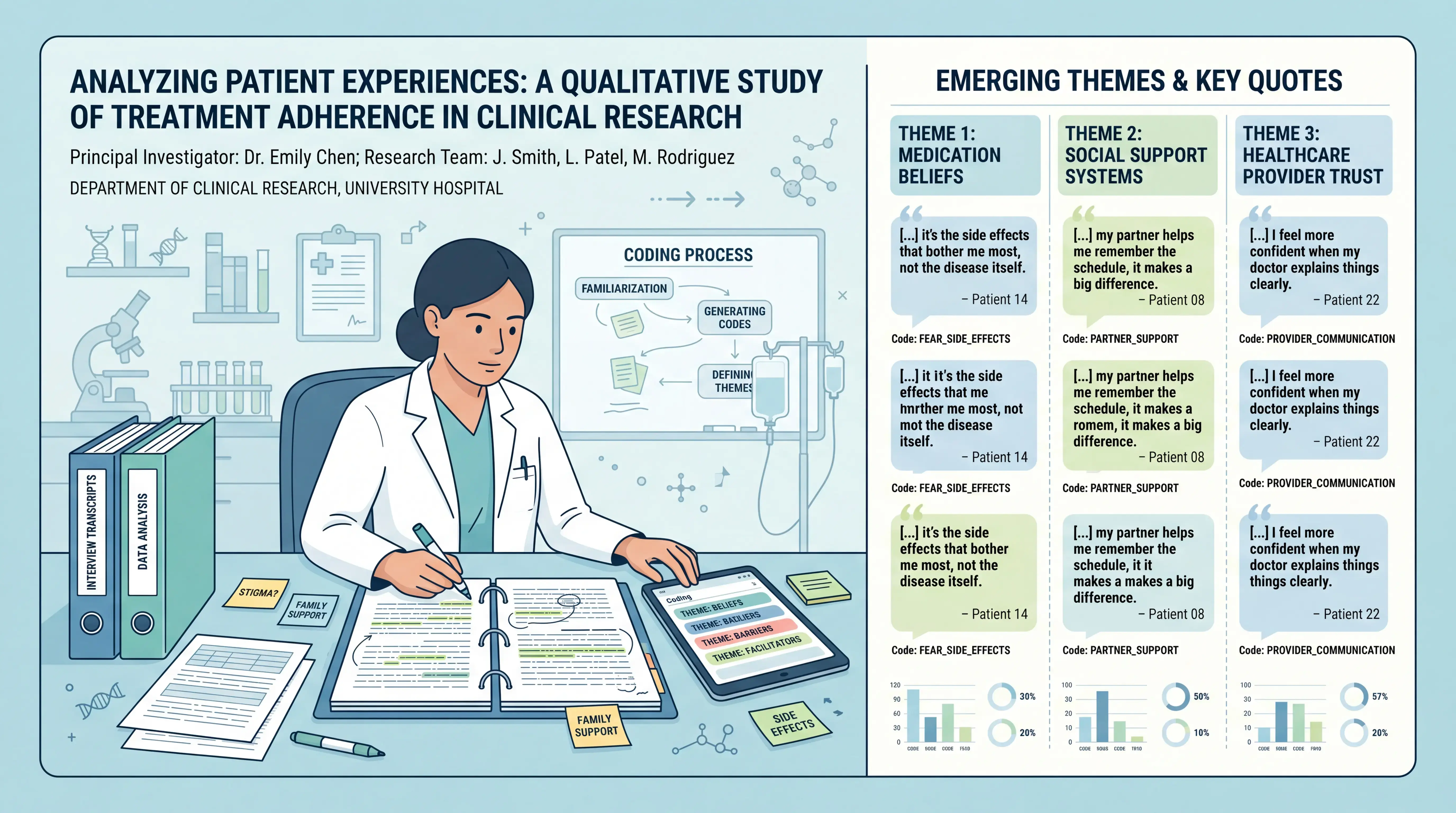
The most effective way to present qualitative data is by theme. Each theme should have a short heading, a clear explanation, and one or two representative quotes.
A practical structure is:
- Theme title.
- Short interpretation.
- Supporting quote.
- Link to the research question.
This format helps readers follow the logic without getting lost in long narrative blocks.
2.2 Present themes in a logical order
Order matters. You can arrange themes by:
- Frequency, from most common to least common.
- Clinical importance, from major impact to minor impact.
- Research process, from baseline perceptions to outcomes.
For medical writing, clinical relevance usually works best. Readers should see the most important findings early.
2.3 Keep theme labels precise
Avoid vague labels like “general concerns” or “miscellaneous issues.” Use specific headings such as:
- Delayed access to care
- Unclear treatment communication
- Emotional burden during follow-up
- Trust in the clinical team
Specific labels improve readability and make the essay look more professional.
3. Use Quotes and Evidence Correctly
3.1 Select quotes that do real work
Quotes are the backbone of qualitative presentation. They should prove a point, not just decorate the page. Choose statements that are:
- Representative.
- Clear and concise.
- Directly tied to the theme.
- Strong enough to carry meaning.
One or two good quotes are often better than five repetitive ones.
3.2 Introduce each quote properly
Do not drop quotes into the text without context. Prepare the reader first, then show the evidence, then explain its meaning.
For example:
- Participants consistently described uncertainty about discharge planning.
- One doctor noted that “patients often leave without fully understanding the next step.”
- This suggests a communication gap during transition of care.
This is the kind of sequence that makes an essay sound disciplined and research-driven.
3.3 Protect anonymity and accuracy
If the data come from patients, staff, or interviewees, keep identifiers anonymous. Use labels such as:
- Patient 01
- Resident 03
- Nurse 02
Do not alter the meaning of quotes. If editing is needed for grammar or length, make sure the original intent remains intact.
4. Write the Results Section With Discipline
4.1 Separate description from interpretation
In many papers, the results section should describe what was found, while the discussion explains what it means. That distinction matters.
A results section should say:
- What themes emerged.
- What participants reported.
- What patterns were observed.
A discussion section can then explain:
- Why the findings matter.
- How they compare with prior studies.
- What they imply for practice or future research.
This separation makes the essay clearer and more acceptable to reviewers.
4.2 Use signposting language
Simple transition words improve flow. Useful words include:
- Consistently
- Moreover
- Furthermore
- In contrast
- Similarly
- This suggests
- These findings indicate
These words help connect one finding to the next without sounding repetitive.
4.3 Reference figures and tables when useful
Qualitative work can benefit from structured visuals. For example:
- A table of themes and subthemes.
- A figure showing the coding framework.
- A matrix comparing participant groups.
This is especially useful in clinical papers where readers need a quick overview. Visuals make the essay easier to scan and remember.
5. Build the Discussion Around Interpretation
5.1 Explain why the themes matter
The discussion should translate qualitative findings into clinical meaning. If patients report confusion about instructions, the question is not only “what did they say,” but “what does that mean for adherence, safety, or outcomes?”
Good discussion writing does three things:
- Interprets the theme.
- Connects it to the literature.
- States the practical implication.
This is where many papers become strong or weak.
5.2 Compare findings with prior studies
You do not need many citations, but you do need relevant ones. Use recent, credible studies to show whether your findings are:
- Consistent with previous observations.
- Different from earlier reports.
- Extending existing knowledge.
Useful expressions include:
- Consistent with previous observation
- In line with previous studies
- Contrary to the findings of earlier reports
- Recent work on this topic shows that
This helps position your essay within the scientific conversation.
5.3 Be honest about limitations
Qualitative studies have limits. A small sample, one institution, or interviewer influence can affect transferability. State these clearly and briefly.
A good limitation statement is not a weakness. It is a sign of trustworthiness. Reviewers expect it.
6. Write in a Style That Sounds Scientific
6.1 Use precise verbs
Avoid repetitive wording. Use a range of academic verbs such as:
- Demonstrate
- Indicate
- Reveal
- Suggest
- Show
- Substantiate
For example:
- The interviews revealed a recurring concern about follow-up care.
- The analysis suggests that communication quality shaped patient confidence.
These verbs give the essay a more polished scientific tone.
6.2 Keep sentences short and direct
Long sentences can blur the meaning of qualitative findings. Shorter sentences improve clarity, especially for readers in medicine and research.
A clean style often works best:
- State the theme.
- Add evidence.
- Explain the significance.
- Move on.
This structure reduces confusion and improves readability.
6.3 Avoid overclaiming
Qualitative data can explain experiences, but it should not be used to claim causation unless the design supports it. Stay within the evidence.
Say:
- Participants reported reduced confidence after discharge.
Not: - Discharge caused reduced confidence in every case.
Precision is part of scientific credibility.
7. A Practical Template for Your Paper
7.1 Results template
You can structure the results like this:
- Theme 1: Access barriers
- Theme 2: Communication challenges
- Theme 3: Emotional response to illness
- Theme 4: Suggestions for improvement
Under each theme:
- One-sentence summary.
- One quote.
- One interpretation.
7.2 Discussion template
Then write the discussion in this order:
- Main finding summary.
- Comparison with prior studies.
- Clinical relevance.
- Limitations.
- Future research.
This structure works well for an essay, a thesis chapter, or a journal manuscript.
7.3 Final quality check
Before submission, ask:
- Does every theme answer the research question?
- Are quotes selected and labeled clearly?
- Is the interpretation separate from the raw data?
- Does the discussion explain relevance to medicine?
- Is the essay concise and readable?
If the answer is yes, your paper is much more likely to satisfy reviewers.
8. How SciFocus.ai Can Help You Write Faster
If you need to turn raw interviews, coded notes, and scattered observations into a polished paper, SciFocus.ai can help streamline the process. It supports structured academic writing, improves organization, and helps you move from data to a clean manuscript draft faster.
For busy medical students, clinicians, and researchers, this matters. It saves time, reduces writing friction, and helps you focus on the science instead of formatting stress. When your essay needs to present qualitative data clearly and professionally, using the right workflow can make the difference between a rough draft and a submission-ready paper.
Conclusion
To present qualitative data well in a paper, focus on themes, use quotes with purpose, and keep interpretation structured. Separate results from discussion. Stay precise. Stay concise. And always connect the findings to the research question and clinical value. A strong essay does not just report what people said. It shows what the data mean.
If you want to write faster and organize your findings with less effort, consider using SciFocus.ai to support your next manuscript.

Did you like this article? Explore a few more related posts.
Start Your Research Journey With Scifocus Today
Create your free Scifocus account today and take your research to the next level. Experience the difference firsthand—your journey to academic excellence starts here.