

How to Preregister Your Study and Why It Matters
Introduction
Preregistration is no longer optional for serious clinical researchers. If you are a medical student, physician, or investigator planning an essay on clinical research practice, the real question is not whether to register. It is how to do it correctly, before patient recruitment begins. Failure to preregister can create ethical concerns, weaken credibility, and make publication harder. This guide explains what preregistration means, who needs it, and how to complete it without avoidable mistakes.
1. What Preregistration Means in Clinical Research
1.1 A record created before the first participant is enrolled
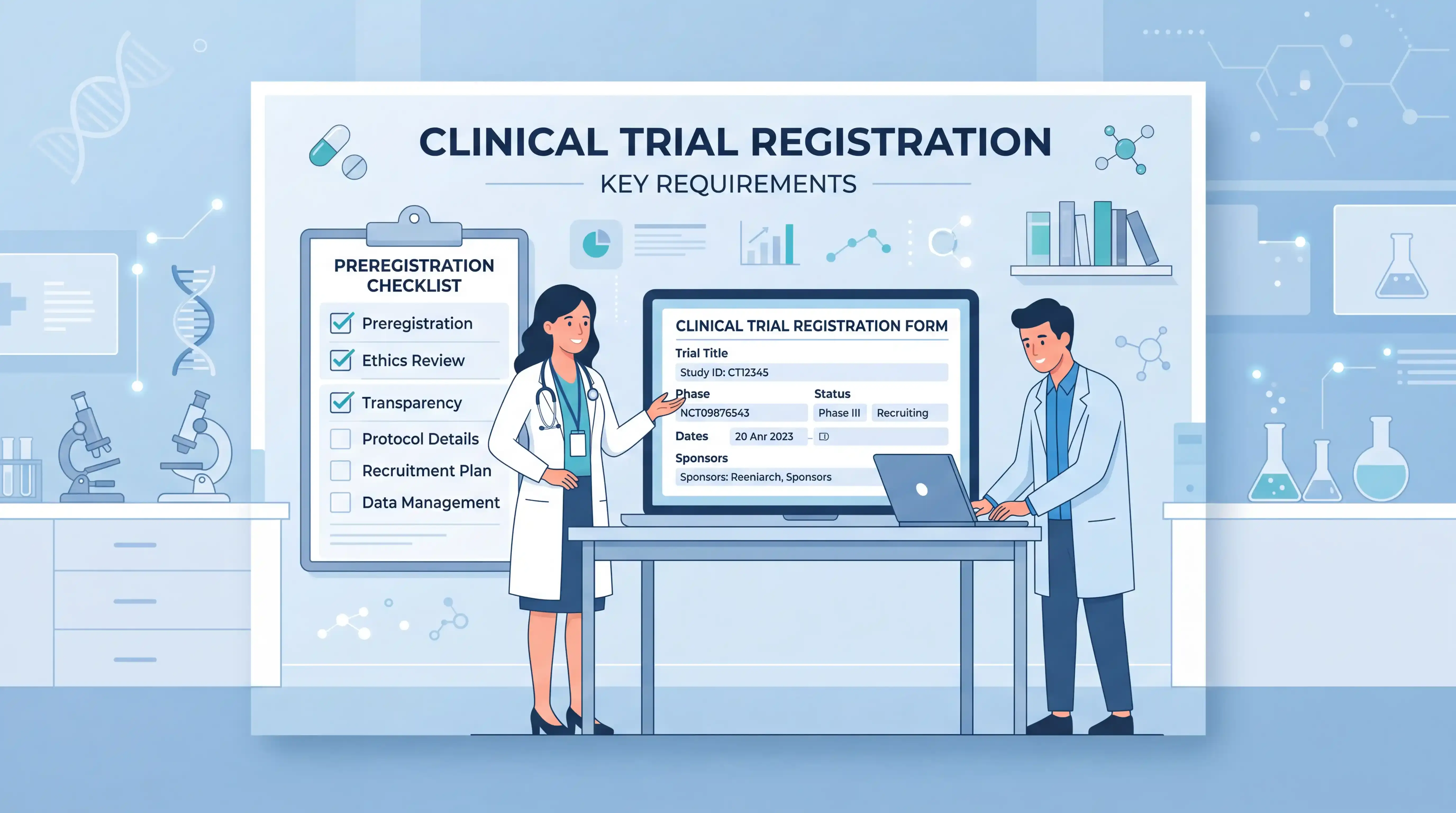
Preregistration means submitting key study information to a recognized registration platform before recruiting the first participant. In clinical research, this is not a formality. It is part of scientific transparency.
The WHO considers trial registration a scientific, ethical, and moral responsibility. That applies broadly to interventional studies and to many observational studies involving human participants or human-derived materials, such as blood, tissue, cells, or body fluids.
1.2 Which studies should be registered
All clinical trials should be registered. That includes studies involving treatment, prevention, diagnosis, prognosis, epidemiology, and other human-based research, regardless of design.
Common examples include:
- Randomized controlled trials
- Non-randomized controlled trials
- Single-arm studies
- Cohort studies
- Case-control studies
- Diagnostic accuracy studies
- Real-world observational research
If your research involves humans, or samples taken from humans, preregistration should be strongly considered and is often required.
2. Why Preregistration Matters
2.1 It strengthens ethics and trust
Participants contribute time, risk, and biological material. They deserve assurance that the results will not disappear into a drawer. Open registration helps show that the study was planned in advance and that outcomes were not selected after the fact.
This improves public trust and protects the ethical basis of research. It also supports the principle that knowledge gained from participants should improve care for others.
2.2 It reduces bias and supports publication
Preregistration helps researchers and journals track what was planned, what was changed, and what was actually found. That reduces selective reporting and makes it easier to identify outcome switching or incomplete disclosure.
Many journals now expect registration as a baseline requirement. Some will not accept retrospective registration at all. In practice, preregistration can influence whether your essay, manuscript, or clinical report is publishable.
3. Who Is Responsible for Registration
3.1 The PI or sponsor must take ownership
The registration responsibility can belong to the principal investigator or the primary sponsor, depending on the study arrangement. For multicenter or jointly sponsored studies, the key PI or key sponsor should take the lead.
The sponsor remains ultimately responsible for ensuring the study is properly registered. This should be decided before recruitment starts.
3.2 Timing matters more than many teams expect
The ideal time to preregister is before the first participant is recruited. Some registries ask for ethics approval first. Others allow registration first and ethics submission later.
The safest rule is simple: register early, but never after enrollment begins if you can avoid it. If your site requires a different sequence, document it clearly and upload the ethics approval as soon as it becomes available.
4. What Information You Need to Prepare
4.1 Core information usually required
Most registries ask for the study details defined in the WHO trial registration dataset. Exact requirements vary by registry, but the following information is commonly needed:
- Study title and acronym
- Sponsor and contact details
- Principal investigator
- Ethics committee status
- Study design
- Research type
- Interventions
- Outcome measures
- Recruitment plan
- Study sites
- Data management plan
You may also need to provide the names of the CRF and EDC systems used for data collection and management.
4.2 Be precise and consistent
Inconsistent descriptions create problems later. The protocol, ethics application, registry entry, and eventual manuscript should match. If one document says “randomized parallel design” and another says “single-arm observational study,” reviewers will notice.
Use the same terminology across all documents. That is one of the simplest ways to avoid delays and credibility issues.
5. How to Preregister Step by Step
5.1 Create an account and start a new project
On the registry platform, first create a user account. After logging in, select “New Project” or the equivalent registration option. Most systems support English and Chinese interfaces, and some allow both pre-registration and retrospective registration.
Next, enter the basic study information. Required fields are usually marked. Do not rush this stage. Small errors here can cause long review delays.
5.2 Complete the study fields carefully
You will typically be asked to fill in several sections:
- Basic project information
- Contact person and study lead details
- Ethics review status
- Sponsor or coordinating unit information
- Research type and design
- Intervention details
- Study sites
- Outcome measures
- Human sample collection details
- Recruitment information
- Data management details
If your study has multiple sites, interventions, or outcomes, list them all. Do not compress separate elements into one vague entry.
5.3 Upload ethics documents and submit
If ethics approval has already been granted, upload the approval letter in the required format. If not, some registries permit submission first and ethics upload later.
After review, you may receive a registration number. Some platforms also send email confirmation once the entry is approved. After approval, changes are usually limited, so review every field before submission.
6. Common Mistakes to Avoid
6.1 Retrospective registration without a clear plan
A study registered after enrollment has started is considered retrospective registration. Some registries accept it, but many journals treat it less favorably. In some cases, publication options may be limited.
6.2 Duplicate registration across platforms
Do not register the same study repeatedly in multiple systems without a clear reason. This can create duplication problems in international databases. For multinational studies, a unique trial number may be needed to prevent repeated counting.
6.3 Incomplete data management information
Many researchers underestimate this section. Yet the registry may require details on CRF and EDC systems, data flow, and data sharing plans. A weak data management description makes the entire submission look unfinished.
7. Why Using a Research Support Tool Can Help
7.1 Reduce drafting errors and save time
Clinical registration requires consistent writing, clean structure, and precise terminology. That is hard when teams are busy. A support tool such as scifocus.ai can help researchers organize study text, refine wording, and keep protocol language aligned across sections.
For doctors and research teams preparing an essay, protocol draft, or registration summary, this kind of support reduces avoidable rework. It helps you move from scattered notes to a structured submission faster.
7.2 Improve clarity before submission
The real value of a tool is not just speed. It is consistency. scifocus.ai can help you turn complex study notes into cleaner, more readable research content before you submit to a registry, ethics committee, or journal.
That matters because registration quality affects credibility. Clean, precise language makes your study easier to review and easier to trust.
Conclusion
Preregistration is a core part of responsible clinical research. It supports ethics, transparency, and publication readiness. It also helps your team avoid bias, missing data, and duplicated reporting. If you are planning a clinical study, register before recruitment whenever possible, keep your protocol and registry entry aligned, and document ethics approval carefully. For researchers who want faster, clearer, and more consistent drafting, scifocus.ai can help you prepare a stronger submission with less friction.
Did you like this article? Explore a few more related posts.
Start Your Research Journey With Scifocus Today
Create your free Scifocus account today and take your research to the next level. Experience the difference firsthand—your journey to academic excellence starts here.