

How to Paraphrase a Source Without Plagiarizing
Introduction
Writing an essay for medical school, clinical work, or research often means using published sources. The problem is simple: you must explain prior evidence clearly, but you cannot copy the original wording. How to paraphrase a source without plagiarizing is a core skill for students, doctors, and researchers who write under strict academic standards.
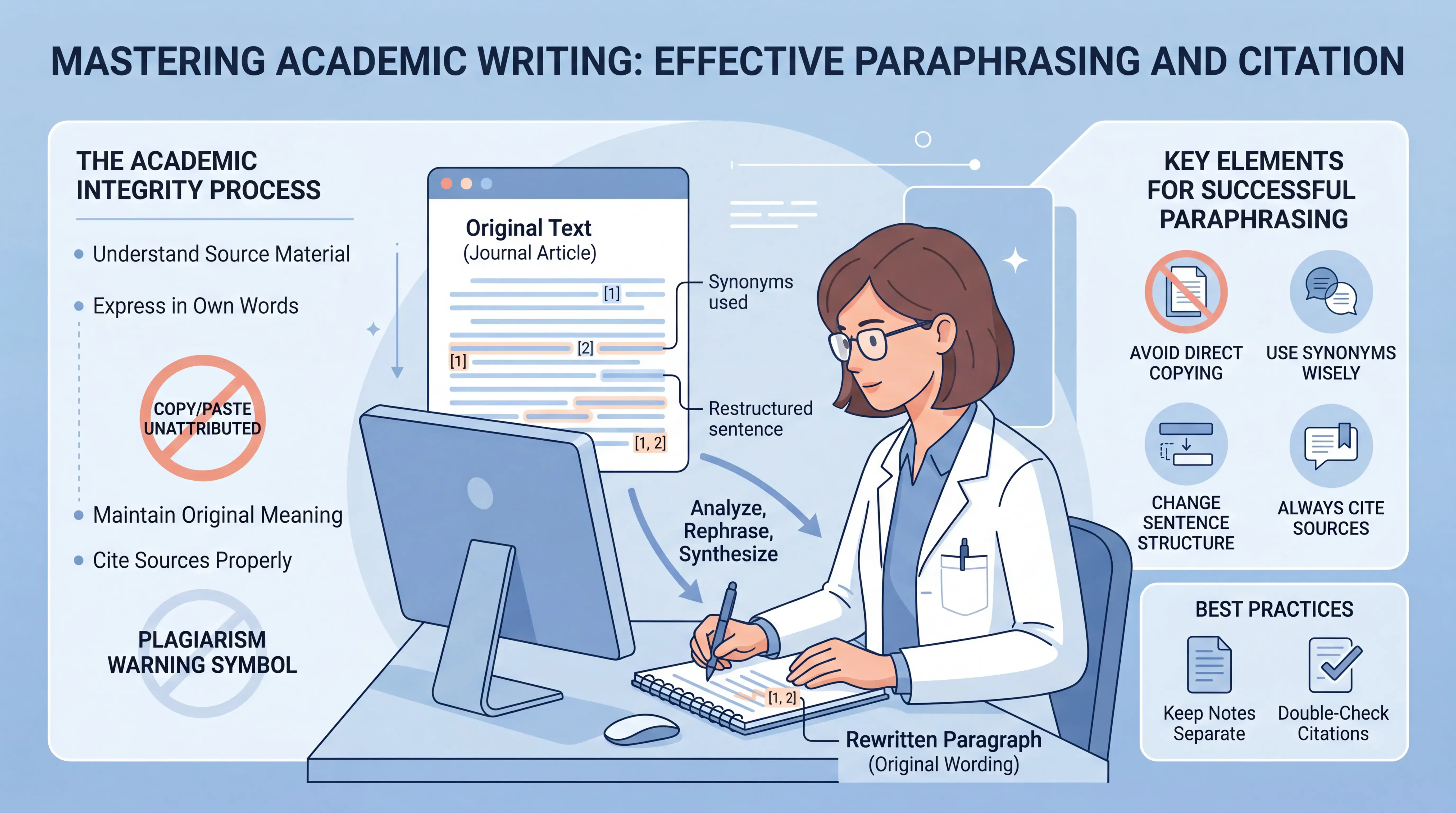
1. Understand What Paraphrasing Really Means
1.1 Paraphrasing is not word substitution
Paraphrasing means restating an idea in your own language and sentence structure. It is not enough to replace a few words with synonyms. If the structure stays too close to the source, the text may still be judged as plagiarism.
In scientific writing, this matters most when you discuss previous findings. You may need to compare your results with earlier studies. In that case, you must change both the wording and the structure while keeping the original meaning.
1.2 Paraphrasing is different from quoting and summarizing
There are three common ways to restate source material:
- Direct quoting. Use the exact words and put them in quotation marks.
- Paraphrasing. Rewrite the source in your own words with the same level of detail.
- Summarizing. Reduce a longer passage to its main point.
This distinction is important. A quote preserves the original language. A paraphrase keeps the full meaning but uses a new form. A summary removes most details and focuses only on the conclusion.
1.3 Why medical writers need this skill
Medical essays and research papers often cite clinical findings, trial results, or disease mechanisms. If you rely too heavily on the source text, your paper may show high textual similarity. Many journals use similarity-checking software before review. That is why paraphrasing must be deliberate, accurate, and traceable.
2. Use a Step-by-Step Paraphrasing Method
2.1 Read the source until you understand it
Before rewriting, read the passage several times. Identify the core claim, the key data, and any qualifiers such as “may,” “associated with,” or “up to.” Do not start rewriting sentence by sentence too early. That often leads to close imitation.
A practical method is this:
- Read the source once for meaning.
- Highlight the main point.
- Close the source.
- Rewrite from memory.
- Reopen the source and compare.
This helps you avoid copying the original sequence of ideas.
2.2 Change the structure, not just the vocabulary
A weak paraphrase keeps the same grammar and sentence order. A strong paraphrase changes the entire frame. You can do this by:
- Switching from active to passive voice.
- Moving the result before the explanation.
- Combining two short sentences into one.
- Splitting one long sentence into two shorter ones.
For example, if the source says that a condition is linked to intravenous drug use and blood transfusion before 1992, a strong paraphrase should not repeat the same phrase order. It should reframe the risk factors in a new structure.
Good paraphrasing sounds like a new sentence written by a knowledgeable reader, not a lightly edited copy.
2.3 Preserve the scientific meaning exactly
In an essay or research discussion, accuracy matters more than style. Do not weaken or strengthen the original claim. If the source says “up to 20%,” keep that number. If it says “may have been caused by,” do not turn it into a definite cause.
This is especially important in medicine. Changing the degree of certainty can distort evidence and mislead readers. A paraphrase must remain faithful to the original data, limitations, and conclusions.
3. Avoid Plagiarism in Practice
3.1 Do not keep long sequences of the original text
One of the most common mistakes is preserving too many consecutive words from the source. Even if you change a few terms, the passage may still look copied. In academic writing, repeated phrase patterns can trigger similarity flags.
To reduce risk, rewrite at the clause level, not just at the word level. Ask yourself:
- Did I change the sentence order?
- Did I change the emphasis?
- Did I use a different grammatical pattern?
- Would this sentence still work if the source disappeared?
If the answer is no, rewrite again.
3.2 Avoid “patchwriting”
Patchwriting happens when a writer stitches together pieces of the original text with minor edits. This often happens under time pressure. It is common in first drafts, but it is not safe for final submission.
To avoid it, write from understanding, not from visual memory. Cover the source text and explain it in your own words first. Then check whether your version is genuinely original in form.
3.3 Cite the source even when you paraphrase
Paraphrasing does not remove the need for citation. You are still using someone else’s idea, result, or interpretation. In fact, in scientific writing, the citation is what makes the paraphrase credible.
A paraphrase without a citation is still academically incomplete.
A paraphrase with a citation shows both integrity and scholarship.
4. When to Paraphrase, Quote, or Summarize
4.1 Use direct quotes only when the exact wording matters
Quote when the source contains a fixed phrase, a widely recognized concept, or wording that must be preserved exactly. Examples include established terms, classic hypotheses, or memorable statements.
For instance, some phrases in medicine or science are best quoted because they have become standard expressions. In those cases, use quotation marks and cite the source properly.
4.2 Use paraphrasing for most literature discussion
Paraphrasing is the default choice in most essays, introductions, and discussion sections. It allows you to integrate evidence smoothly while keeping your paper original.
This is useful when you explain prior studies, compare findings, or describe clinical evidence. It helps you create a coherent narrative instead of a list of copied sentences.
4.3 Use summaries for broad background statements
Summaries are best when the source is long and you only need the main conclusion. You remove most details and keep the central message.
For example, if a paper presents multiple experiments and several mechanistic explanations, your essay may only need one sentence about the main finding. That is summarizing, not paraphrasing.
5. A Reliable Workflow for Medical and Research Writing
5.1 Build a note system before drafting
When you collect sources for an essay, create notes in three columns:
- Source claim.
- Your understanding.
- Final rewritten version.
This helps you separate reading from writing. It also makes later citation easier.
5.2 Compare your draft against the source
After writing, compare the draft line by line. Check for:
- Repeated sentence structure.
- Identical opening phrases.
- Unchanged technical phrase clusters.
- Missing citation.
If the draft still sounds too close, rewrite again. This step is essential in clinical and scientific writing because precision and originality must coexist.
5.3 Use tools carefully, but do not depend on them alone
Plagiarism-checking tools can help identify similarity, but they do not replace judgment. A low similarity score does not always mean the paraphrase is strong. A high score does not always mean misconduct.
The real goal is clear: write in a way that shows understanding, not substitution.
5.4 Save time with structured writing support
If you regularly write essays, reports, or research drafts, a structured writing tool can help you organize source material, refine sentence structure, and reduce accidental overlap. For example, scifocus.ai can support academic drafting by helping you turn raw notes into clearer, more original research language while keeping the citation workflow in mind. For busy medical students, physicians, and researchers, that kind of support can save time and improve consistency.
6. Common Mistakes to Avoid
6.1 Using only synonyms
This is the weakest form of rewriting. It often leaves the original sentence visible. Search engines and plagiarism tools may still detect it.
6.2 Keeping the same order of ideas
Even if every word is changed, the sentence may still be too close if the logic and structure are identical. Reorder the ideas when possible.
6.3 Forgetting the citation
This is one of the most serious errors. A rewritten sentence still belongs to the original author’s intellectual work.
6.4 Changing the meaning unintentionally
Do not turn “associated with” into “caused by” unless the source proves causation. In medicine, this kind of error can damage the credibility of your essay and your professional reputation.
Conclusion
Paraphrasing is a practical academic skill, not a cosmetic edit. To paraphrase a source without plagiarizing, you must understand the meaning, change the structure, preserve the data, and cite the source. That approach is essential in medical essays, clinical writing, and research papers where accuracy and integrity are nonnegotiable.
If you want to write faster and stay original, tools like scifocus.ai can help you organize source material, refine phrasing, and build cleaner drafts with less risk of accidental overlap.

Did you like this article? Explore a few more related posts.
Start Your Research Journey With Scifocus Today
Create your free Scifocus account today and take your research to the next level. Experience the difference firsthand—your journey to academic excellence starts here.