
How to Improve Rigorous Medical Teaching with Digital Tools?
Introduction
Medical education demands accuracy, consistency, and measurable outcomes. Yet many educators still face fragmented resources, uneven learner engagement, and limited time for feedback. This is where education can benefit from digital tools in a practical, structured way. Used well, digital platforms can support rigorous teaching without lowering academic standards.
1. Why Digital Tools Matter in Medical Education
1.1 Raising consistency in teaching
Medical teaching depends on standardization. Digital tools help instructors deliver the same core content across different cohorts, rotations, and campuses. This matters in anatomy, pathology, pharmacology, and clinical reasoning, where small gaps can affect patient safety later.
A strong digital workflow reduces variation in what students see, practice, and retain. It also makes it easier to update materials when guidelines change.
1.2 Supporting evidence-based learning
Modern education in medicine should reflect how learners absorb, apply, and review information. Digital tools can organize lectures, reading lists, quizzes, and case materials into one system. This allows students to move from passive listening to active recall and spaced repetition.
For example, short quizzes after class can reveal weak points immediately. Case-based modules can help students connect theory to real clinical judgment. These methods are not a replacement for teaching. They are a way to make teaching more measurable and more rigorous.
2. Core Digital Tools for Rigorous Teaching
2.1 Learning management systems
A learning management system, or LMS, is the foundation of organized education. It can host syllabi, lecture slides, assignments, deadlines, and assessments in one place. For medical programs, this improves traceability and reduces administrative confusion.
Key advantages include:
- Centralized course materials
- Version control for updated content
- Grade tracking and feedback records
- Better communication between faculty and students
In medical training, a well-managed LMS supports accountability. It shows what was taught, when it was taught, and how students performed.
2.2 Digital assessment tools
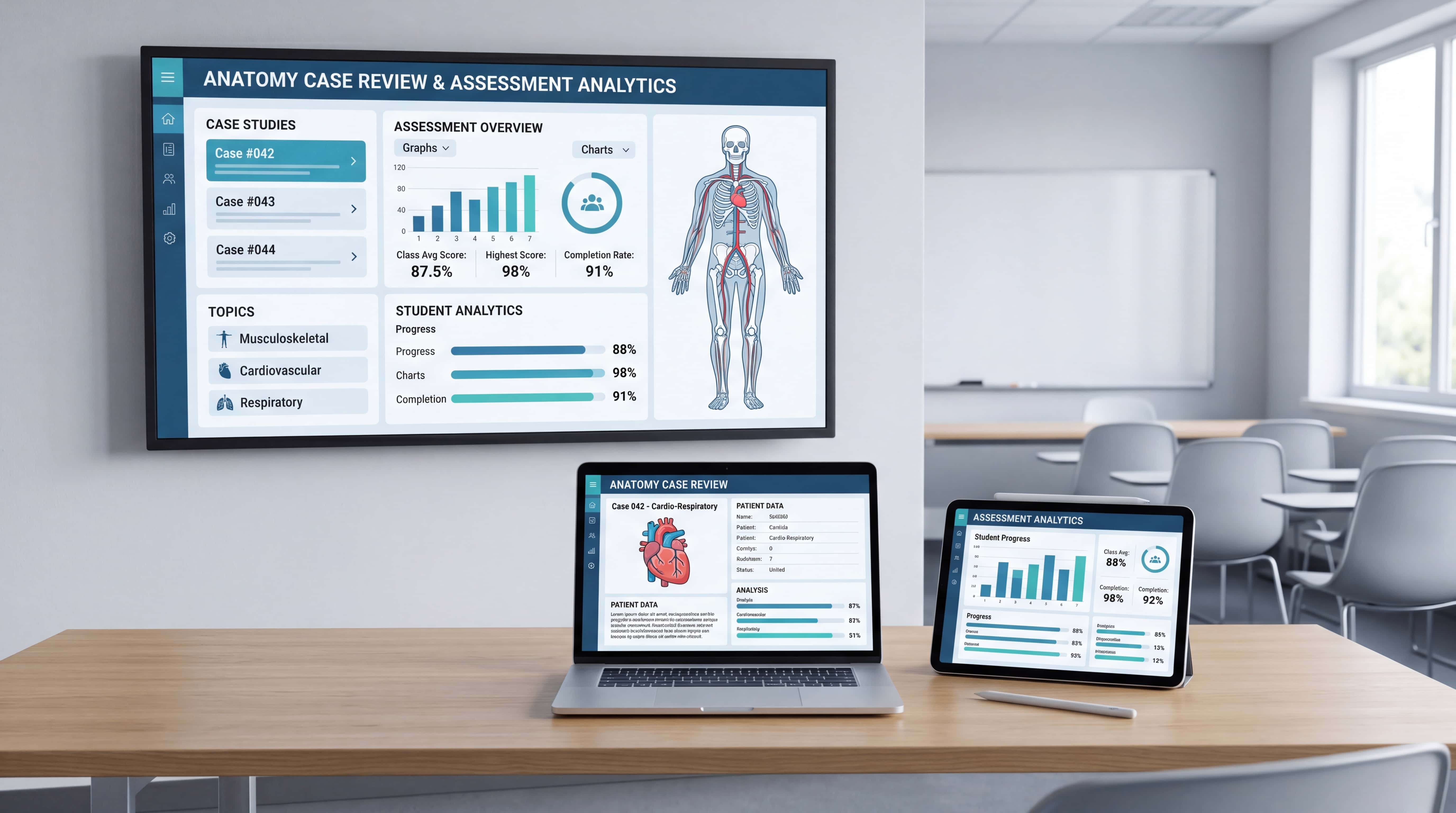
Assessment is where rigor becomes visible. Online testing platforms can support MCQs, short-answer questions, image labeling, and case analysis. They also allow item analysis, so educators can see which questions are too easy, too hard, or poorly written.
This is especially useful in medical education, where precision matters. A good assessment tool helps faculty test not only recall, but also diagnostic reasoning and application under pressure.
2.3 Virtual simulation and case platforms
Simulation is one of the most effective ways to improve clinical readiness. Digital simulation can include virtual patients, decision trees, ultrasound practice modules, or procedure walkthroughs. These tools let students make decisions in low-risk environments before entering the ward.
Simulation strengthens clinical judgment by exposing learners to repeated practice, controlled complexity, and immediate consequences. That makes teaching more rigorous and safer.
3. How to Use Digital Tools Without Losing Academic Rigor
3.1 Align tools with learning outcomes
Digital tools should not be added for decoration. They must support clear learning outcomes. If the goal is diagnostic reasoning, then use case-based tools and structured feedback. If the goal is pharmacology recall, use retrieval practice and interval review.
A rigorous education model begins with the question, “What should the learner be able to do?” Only then should the tool be chosen.
3.2 Use blended teaching, not tool dependence
The best results usually come from blended learning. This combines face-to-face teaching with digital support. In medicine, this protects the strengths of direct clinical mentorship while adding flexibility and scale.
A balanced model may include:
- Pre-class digital reading or micro-lectures
- In-class discussion or bedside teaching
- Post-class quizzes and feedback
- Simulation for high-risk scenarios
This approach keeps teaching structured and keeps learners accountable.
3.3 Build feedback loops
Feedback is essential in medical education. Digital tools can speed up feedback by making comments, score reports, and revision tasks available faster than paper-based systems. Students can then identify errors early and improve before formal exams or clinical evaluations.
For faculty, analytics can reveal class-wide weaknesses. If many learners miss the same topic, the issue may be teaching design, not student effort. That insight improves rigor.
4. Practical Benefits for Students, Doctors, and Researchers
4.1 For medical students
Students often struggle with heavy content volume. Digital tools help them organize notes, review cases, and test themselves regularly. They also support self-paced learning, which is useful during rotations and exam preparation.
When students can review material repeatedly and track progress, retention improves. This is a major advantage in education for complex medical subjects.
4.2 For doctors and clinical educators
Doctors who teach need efficient ways to share knowledge without sacrificing clinical time. Digital systems make it easier to assign pre-reading, review cases, and monitor learner progress. They also support multidisciplinary teaching across departments.
This improves consistency in teaching rounds, resident education, and continuing professional development.
4.3 For researchers
Research training also benefits from digital structure. Tools for reference management, data visualization, collaborative writing, and literature screening can improve methodological discipline. They help trainees learn how to document, analyze, and present evidence accurately.
In this context, education becomes more than content delivery. It becomes a framework for scientific thinking.
5. Common Mistakes to Avoid
5.1 Overloading students with too many platforms
Too many apps create confusion. If students must switch between multiple systems, engagement drops. Choose a small, stable toolset and define its purpose clearly.
5.2 Ignoring data privacy and compliance
Medical learners handle sensitive information in cases, simulations, and assessments. Any digital tool must respect data protection, access control, and institutional rules. Security is not optional.
5.3 Using technology without evaluation
Every digital intervention should be reviewed. Ask whether it improved scores, participation, completion rates, or clinical reasoning. If there is no measurable benefit, the tool may be adding complexity without value.
Rigorous medical education requires evaluation, not assumption.
6. Where scifocus.ai Fits in Medical Education
6.1 A smarter workflow for teaching and research
For educators who want a more structured workflow, scifocus.ai can support the planning and organization of academic work. It is especially useful when medical teaching must stay evidence-based, efficient, and traceable.
Used properly, a platform like scifocus.ai can help instructors manage research reading, content organization, and knowledge synthesis more efficiently. That saves time and supports better academic preparation.
6.2 Supporting better teaching decisions
In rigorous education, time spent on preparation matters. If faculty can organize materials faster, review sources more systematically, and keep content aligned with learning goals, they can focus more on teaching quality and student feedback.
The real value of a digital tool is not convenience alone. It is whether it improves clarity, discipline, and academic reliability. That is the standard medical education should use.
Conclusion
Digital tools can significantly improve medical teaching when they are used to strengthen structure, feedback, assessment, and consistency. The goal is not to digitize everything. The goal is to make education more precise, more measurable, and more effective for medical students, doctors, and researchers.
If you want a more organized academic workflow, consider integrating scifocus.ai into your teaching and research process. It can help you reduce manual friction and keep your work aligned with rigorous standards.
Did you like this article? Explore a few more related posts.
Start Your Research Journey With Scifocus Today
Create your free Scifocus account today and take your research to the next level. Experience the difference firsthand—your journey to academic excellence starts here.