

How to Get Ethics Approval for Human and Animal Studies
Introduction
Getting an essay on ethics approval right is not just a writing task. It is a research survival skill. For medical students, physicians, and researchers, missing ethics approval can delay a study, block publication, or lead to rejection. Human studies, animal experiments, retrospective reviews, and case reports all have different requirements. The key is to apply before the study starts, not after the paper is finished.
1. Understand When Ethics Approval Is Required
1.1 Human studies usually need prior review
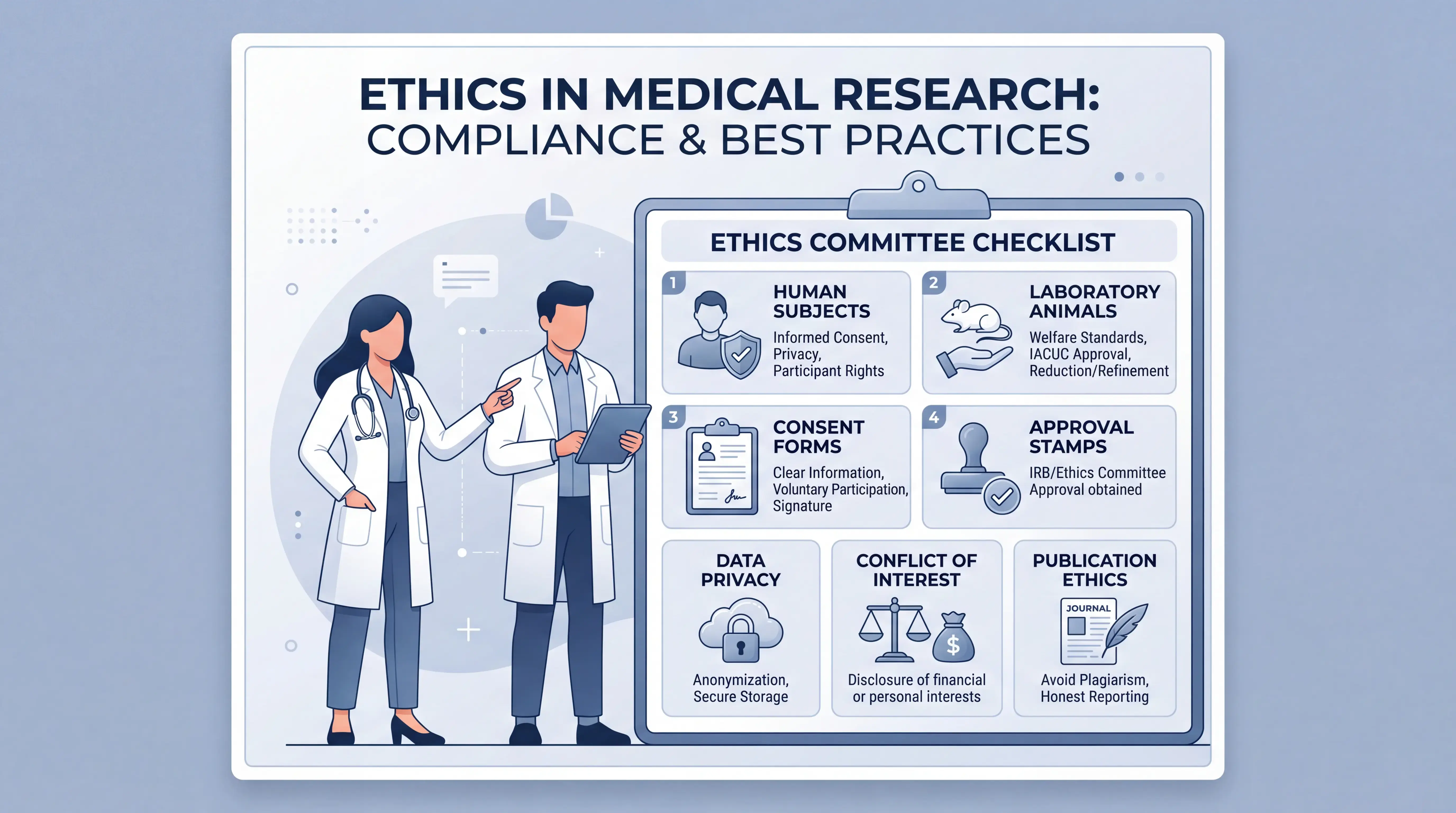
Most studies involving human participants require ethics committee approval before recruitment begins. This includes prospective trials, observational studies, chart reviews, imaging studies, and studies using human samples. In the source material, ethics review is described as a core step to protect participants’ rights, safety, and health.
Do not wait until submission to address ethics. Many journals ask for the ethics committee name, approval number, and a statement that the work follows the Declaration of Helsinki.
1.2 Retrospective studies still need review
A common mistake is assuming retrospective studies do not need approval because no new intervention is performed. That is not correct. Retrospective studies based on hospital records still need ethics review. In many cases, informed consent may be waived, but this must be approved by the ethics committee and stated clearly in the manuscript.
1.3 Animal studies also require approval
Animal experiments also need formal ethics review. Institutions usually have an animal ethics committee that reviews protocols before any experiment begins. The purpose is to prevent unnecessary animal use and ensure humane treatment, proper oversight, and justified study design.
2. Apply Before the Study Starts
2.1 Submit early
Ethics approval should be sought before the first participant is enrolled, before the first animal is used, and before data analysis begins. If you discover the issue only at the publication stage, some journals may not accept a retrospective approval.
A post hoc approval is not always enough. The safest route is to secure approval first, then start the study.
2.2 Prepare a complete protocol
A strong application usually includes:
- Study title and objectives
- Study design and methods
- Inclusion and exclusion criteria
- Risk and benefit assessment
- Consent process
- Data protection plan
- Adverse event monitoring
- For animal studies, welfare measures and humane endpoints
Ethics committees are not only checking paperwork. They are evaluating whether the study is scientifically sound and ethically justified.
2.3 Multicenter studies need local handling
If a study involves multiple sites, the lead center and participating sites may each need ethics submission. The exact process varies by institution. The lead institution may receive faster review, while participating institutions may use备案 or local record filing. However, site-specific documents, such as consent forms and case report forms, should match each local study context.
3. What Ethics Committees Look For
3.1 Scientific validity
A study that is poorly designed and unlikely to produce useful knowledge is ethically weak. The source material makes this clear. If a project exposes people or animals to risk without a reasonable chance of generating valid knowledge, it fails both scientific and ethical review.
Committees often assess:
- Whether the hypothesis is clear
- Whether the design can answer the research question
- Whether the sample size is justified
- Whether the methods minimize avoidable harm
3.2 Risk and benefit balance
Ethical review focuses on whether the expected benefits justify the risks. In human research, this includes physical, psychological, social, and privacy risks. In animal research, it includes pain, distress, and unnecessary use.
The lower the direct benefit, the stronger the justification must be. This principle is especially important in early-stage or exploratory studies.
3.3 Consent and fairness
For human research, informed consent is central. Participants must understand the purpose, procedures, risks, and impact on their rights. Recruitment must also be fair. Vulnerable groups, including children, pregnant women, prisoners, and people with mental illness, need special protection.
The source material also notes that placebo use and participant selection must be ethically justified. If proven effective treatment exists, researchers should not withhold it without strong scientific reason and ethical review.
4. How to Handle Common Ethics Scenarios
4.1 Human tissue and sample studies
If your study uses human specimens, the ethics statement usually needs the committee name, approval number, and a declaration of compliance with the Declaration of Helsinki. Written informed consent is generally required unless waived by the board.
A typical statement may include:
- Committee name
- Approval number
- Helsinki compliance
- Informed consent status
4.2 Retrospective chart reviews
For retrospective hospital data, ethics approval is still required. Informed consent may be waived when the committee agrees that the study poses minimal risk and uses existing records. If your institution approves an opt-out process, that should be stated clearly.
4.3 Case reports
Case reports are not exempt from ethics concerns. They usually require ethics review, and patient consent for publication is normally needed. This matters because the patient may be identifiable even if the name is removed.
4.4 Animal experiments
Animal ethics applications should explain why animals are necessary, why the species was chosen, how pain will be reduced, and what humane endpoints will be used. The review board wants to see necessity, refinement, and responsible oversight.
5. What to Do If You Only Have an Approval Letter
5.1 An approval letter may not be enough
Sometimes researchers have an ethics approval document but no approval number. Whether this is acceptable depends on the journal. Some journals may accept a formal approval letter if it clearly states the protocol, approval date, and committee decision. Others require a specific ethics approval number.
5.2 Contact the committee early
If the number is missing, contact the ethics committee and ask whether they can issue the number or a formal confirmation. If that is impossible, explain the situation honestly in the cover letter and provide all supporting documentation.
Transparency is better than silence. Editors value clear, accurate reporting.
5.3 Follow the target journal rules
Always check the author instructions before submission. Some journals are strict. Others allow limited flexibility if the ethics evidence is strong. The best strategy is to align your documents with the journal’s exact requirements.
6. Writing the Ethics Statement for Submission
6.1 Make it specific
A vague ethics sentence can cause avoidable revision requests. Your statement should identify the committee, approval number, consent status, and relevant ethical framework.
Examples from the source material include:
- Human sample studies with written informed consent
- Retrospective studies with consent waived
- Case reports with written patient consent
- Animal studies approved by the institutional animal ethics committee
6.2 Keep the language precise
A strong ethics statement should not overstate what happened. Use only facts you can support. If consent was waived, say so. If the study was retrospective, say so. If the board approved the protocol, include the approval number exactly as issued.
Precision reduces editorial friction. It also builds trust with reviewers.
7. How scifocus.ai Can Help You Move Faster
7.1 Reduce drafting and formatting errors
Many researchers lose time rewriting ethics statements, cover letters, and submission documents. scifocus.ai can help you organize manuscript sections, sharpen wording, and keep your ethics language consistent with journal expectations. That matters when you are balancing clinical work, lab work, and publication deadlines.
7.2 Support a cleaner submission workflow
For medical students, physicians, and researchers, the hardest part is often not the science. It is the administrative overload. scifocus.ai helps streamline the writing process so you can focus on protocol quality, document accuracy, and submission readiness.
If your study involves human or animal ethics approval, a structured writing workflow can reduce mistakes in the final essay, manuscript, and cover letter.
Conclusion
Ethics approval is not a formality. It is a required part of responsible human and animal research. Apply before the study starts, secure the right committee review, document consent properly, and write a precise ethics statement for submission. If your workflow feels slow or fragmented, consider using scifocus.ai to help you organize the essay, polish the manuscript, and prepare cleaner submission materials with less effort.
Did you like this article? Explore a few more related posts.
Start Your Research Journey With Scifocus Today
Create your free Scifocus account today and take your research to the next level. Experience the difference firsthand—your journey to academic excellence starts here.