

How to Evaluate the Credibility of a Source
Introduction
In medical writing, one weak essay source can damage an entire argument. For medical students, doctors, and researchers, the real challenge is not finding information. It is judging whether that information is trustworthy. How to evaluate the credibility of a source is a core skill in evidence-based work, because flawed sources can lead to weak conclusions, poor citation choices, and wasted time. The good news is that credibility can be assessed with a clear, repeatable method.
1. Start with the Source Type
1.1 Identify whether it is primary, secondary, or tertiary
Not all sources serve the same purpose. A primary source reports original data, such as a clinical trial or cohort study. A secondary source interprets evidence, such as a review article or meta-analysis. A tertiary source summarizes knowledge, such as textbooks or encyclopedias.
For a medical essay, primary and high-quality secondary sources usually carry more weight. They show the closest link to evidence. Tertiary sources are useful for orientation, but they should not be the final proof for a serious claim.
1.2 Match the source type to your question
A source can be credible and still be the wrong fit. If your topic is treatment effectiveness, systematic reviews and randomized controlled trials are usually stronger than opinion pieces. If your question is historical or conceptual, a narrative source may still be useful, but it should not replace evidence.
The best source is not the most popular one. It is the one that best answers the question with the least bias.
2. Check the Author and Institutional Affiliation
2.1 Look for expertise and accountability
Author credentials matter. In medicine, relevant degrees, clinical appointments, research roles, and publication history can signal expertise. A source written by a specialist in the field is usually more credible than one written by an anonymous contributor.
Also check whether the author is identifiable. A credible source should clearly name its author and, ideally, provide an institutional affiliation. If you cannot verify who produced the material, treat it cautiously.
2.2 Confirm whether the organization has authority
Institutional reputation matters too. Peer-reviewed journals, universities, hospitals, and recognized research bodies generally apply stronger editorial standards than personal blogs or commercial pages. That does not automatically make every institutional source correct, but it does improve trust.
For a medical essay, ask one simple question. Would you trust this source enough to cite it in a journal club, ward presentation, or thesis defense? If the answer is no, keep looking.
3. Evaluate Evidence Quality, Not Just Claims
3.1 Ask what data supports the statement
A credible source does not rely on vague language. It cites data, methods, and references. In clinical contexts, look for sample size, study design, outcomes, and statistical testing. A claim without evidence is just an assertion.
For example, a statement about treatment benefit should ideally show how many participants were studied, what comparator was used, and whether the results were statistically and clinically meaningful. Strong sources explain how they know what they know.
3.2 Prefer transparent methods
Methodology is one of the clearest signs of credibility. In research papers, look for the study design, inclusion criteria, exclusion criteria, endpoints, and limitations. In systematic reviews, check whether the authors describe search strategies and selection criteria.
If methods are hidden or poorly described, the source becomes harder to trust. Transparency is a major feature of credible academic writing, especially in medicine where decisions can affect patient care.
4. Inspect Publication Quality
4.1 Check whether the journal is peer-reviewed
Peer review is not perfect, but it remains a useful filter. A peer-reviewed journal has usually undergone editorial scrutiny before publication. That process helps reduce obvious errors, unsupported claims, and methodological flaws.
For a medical essay, use journal quality as part of your judgment. One useful indicator is CiteScore. It is calculated from citations received in a three-year period divided by the number of documents published in that same period. In simple terms, it estimates average citation impact. A journal that publishes 100 articles and receives 300 citations over the measured period has a CiteScore of 3.
4.2 Use multiple journal metrics
No single metric tells the whole story. Impact Factor, CiteScore, h-index, SJR, and field-specific rankings each measure something slightly different. That is why researchers should avoid relying on one number alone.
A higher metric may suggest broader influence, but it does not guarantee better science. Always combine metrics with content review. A journal’s reputation is helpful, but the actual article still needs to be read critically.
5. Look for Bias, Conflict of Interest, and Sponsorship
5.1 Identify funding and author disclosures
A source can be technically well written and still be biased. Check whether the authors disclose funding sources, consultant roles, or industry ties. In medicine, this matters because sponsorship can shape study design, interpretation, and reporting.
This does not mean funded studies are automatically unreliable. It means readers should be aware of possible incentives. A transparent disclosure section is a positive sign. Missing disclosure is a warning sign.
5.2 Watch for persuasive language
Credible academic writing is careful. It avoids overstatement. Be cautious when you see words like “proven,” “miracle,” or “guaranteed” without strong evidence. These terms often signal marketing rather than scholarship.
For a medical essay, neutral language is a good test of credibility. Reliable authors usually report results with limitations, not absolute certainty.
6. Examine Currency and Relevance
6.1 Check the publication date
In fast-moving fields such as oncology, infectious disease, and digital health, older sources may no longer reflect current practice. Guidelines, drug approvals, and evidence standards change. A source from ten years ago may still be useful for background, but it may not support current clinical decisions.
That said, age alone does not make a source weak. Classic studies and landmark reviews can remain important. The key is whether the source is still relevant to the question you are asking.
6.2 Compare with current evidence
One source should never stand alone. Cross-check major claims against recent guidelines, systematic reviews, or multiple independent studies. If a source makes a strong claim that no other reputable source supports, be skeptical.
Credibility improves when the source fits the broader evidence base. When it conflicts with current consensus, the burden of proof becomes much higher.
7. Apply a Simple Credibility Checklist
7.1 Use a repeatable method
A practical way to evaluate credibility is to ask these questions every time:
- Who wrote it.
- Where was it published.
- What evidence is provided.
- Is the method transparent.
- Are there conflicts of interest.
- Is it current.
- Do other reputable sources agree.
This checklist works well for literature screening and for building a defensible essay argument. It reduces guesswork and makes source selection more systematic.
7.2 Score the source before you cite it
A fast internal scoring system can save time. For example, assign one point for clear authorship, one for peer-reviewed publication, one for strong evidence, one for transparency, one for relevant currency, and one for low bias risk. Sources with low total scores should be excluded or used only with caution.
This kind of structured review is especially useful when you are handling many references under deadline. It helps you focus on quality, not volume.
8. Use AI Tools to Support, Not Replace, Judgment
8.1 Reduce manual screening time
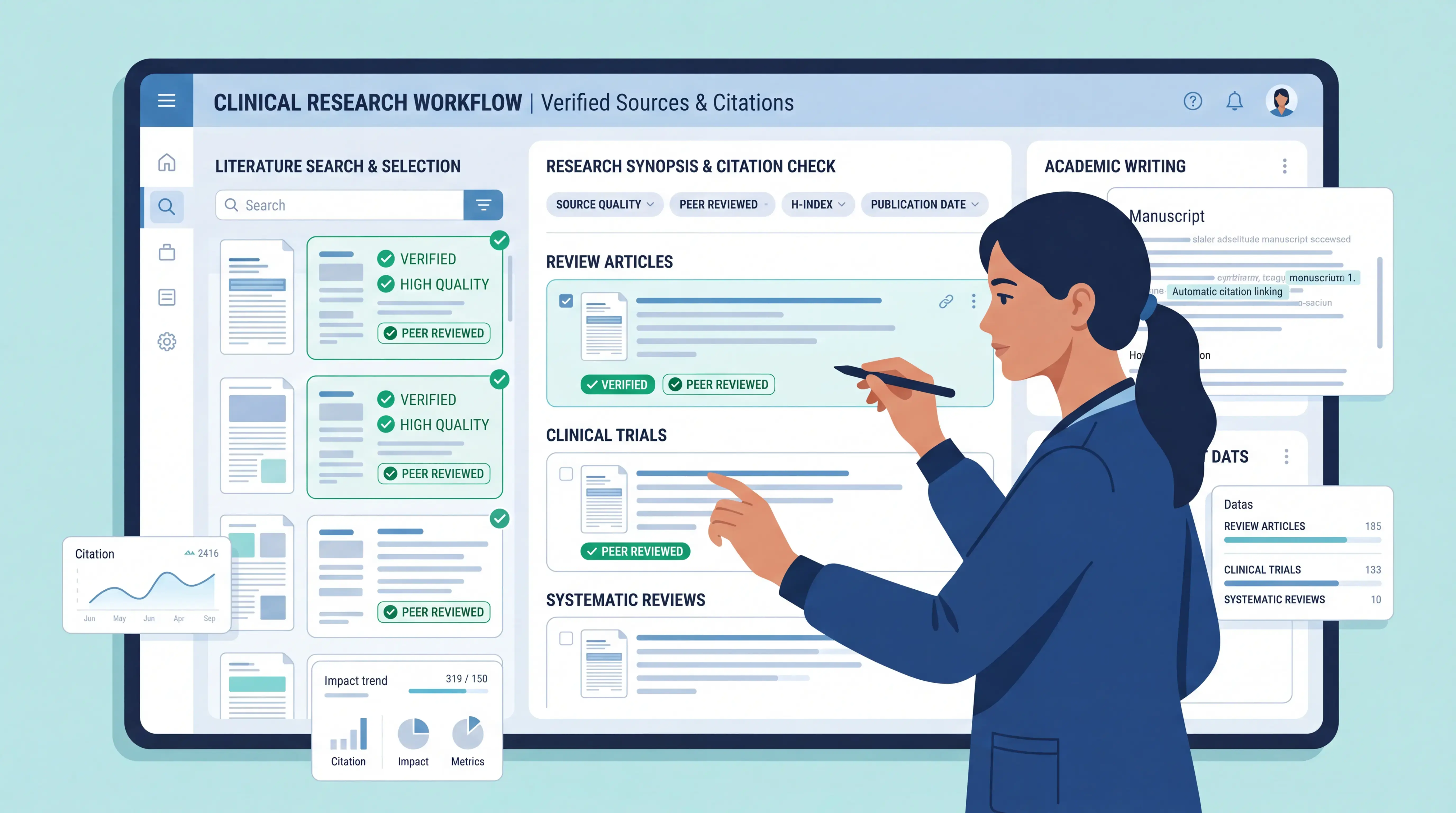
Medical professionals often need to review dozens of sources in a short time. That is where a structured research assistant can help. scifocus.ai can support source screening, literature organization, and faster evidence review so you spend less time sorting and more time thinking.
Instead of starting from a blank page, you can use the tool to organize papers, compare relevance, and surface stronger references for your essay or manuscript.
8.2 Keep human verification in the loop
AI can speed up the process, but it should not replace expert judgment. You still need to verify journal quality, study design, and conclusions. The best workflow combines automation with critical reading.
Use scifocus.ai to streamline the search, then apply professional judgment to confirm credibility. That is the safest and most efficient way to build a strong academic argument.
Conclusion
Learning how to evaluate the credibility of a source is essential for anyone writing in medicine or research. The process is straightforward when you break it into parts: identify the source type, verify the author, assess evidence quality, review publication standards, check for bias, and compare with current literature. A strong essay depends on sources that are transparent, relevant, and methodologically sound. If you want to work faster without sacrificing rigor, try scifocus.ai to organize and screen your sources more efficiently.
Did you like this article? Explore a few more related posts.
Start Your Research Journey With Scifocus Today
Create your free Scifocus account today and take your research to the next level. Experience the difference firsthand—your journey to academic excellence starts here.