

How to Efficiently Conduct Literature Review and Critical Analysis in Biomedical Essay Writing?
Introduction
Avoiding academic misconduct is not only about citation rules. It is about building a trustworthy argument. In biomedical essay writing, many students and researchers struggle with how to review literature efficiently without copying, losing structure, or missing key evidence. This is especially true when the topic is complex and the evidence base is large. To avoid academic misconduct, you need a clear review strategy, critical reading habits, and disciplined source management.

1. Start with the Right Review Scope
1.1 Define a focused topic
A strong biomedical essay starts with a focused review question. If the topic is too broad, the writing becomes vague. If it is too narrow, the essay lacks depth. The best approach is to choose a question that is connected to your training, research direction, or clinical interest.
A useful rule is to ask three questions before collecting papers:
- Is the topic important in current biomedical practice or research?
- Is there enough literature to support a balanced discussion?
- Can the topic be framed within a specific disease, pathway, method, or clinical issue?
A well-scoped topic makes it easier to avoid academic misconduct because you are less likely to rely on shallow paraphrasing or unstructured copying.
1.2 State the purpose early
In biomedical essays, the introduction should briefly explain why the topic matters. For clinical reviews, this may include epidemiology, disease classification, or key clinical terminology. For basic science reviews, you can explain the historical development and important milestones.
The last sentence of the introduction should clearly state the purpose of the review. This keeps the writing focused and signals to the reader what will be covered. A short purpose statement also improves logic and helps you stay aligned with the outline.
2. Collect Literature from Reliable Databases
2.1 Use the right databases
Efficient literature review depends on choosing reliable databases. In biomedical writing, the most common tools include PubMed, Scopus, and Web of Science. PubMed is a core database for biomedical research. Scopus is useful for citation tracking and broad journal coverage. Web of Science is valuable because it complements Scopus in coverage. For European and non-English publications, Excerpta can be relevant.
Using multiple databases reduces bias and strengthens the credibility of your essay. It also helps you avoid incomplete evidence selection, which can weaken both academic quality and originality.
2.2 Record search boundaries
For literature reviews, the time range and topic range should be clear. This is especially important for systematic reviews and meta-analyses, where the search strategy must be transparent. In these formats, the method of collecting literature is part of the scientific value of the paper.
A practical search record should include:
- Database name
- Search terms
- Date of search
- Inclusion and exclusion criteria
- Publication time window
- Language restrictions, if any
This documentation helps you stay organized and makes later writing easier. It also supports traceability, which is important when you need to defend your source selection.
2.3 Balance classic and recent studies
A strong biomedical essay should include both landmark studies and recent findings. Classic papers explain how a field developed. Recent papers show where the field is going. If you only cite old literature, the review looks outdated. If you only cite new studies, the background may be unstable.
A balanced source pool usually improves the essay’s academic depth. It also prevents overreliance on a few popular papers, which can lead to poor synthesis.
3. Reorganize Sources Before You Write
3.1 Group studies by argument
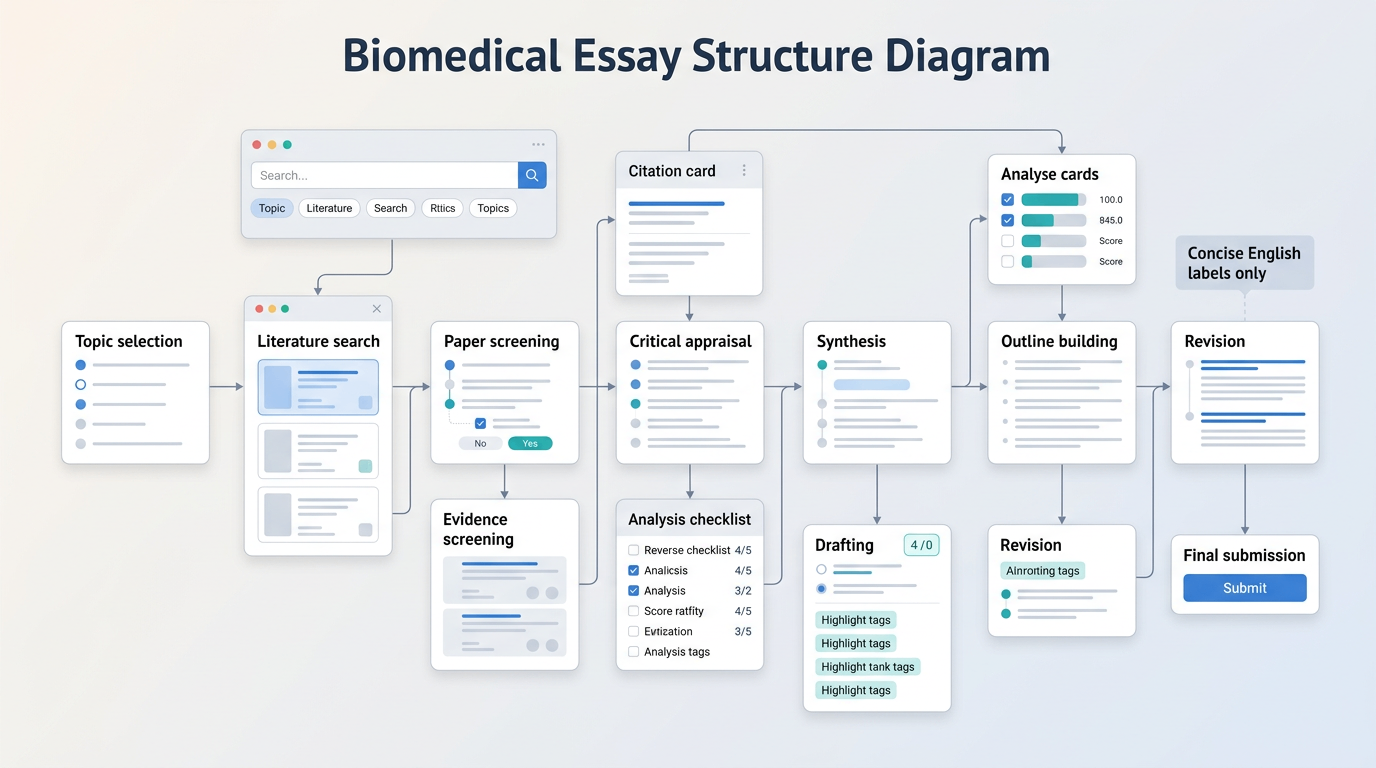
After collecting papers, do not start writing immediately. First, reorganize the literature according to your outline. Put studies with similar findings together. Group papers by mechanism, clinical subtype, intervention, or methodological approach.
This step changes literature collection into literature synthesis. Instead of repeating individual studies one by one, you begin to build a structured argument.
For example, if your essay is about drug resistance, you might group the literature into:
- Transporter-based resistance
- Mutation-based resistance
- Microenvironment-related resistance
This method improves clarity and makes the essay easier to follow.
3.2 Turn notes into synthesis
A literature review is not a list of references. It is an explanation of what the literature means. That means you should rewrite key findings in your own words, then connect them logically.
A good synthesis sentence often does three things:
- Identifies the shared result.
- Explains the significance.
- Connects the result to your review question.
This is one of the most effective ways to avoid academic misconduct. You are not copying the source language. You are transforming evidence into analysis.
3.3 Use a reference manager
Reference management software such as EndNote can save time and reduce errors. It helps with citation formatting, duplicate removal, and source organization. When used well, it also lowers the risk of accidental plagiarism caused by poor note-taking.
If you work with many biomedical sources, keep folders for different themes or sections. This makes it easier to retrieve citations when drafting and revising.
4. Apply Critical Analysis, Not Summary
4.1 Ask the right critical questions
Critical analysis means evaluating the literature, not just repeating it. For biomedical essay writing, the main questions are practical and precise:
- What are the strengths and weaknesses of this study?
- Is the methodology appropriate?
- Are the sample size and controls adequate?
- Can the conclusion be generalized?
- Under what conditions does the conclusion hold?
A review becomes more persuasive when it explains not only what was found, but also how reliable the finding is.
4.2 Assess methods and validity
Many essays fail because they describe outcomes without checking methods. In biomedical research, method quality changes interpretation. A result from a small, uncontrolled study should not be treated the same as a multicenter study with stronger design.
When reviewing evidence, pay attention to:
- Study design
- Population characteristics
- Experimental controls
- Statistical methods
- Outcome measures
- Limitations reported by the authors
This level of analysis helps you identify whether a paper is broadly applicable or only valid in a specific setting.
4.3 Compare studies instead of repeating them
Critical writing requires comparison. If two studies reach different conclusions, do not avoid the conflict. Explain why the difference may exist. It may be related to sample selection, disease stage, assay platform, or follow-up length.
This approach shows maturity in biomedical writing. It also prevents simplistic quoting, which can look like unprocessed source-based writing.
5. Build a Clear Structure for the Essay
5.1 Use a logical flow
A high-quality biomedical essay usually moves from broad to narrow. Start with the clinical or biological significance. Then introduce the main subtopics. Finally, evaluate the evidence and state the gaps.
A useful structure is:
- Why the topic matters
- What the literature shows
- Where the evidence is weak
- What future research should address
This structure is efficient and readable. It also helps the writer stay disciplined and avoid unnecessary repetition.
5.2 Keep paragraphs focused
Each paragraph should address one idea. Use short sentences. Avoid long blocks of text. A clear paragraph should contain:
- One main point
- One or two supporting studies
- One critical comment
- One transition to the next point
Focused paragraphs improve readability and make your argument easier to verify. That matters for both academic integrity and reader trust.
5.3 Use cautious academic language
Biomedical writing should be precise. Avoid absolute claims unless the evidence is strong. Words like “may,” “suggest,” “indicate,” and “is associated with” are often more accurate than sweeping statements.
This is important for two reasons. First, it reflects scientific caution. Second, it helps you avoid overstating conclusions from limited studies.
6. Reduce the Risk of Academic Misconduct
6.1 Paraphrase with understanding
Avoiding academic misconduct begins with understanding, not rewriting. If you do not understand a paper, you are more likely to copy its structure or vocabulary. Read the paper, extract the point, then rewrite the idea from memory using your own logic.
A safe workflow is:
- Read the source carefully.
- Close the source.
- Write the idea in your own words.
- Check accuracy against the original.
- Add the citation immediately.
This process is simple and effective.
6.2 Keep source notes separate from draft text
One common cause of accidental plagiarism is mixing notes and draft language. To avoid this, label your notes clearly. Mark direct quotations if you truly need them. Otherwise, store only paraphrased ideas and your own comments.
This habit makes revision safer and faster. It also protects you when moving between multiple papers and draft versions.
6.3 Use AI-assisted writing carefully
Tools like scifocus.ai can support biomedical essay writing by helping organize literature, structure outlines, and improve drafting efficiency. Used properly, such tools can reduce time spent on formatting and repetitive synthesis tasks.
But they should not replace judgment. The final responsibility for accurate citation, critical interpretation, and originality always belongs to the writer. The best use of AI is as a support tool for planning, organizing, and checking, not as a shortcut for thinking.
Conclusion
Efficient literature review and critical analysis in biomedical essay writing require a clear scope, reliable databases, structured synthesis, and disciplined evaluation. The goal is not to collect more papers. The goal is to build a sharper argument from better evidence. If you want to avoid academic misconduct, focus on understanding, rewriting in your own words, and citing every source correctly. For faster and more organized writing, consider using scifocus.ai to streamline literature management and outline development while keeping full control over your academic judgment.
Did you like this article? Explore a few more related posts.
Start Your Research Journey With Scifocus Today
Create your free Scifocus account today and take your research to the next level. Experience the difference firsthand—your journey to academic excellence starts here.