
Introduction
A strong essay on research practice starts with one idea: results must be reproducible. In medicine, that means another clinician, student, or researcher should be able to repeat your workflow and reach the same conclusion. Yet many projects fail because methods are incomplete, records are inconsistent, or key parameters are missing. A reproducible research workflow is not only a writing issue. It is a scientific quality issue.
1. Why reproducibility should shape every research workflow
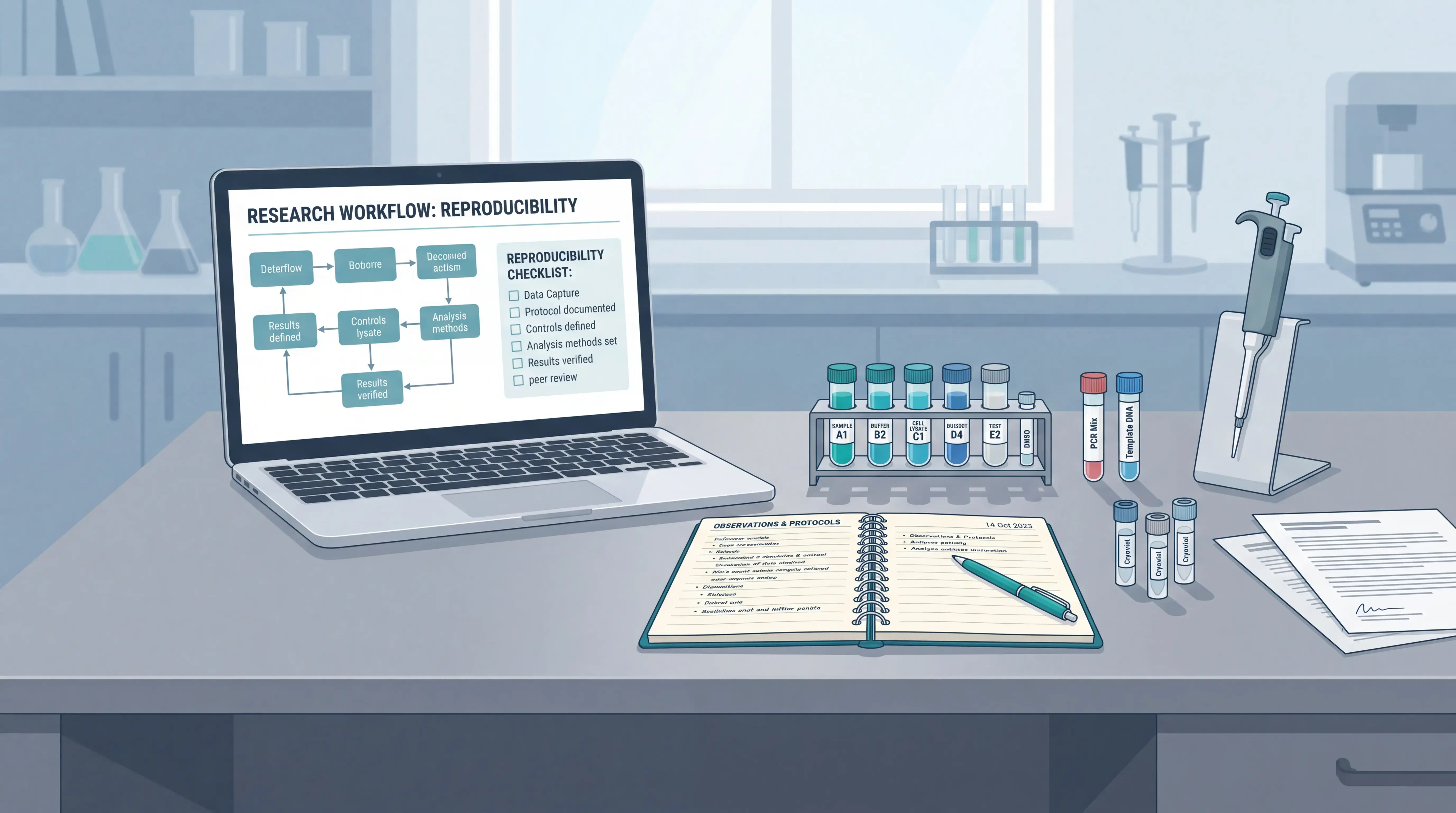
Reproducibility is the foundation of scientific trust. In biomedical research, the Materials and Methods section exists to show whether the study can be repeated. The goal is not to sound impressive. The goal is to make the work verifiable.
For medical students, physicians, and researchers, this matters at every stage. If a protocol cannot be repeated, the findings become difficult to evaluate. A clear research workflow reduces errors, improves peer review, and protects the credibility of the study.
A good workflow also improves internal consistency. It helps you decide what to record, how to name samples, how to report reagents, and how to organize experiments in the same order they were performed. That is why reproducibility starts long before the final essay is written.
1.1 What reproducibility really means in practice
A reproducible workflow gives enough detail for another person to repeat the study without guessing. That includes the sample source, inclusion and exclusion criteria, equipment, software version, reagent supplier, and data analysis method.
It also means reporting failures and exclusions honestly. Do not record only successful runs. Do not hide repeated experiments that gave different outcomes. A reliable workflow reflects the full process, not just the final positive result.
1.2 Why many workflows fail
Most reproducibility problems come from missing details, not from complex science.
Common failures include:
- No clear record of instrument model or calibration
- Missing reagent lot numbers or supplier names
- Incomplete sample selection criteria
- Retrospective note-taking after the experiment
- Inconsistent terminology across sections
If the method cannot be repeated, the result cannot be fully trusted.
2. Build the workflow before you write the paper
A reproducible workflow begins with planning. Before writing, define the main research question and decide which experiments support it. If you are working on cell biology, molecular biology, pathology, or animal models, organize the sequence according to the actual experimental order.
This structure helps the reader understand how the study was built. It also helps you avoid mixing unrelated experiments in one section. For a scientific essay, the logic must be visible from the first paragraph to the last figure legend.
If the project includes outsourced experiments or complex analysis, use AI tools carefully to help map the workflow. They can help summarize the sequence of methods, identify missing reporting items, and suggest how to group related procedures. Tools like scifocus.ai can support this stage by helping researchers organize methods, improve clarity, and reduce writing friction.
2.1 Define the workflow in a reproducible order
The best workflow usually follows the order of the study itself.
A practical structure is:
- Sample collection and eligibility screening
- Experimental preparation and instrument setup
- Primary assays or interventions
- Data capture and quality control
- Statistical analysis
- Reporting and archiving
This order is not decorative. It mirrors how the study actually happened. That makes the method easier to audit and easier to replicate.
2.2 Decide what must be included
Not every detail needs to appear in the main text, but critical details must be documented somewhere.
At minimum, report:
- Study site and conditions
- Participant selection and exclusion criteria
- Animal ethics approval or informed consent, when relevant
- Reagent source and version
- Equipment model and calibration status
- Software and statistical methods
- Data processing rules and thresholds
Clear, precise, and consistent reporting is the standard.
3. Write methods so another expert can repeat them
The Methods section is not a summary. It is a replication guide. That is why the language should be factual, past tense, and specific. Do not write results here. Do not describe conclusions here. Describe only what was done.
For biomedical studies, detail matters. If you used a Western blot, report the target, antibody source, dilution, incubation time, and detection method. If you used qPCR, report primer sequences, reverse transcription conditions, and analysis software. If you used patient samples, explain selection criteria and exclusions.
A reproducible essay on methods should make the process transparent enough that a competent reader could repeat it.
3.1 Report methods in the order they were performed
Use the actual experimental order. Group related procedures together. This keeps the narrative logical and reduces confusion.
For example:
- Sample preparation
- Assay execution
- Image acquisition
- Quantification
- Statistical testing
This approach is especially useful for medical and life science papers, where several experiments may depend on each other. It also helps readers see how one result led to the next experiment.
3.2 Use the right level of detail
The method should be detailed enough to support replication, but not overloaded with irrelevant content.
Include:
- Exact concentrations, durations, and temperatures
- Instrument names and settings
- Brand names and catalog numbers when important
- Data exclusion rules
- Replicate strategy and sample size handling
Avoid vague phrasing such as “standard protocol” unless you also cite a validated reference. If a detail can change the outcome, it should be reported.
3.3 Keep terminology and formatting consistent
Consistency is part of reproducibility. Use the same name for the same concept throughout the paper. Keep capitalization, sample labels, and abbreviations stable.
This also applies to notes and lab records. Use durable ink. Record data on time. Do not rely on memory. Do not rewrite raw results after the fact. If a correction is needed, mark it clearly and document who made the change and when.
4. Strengthen the workflow with reliable recordkeeping
A reproducible workflow depends on reliable records. A lab notebook should contain full experimental information, not just a final outcome. A person who was not present should still be able to understand what happened.
That means recording:
- Protocol version
- Machine model
- Reagent lot or source
- Raw output files
- Failed attempts
- Data processing steps
Paper records are still valuable because they are harder to alter. Electronic files should be backed up regularly. Original data should be stored securely and transferred in a controlled way when projects change hands.
4.1 Do not treat edited data as raw data
Raw data should be the direct output from the machine or original observation. Avoid replacing it with a cleaned or interpreted version. If processing is necessary, document each step.
Also report how many repeats were performed and how any outliers were handled. If some replicates were excluded, explain the reason and the rule used. Selective recording weakens trust and damages reproducibility.
4.2 Calibrate before you generate data
Instrument quality matters. A workflow is not reproducible if the equipment is uncalibrated or maintained inconsistently. Report calibration when relevant, especially for clinical or lab instruments that affect measurement accuracy.
This is a simple rule with major impact. Reliable data come from reliable tools.
5. Use AI tools to support, not replace, scientific judgment
AI can be helpful when you are organizing a workflow or drafting an essay about your methods. It can help you identify missing details, structure the sequence of experiments, and turn scattered notes into a clearer outline.
For example, if you are working with complex data such as single-cell sequencing, AI can help you map the logic from sample integration to quality control, clustering, annotation, and downstream analysis. It can also help you check whether the method description matches the results section.
But AI should not invent facts. It should not replace actual protocol knowledge. Use it to accelerate organization, then verify every detail against the real study record. That is where tools like scifocus.ai can add value: by helping researchers structure scientific writing, improve clarity, and save time without sacrificing rigor.
5.1 A practical AI-assisted workflow
A safe workflow looks like this:
- Collect the real protocol and raw notes
- List the experiment sequence
- Identify missing reporting details
- Draft the method structure
- Verify every parameter manually
- Align the Methods and Results sections
This approach saves time while preserving scientific accuracy. It is especially useful for clinicians and young researchers who need to write efficiently without losing technical precision.
5.2 What AI should never do
AI should not:
- Create fake methods
- Guess reagent details
- Invent software versions
- Add unsupported conclusions
- Replace ethics documentation
The final responsibility always belongs to the author.
Conclusion
A reproducible research workflow is built on planning, detailed methods, consistent records, and honest reporting. It begins with the experiment, not the manuscript. It depends on clear parameters, raw data preservation, proper calibration, and transparent documentation. For medical students, physicians, and researchers, this is the difference between a paper that merely reads well and a study that can stand up to scrutiny.
If you want to write faster and more systematically, use tools that support scientific structure without weakening rigor. scifocus.ai can help you organize your workflow, refine your scientific writing, and turn complex research notes into a clearer, more reproducible manuscript.
Did you like this article? Explore a few more related posts.
Start Your Research Journey With Scifocus Today
Create your free Scifocus account today and take your research to the next level. Experience the difference firsthand—your journey to academic excellence starts here.