

How to Conduct a Systematic Review Using the PRISMA 2020 Guidelines
Introduction
A strong essay on systematic review methods must do more than summarize studies. It must show how evidence is selected, checked, and reported with transparency. That is exactly why the essay structure of a systematic review matters for medical students, physicians, and researchers. PRISMA 2020 gives you a clear reporting framework, reduces missing details, and improves trust in your review.
1. Understand What a Systematic Review Is
1.1 Why systematic reviews matter
A systematic review is a structured literature review method. It identifies, appraises, and synthesizes all relevant studies for a focused clinical question. In evidence-based medicine, it is one of the best sources of evidence because it reduces bias compared with narrative reviews.
Cochrane introduced the systematic review concept in the 1970s. Since then, it has become a core method in medicine. It helps clinicians compare interventions, diagnose uncertainty, and support patient care with reliable evidence.
A systematic review is not just a summary. It is a methodical process built on a predefined question, reproducible search, and transparent reporting.
1.2 Where PRISMA 2020 fits
PRISMA 2020 is a reporting guideline. It does not tell you how to judge the quality of evidence or run meta-analysis in detail. Instead, it helps you report the review clearly and completely.
Use PRISMA 2020 to improve:
- Title and abstract reporting
- Search strategy transparency
- Study selection documentation
- Data extraction clarity
- Results presentation
- Flow diagram reporting
For readers, this means your essay becomes easier to follow and easier to trust.
2. Define the Review Question Before You Search
2.1 Use PICOS to narrow the question
A systematic review starts with a precise question. In clinical research, PICOS is the standard framework:
- Population
- Intervention
- Comparator
- Outcomes
- Study design
For example, a review may ask whether one chemotherapy regimen is better than another for advanced non-small cell lung cancer. That is more useful than a broad topic like “cancer treatment.”
A clear question prevents scope creep and keeps the review focused.
2.2 Set inclusion and exclusion criteria
Before screening any study, define criteria in advance. This improves reproducibility and reduces selection bias. Common criteria include:
- Population age or disease stage
- Type of intervention or exposure
- Comparator group
- Eligible study designs
- Outcome measures
- Language or publication date, if justified
Be careful with restrictions. Unnecessary limits can exclude important evidence. If you decide to exclude certain studies, explain why in the methods.
3. Build a Reproducible Search Strategy
3.1 Search the right databases
A high-quality search should cover major databases relevant to your topic. In medical research, that often includes PubMed, Embase, Web of Science, and the Cochrane Library. You may also need trial registries and reference lists.
Search terms should combine controlled vocabulary and keywords. Use synonyms, spelling variants, and related concepts. For example, “myocardial infarction” and “heart attack” may retrieve different records.
A weak search strategy can undermine an otherwise well-written review.
3.2 Document everything clearly
PRISMA 2020 expects transparency. Report:
- Databases searched
- Search dates
- Full search strings
- Filters or limits used
- Additional sources searched
- Number of records retrieved
This step is critical for an academic essay because readers should be able to judge whether the search was comprehensive.
4. Screen Studies and Select the Final Set
4.1 Use a two-stage screening process
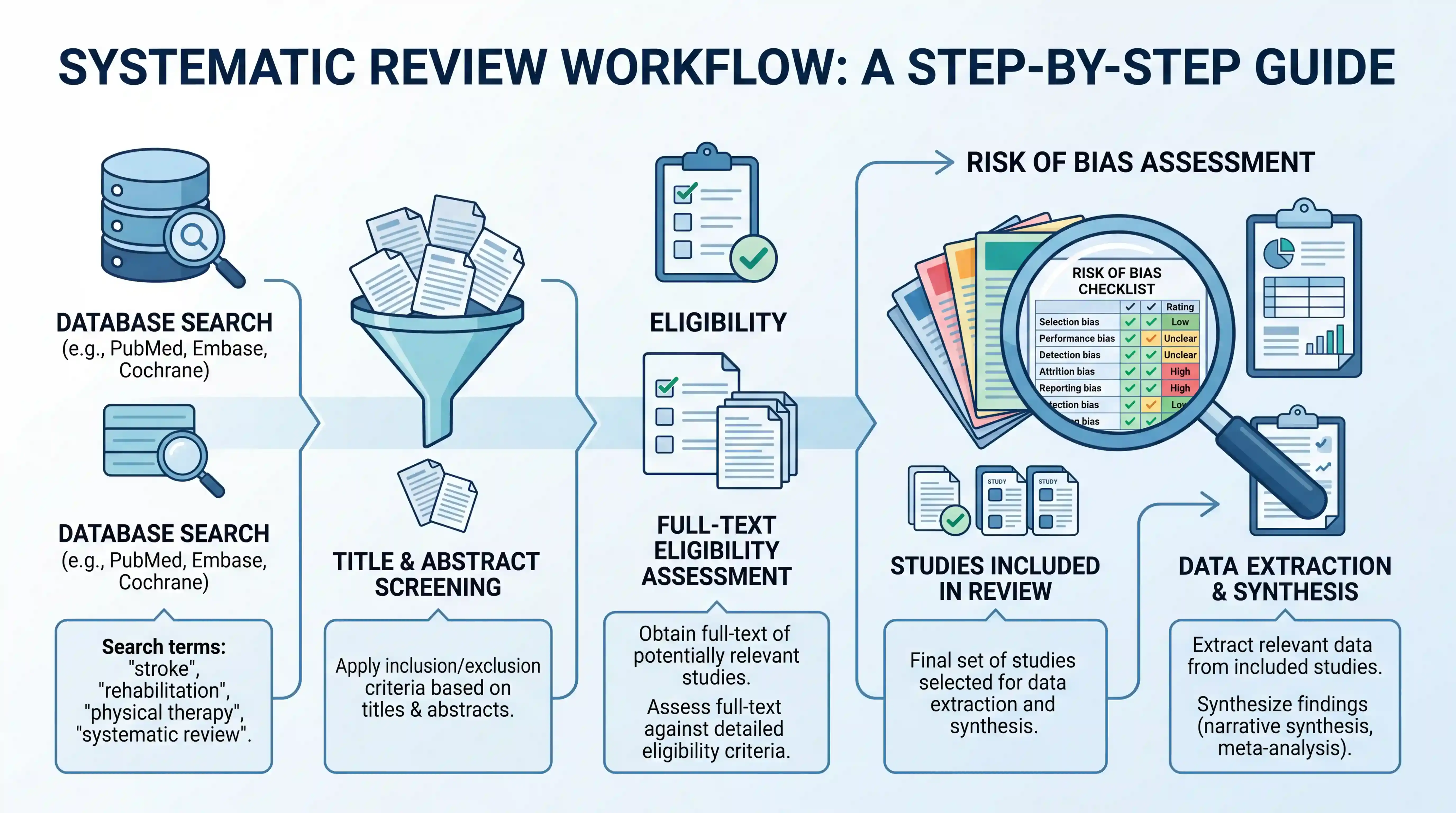
Screening usually has two phases:
- Title and abstract screening
- Full-text screening
At least two reviewers should screen independently whenever possible. Disagreements should be resolved by discussion or a third reviewer. This lowers the risk of missed studies and human error.
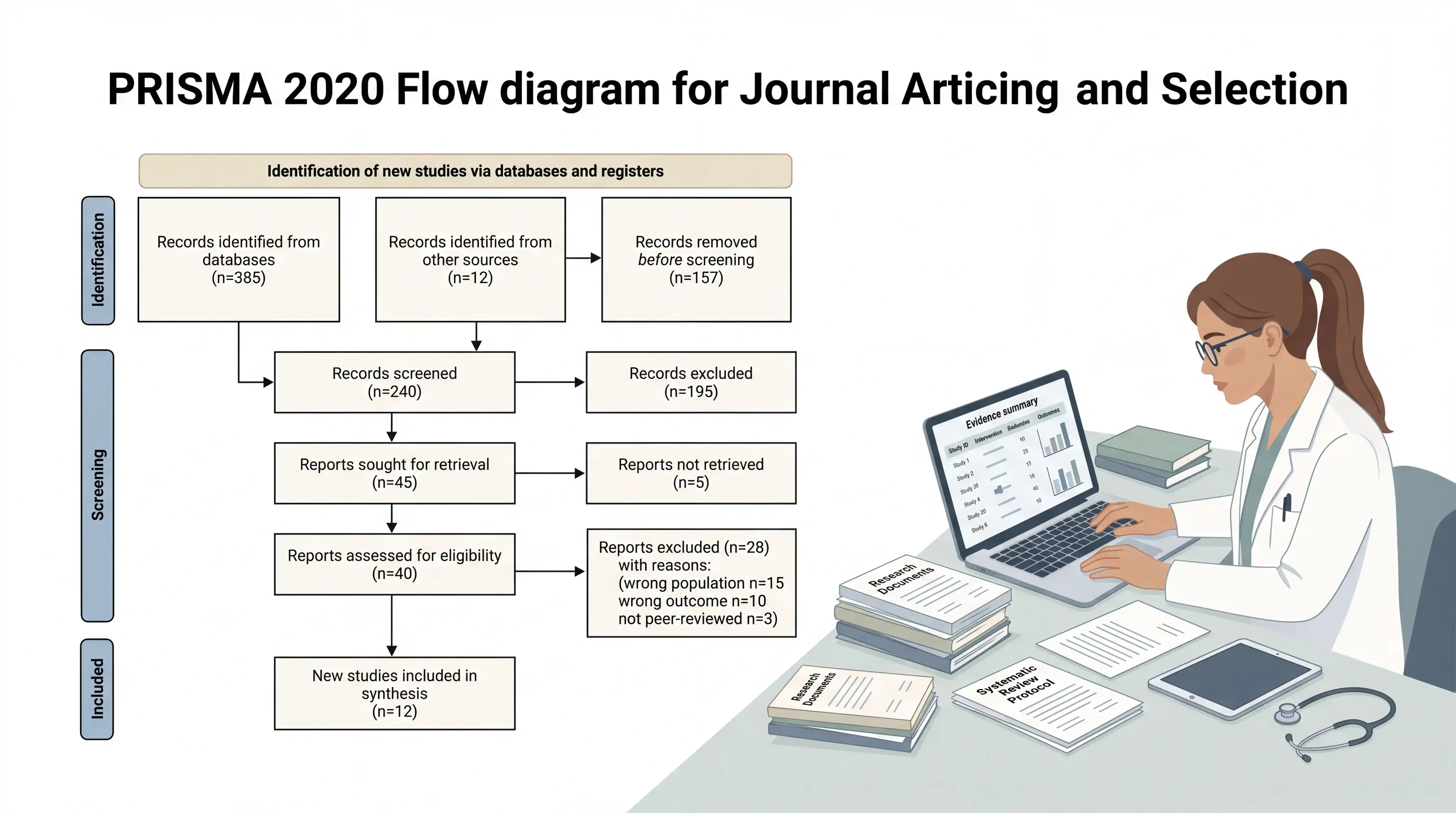
The PRISMA flow diagram is essential here. It shows how many records were identified, removed, excluded, and included. That visual record is one of the most important parts of the final report.
4.2 Keep a detailed exclusion log
At the full-text stage, record why studies were excluded. Common reasons include:
- Wrong population
- Wrong intervention
- No suitable comparator
- Wrong outcome
- Ineligible design
This is not just a formality. It is part of scientific accountability. Readers need to understand why studies did not qualify.
5. Extract Data and Assess Risk of Bias
5.1 Extract data in a structured way
Data extraction should be standardized. Build a table that includes:
- Study author and year
- Country and setting
- Sample size
- Participant characteristics
- Intervention details
- Comparator details
- Outcomes measured
- Follow-up duration
- Main results
If possible, use duplicate extraction. That reduces transcription errors and missing data.
Well-organized extraction is the bridge between study selection and meaningful synthesis.
5.2 Assess risk of bias appropriately
Risk of bias depends on study design. Randomized trials and observational studies need different tools. The key is to evaluate whether the study results may be distorted by flaws in design, conduct, or reporting.
Common domains include:
- Randomization
- Allocation concealment
- Blinding
- Missing data
- Selective reporting
- Confounding, for non-randomized studies
In your essay, do not just state that bias was assessed. Explain how it was assessed and how the results affected interpretation.
6. Synthesize the Evidence Correctly
6.1 Decide between narrative synthesis and meta-analysis
Not every review needs meta-analysis. If studies are too heterogeneous in design, population, intervention, or outcomes, a narrative synthesis may be more appropriate.
If the studies are sufficiently similar, meta-analysis can estimate pooled effects. That can improve precision, but only when the underlying studies are comparable enough to combine.
Important elements include:
- Effect size choice
- Fixed or random effects model
- Heterogeneity assessment
- Subgroup analysis
- Sensitivity analysis
- Publication bias assessment
Statistical pooling should strengthen the review, not force together incompatible studies.
6.2 Interpret results with caution
Results should be interpreted in context. A statistically significant finding is not always clinically important. Consider:
- Magnitude of effect
- Confidence intervals
- Study quality
- Consistency across studies
- Applicability to your target population
For clinicians and researchers, this is where the review becomes useful. It moves beyond numbers and into decision-making.
7. Write the Review According to PRISMA 2020
7.1 Report the core sections clearly
A PRISMA-compliant review should include:
- Title
- Abstract
- Introduction
- Methods
- Results
- Discussion
- Other information such as funding and conflicts
The abstract should briefly cover background, objectives, search methods, eligibility criteria, data collection, main results, and conclusions. The full text should expand each section in a logical sequence.
Clarity is a core part of scientific quality.
7.2 Include the PRISMA flow diagram and tables
The flow diagram is not optional in a well-reported review. It gives readers a fast summary of the selection process.
Useful tables include:
- Study characteristics
- Risk of bias summary
- Outcome synthesis
- Certainty or strength of evidence, if applicable
These tables make the essay easier to scan and review. They also improve journal readiness.
8. Common Practical Issues in Review Writing
8.1 Avoid incomplete methods reporting
Many reviews fail because the methods are too vague. Common problems include:
- Search strings not reported
- Screening process not defined
- Bias assessment not described
- Data synthesis unclear
These omissions reduce credibility. PRISMA 2020 helps prevent that.
8.2 Use the right tools to manage the workflow
For many medical researchers, software can simplify review writing and organization. Review Manager, for example, supports protocol and full review structures, study flow diagrams, references, and track changes.
If your workflow feels scattered, a platform like scifocus.ai can help organize the writing process, structure sections more efficiently, and support a cleaner evidence workflow. That matters when you need speed without sacrificing methodological rigor.
Conclusion
A systematic review requires more than reading papers. It demands a defined question, a reproducible search, careful screening, structured extraction, bias assessment, and transparent synthesis. PRISMA 2020 helps you report each step clearly so your review is credible, usable, and publishable. For medical students, doctors, and researchers, this framework turns a complex research task into a disciplined process. If you want to streamline that process and produce a stronger review faster, explore scifocus.ai as a practical support tool for research writing and organization.
Did you like this article? Explore a few more related posts.
Start Your Research Journey With Scifocus Today
Create your free Scifocus account today and take your research to the next level. Experience the difference firsthand—your journey to academic excellence starts here.