

Fast or Deep? How to Choose Between Two Paper Polishing Modes, with Use Cases
Introduction
Paper polishing is not a single service. For medical students, doctors, and researchers, the real question is often whether your manuscript needs a quick language cleanup or a deep structural refinement. Choosing the wrong mode wastes time, money, and submission opportunities. Choosing the right one can improve clarity, strengthen professionalism, and make your paper easier to review. This article explains the two common modes of paper polishing and shows you how to choose based on your actual submission stage and goals.
1. What Paper Polishing Really Does
1.1 It improves readability and precision
Paper polishing is not just grammar correction. It improves sentence flow, word choice, paragraph logic, and overall readability. In academic writing, especially in medicine and research, readers expect precise language. A polished manuscript helps them understand your method, result, and conclusion faster.
A well-polished paper reduces friction for reviewers. That matters because reviewers often decide within minutes whether the writing is clear enough to evaluate the science fairly.
1.2 It strengthens professionalism and trust
A manuscript with awkward phrasing, inconsistent tense, or frequent punctuation errors can create a weak first impression. This is especially costly in clinical and scientific fields, where accuracy signals credibility.
Paper polishing also helps align the manuscript with formal academic conventions. That includes terminology consistency, logical transitions, and a more disciplined tone. For authors pursuing journal submission, paper-polishing is part of building trust before the science is even judged.**
1.3 It supports clearer communication
Good writing does not only impress editors. It also helps your message travel across disciplines and language backgrounds. This is useful for research teams, hospital departments, and international collaboration.
A clearer manuscript can also reduce back-and-forth during peer review. When the text is easier to follow, reviewers spend less time deciphering language and more time assessing content.
2. Fast Polishing: When Speed Matters Most
2.1 What fast polishing is
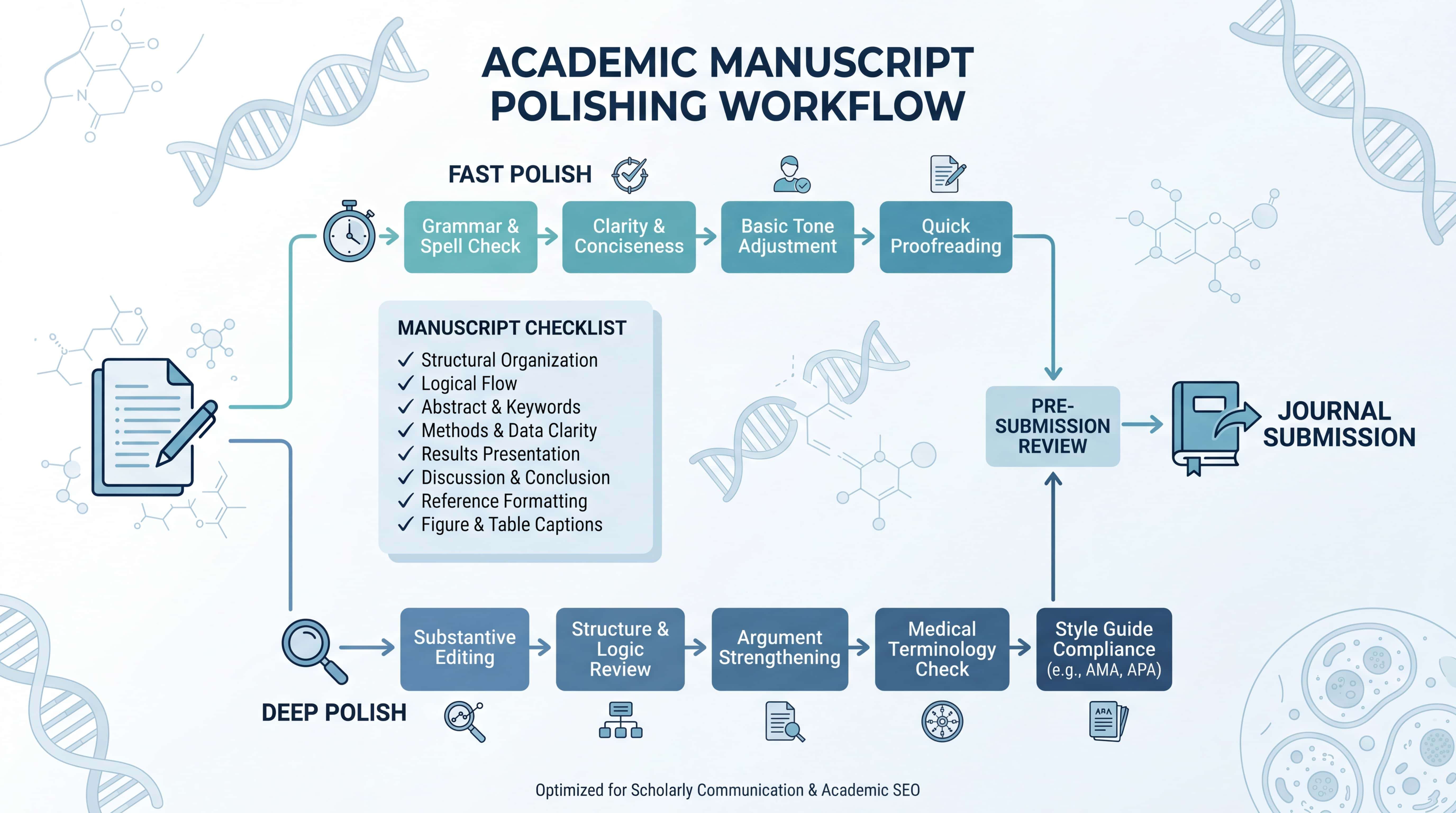
Fast polishing focuses on surface-level improvement. It usually targets grammar, spelling, punctuation, awkward phrases, and obvious sentence errors. The goal is to make the manuscript readable quickly without changing the core structure or argument.
This mode is useful when your draft is already logically sound. If your introduction, methods, results, and discussion are in place, a fast pass can remove language noise and improve submission readiness.
2.2 Best use cases for fast polishing
Fast polishing fits situations where time is limited and the manuscript is already mature. Common examples include:
- Conference abstracts
- Clinical case reports near deadline
- Manuscripts that were drafted in your second language and only need light language correction
- Resubmissions after minor reviewer comments
- Internal reports or department submissions
If your main problem is language, not logic, fast polishing is usually enough.
2.3 Limits of the fast mode
Fast polishing cannot rescue a weak structure. If your argument jumps between sections, your conclusion does not match your data, or your discussion lacks a clear logic chain, surface editing alone will not solve the problem.
This is the key risk. Many authors ask for paper polishing when what they actually need is rewriting, restructuring, or section-level clarification. In that case, fast editing may create smoother sentences, but the paper still feels incomplete.
3. Deep Polishing: When the Manuscript Needs More Than Grammar
3.1 What deep polishing includes
Deep polishing goes beyond sentence correction. It may improve paragraph logic, refine the flow between sections, standardize terminology, and help sharpen the expression of key findings. In some cases, it also involves reorganizing content to make the paper more coherent.
For medical and research writing, this matters because journals look for both clarity and consistency. A deep pass helps the manuscript read like a complete academic argument rather than a collection of isolated paragraphs.
3.2 Best use cases for deep polishing
Deep polishing is a better choice when the draft is promising but not yet submission-ready. It is especially useful in these scenarios:
- First-draft manuscripts
- Articles written by non-native English speakers with structural issues
- Papers with unclear transitions between sections
- Discussion sections that repeat results but do not explain significance
- Multi-author manuscripts with inconsistent style or tone
If your paper contains strong data but weak expression, deep paper polishing can make the difference between rejection for readability and a fair scientific review.
3.3 Why deep polishing is worth the time
A poorly structured manuscript can obscure good research. This is common in medical writing, where methods, outcomes, and interpretation must be tightly connected. Deep polishing helps present the same data in a way that is easier to trust and easier to cite.
It also matters when the target journal is highly selective. Strong journals expect more than grammatical correctness. They expect a manuscript that is logically organized, technically consistent, and written in a style suitable for expert readers.
4. How to Choose the Right Mode
4.1 Use a simple decision framework
A practical way to choose is to assess three questions:
- Is the research logic already complete?
- Is the main problem language or structure?
- How close are you to submission?
If the answer to the first question is yes, and the other two suggest small fixes, fast polishing is likely enough. If the draft still needs clarity, reorganization, or stronger academic tone, deep polishing is the safer choice.
A good rule is simple: fix language when the structure works, and fix structure when the argument is weak.
4.2 Match the mode to your submission stage
Different stages call for different levels of paper polishing.
- Early draft: deep polishing
- Pre-submission final version: fast polishing or light deep polishing
- Resubmission after reviewer comments: depends on the comment type
- Deadline-driven abstract or short report: fast polishing
- High-stakes journal submission: deep polishing if the manuscript is not yet fully stable
This stage-based approach saves time. It also prevents over-editing a paper that only needs light cleanup, or under-editing a paper that still has major clarity issues.
4.3 Match the mode to the risk level
Not every paper carries the same cost of error. A poster abstract and a journal article do not require the same level of refinement. A thesis chapter, a grant-related paper, or a manuscript for a top-tier journal usually deserves deeper work because the consequences of weak writing are higher.
In practice, the more important the publication, the less you should rely on surface-level editing alone.
5. Common Mistakes Authors Make
5.1 Choosing speed too early
Many authors want fast polishing because they are under deadline. But if the manuscript is still unstable, speed becomes a false economy. You may submit faster, but you also increase the chance of revision requests or rejection.
This is especially common when the methods or discussion are still being revised. In those cases, language editing cannot replace intellectual revision.
5.2 Paying for deep polishing when the paper is already strong
The opposite mistake also happens. Some authors request deep polishing for a paper that only needs light cleanup. That can waste resources and create unnecessary changes in tone or style.
If the draft is already logically sound and only has minor language issues, a lighter paper polishing pass is often more efficient.
5.3 Ignoring consistency
Even well-polished papers can fail if terminology changes from one section to another. In medical and scientific writing, consistency is not cosmetic. It affects comprehension. Keep disease names, outcome terms, abbreviations, and statistical expressions aligned across the paper.
6. A Smarter Workflow for Medical and Research Writers
6.1 Start with structure, then language
Before polishing, check whether each section has a clear purpose. The introduction should frame the problem. The methods should be reproducible. The results should be factual. The discussion should interpret, not repeat.
Once the structure is stable, polishing becomes much more effective. Otherwise, you may edit sentences that later get deleted.
6.2 Use a two-step quality check
A practical workflow is:
- Step 1: internal self-check for logic, data accuracy, and section order
- Step 2: professional paper polishing for language, clarity, and academic tone
This sequence is efficient. It reduces wasted editing time and helps the final manuscript read smoothly from start to finish.
6.3 Use the right tool for the job
If you want a faster, more structured polishing workflow, tools like scifocus.ai can help streamline manuscript refinement. It is especially useful for authors who need clearer academic expression, faster revision cycles, and a more efficient way to move from draft to submission.
For busy medical students, doctors, and researchers, that combination matters. You save time. You reduce manual effort. And you keep the final focus on the quality of the science.
Conclusion
Choosing between fast and deep paper polishing is not about preference. It is about manuscript stage, submission risk, and the type of problem you need to solve. If your structure is already solid, fast polishing can prepare your paper for submission quickly. If your draft still needs clarity, flow, and academic consistency, deep polishing is the better investment. For authors who want to improve quality without slowing down their workflow, scifocus.ai offers a practical path forward. If you are preparing a manuscript now, choose the mode that matches your real need, then polish with precision.

Did you like this article? Explore a few more related posts.
Start Your Research Journey With Scifocus Today
Create your free Scifocus account today and take your research to the next level. Experience the difference firsthand—your journey to academic excellence starts here.