

How to Choose a Research Topic
Introduction
Choosing a research topic is often the hardest part of writing an essay or starting a clinical study. Many medical students, doctors, and researchers have ideas, but few ideas are specific, feasible, and worth publishing. The real problem is not a lack of topics. It is selecting one that is scientifically sound, useful in practice, and realistic to complete. This guide shows how to make that decision with a clear method.
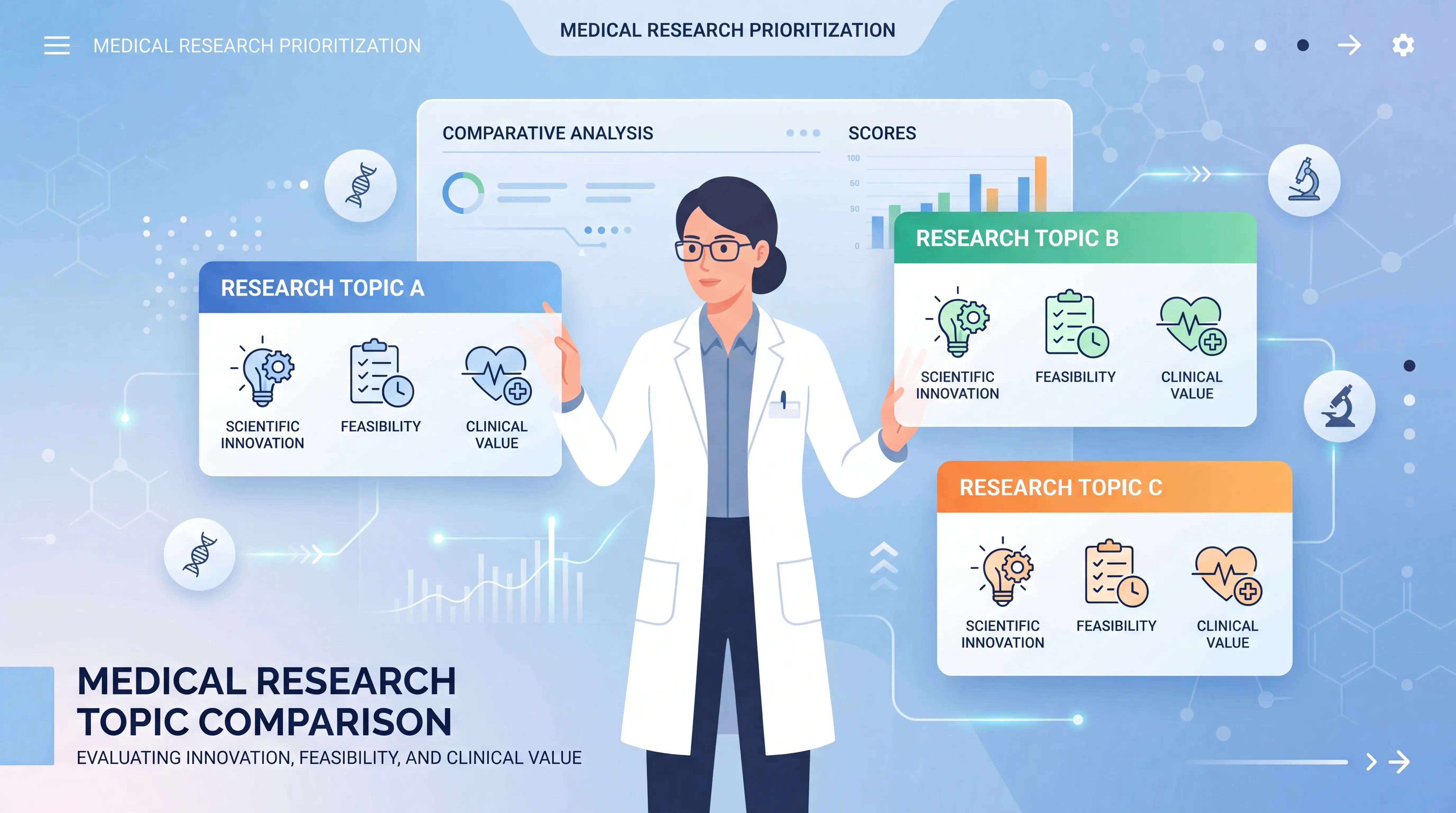
1. Start With the Four Core Principles
1.1 Scientific validity comes first
A good research topic must be scientifically valid. This means the question, design, and methods should make sense. The topic should not rely on pseudoscience or vague assumptions. In clinical research, scientific validity also includes correct study design, appropriate statistics, and reliable sample size planning.
If the design is weak, even a promising essay topic will fail.
For medical learners, this matters because a topic must be testable. A clear hypothesis is stronger than a broad idea. If you cannot explain how the question will be studied, the topic is not ready.
1.2 Innovation does not need to be huge
Many people think a research topic must be groundbreaking. That is not true. In medicine, small innovation is often enough. A study may only solve one narrow problem, but if the question is relevant and well designed, it still has value.
This is important for an essay as well. A topic does not need to change the whole field. It only needs to add a meaningful piece of evidence.
1.3 Practical value is essential
A clinically useful topic solves a real problem in practice. If the question does not help diagnosis, treatment, prognosis, or patient care, its value is limited. Clinical research is applied research. It should answer a real-world need.
For example, a topic about improving sputum clearance after lung cancer surgery is practical because it may reduce infection risk and shorten hospital stay. That is the kind of outcome clinicians care about.
1.4 Feasibility decides whether the study can be completed
A topic must fit your resources, time, and access to patients or data. A young doctor in one hospital may have enough cases for a single-center study, but not for a global multicenter project.
A topic that cannot be completed is not a good topic, no matter how impressive it sounds.
A feasible topic is specific enough to be executed. It matches your setting, available sample, and research experience.
2. Narrow the Topic Before You Commit
2.1 Avoid topics that are too broad
One common mistake is choosing a topic that is too large. For example, a study on all genes related to hypertension is far too broad for an individual researcher. Hypertension affects a large population, and the number of related genes is extensive.
A better approach is to narrow the scope step by step. For instance, a study on insulin receptor gene polymorphism and hypertension in a specific ethnic group is more manageable. It becomes a focused essay topic with a clear target population.
2.2 Study one clinical question type at a time
Clinical research usually falls into four categories. These are etiology, diagnosis, treatment, and prognosis. Do not mix all four into one project. If the topic asks whether a biomarker causes disease, diagnoses disease, and predicts outcome at the same time, the study becomes unclear.
One topic should answer one main question.
That rule improves clarity. It also makes writing the essay easier because the structure becomes simpler and the logic stronger.
2.3 Define the scope with a precise population
Specificity helps both research and writing. Instead of “patients with lung disease,” define the exact population. Instead of “hypertension,” identify a subgroup if possible. The more precise the topic, the easier it is to build a hypothesis, collect data, and write a focused paper.
A narrow topic also improves searchability. Readers and reviewers can immediately understand who the study is about and why it matters.
3. Build the Topic From Real Clinical Problems
3.1 Start from clinical practice
Many strong research topics come from daily practice. Doctors and medical students see repeated problems every day. These are often better sources than abstract brainstorming. If a problem appears often in practice, it is more likely to be worth studying.
For example, postoperative sputum clearance difficulty is a common issue in lung cancer patients and in many bedridden patients. It increases infection risk and may prolong hospitalization. That is a real clinical problem with direct relevance.
3.2 Turn an observation into a question
A clinical observation becomes useful only when it is transformed into a question. A question should be clear and testable. For instance, if video-based education and feedback improve patient behavior, the topic could ask whether this intervention improves postoperative sputum clearance.
This is a good model for building an essay topic too. Start with a problem, then define the intervention, comparison, and outcome. A topic that follows this pattern is easier to defend.
3.3 Use literature to refine the idea
Clinical intuition is only the beginning. After you notice a problem, review the literature. Look for what is already known, what remains controversial, and what is missing. A topic becomes stronger when it is based on evidence, not only on experience.
The more relevant literature you read, the more valuable your research topic becomes.
Literature review helps you avoid duplication. It also shows whether the question has enough evidence to support a new study.
4. Use a Stepwise Selection Process
4.1 Step one, generate a clinical idea
The process starts with an idea from practice, literature, or academic discussion. Most ideas are not useful, so do not stop here. Treat the idea as raw material.
4.2 Step two, link the idea to evidence
Next, compare your idea with existing studies. Ask whether the idea is already answered, still debated, or only partly explored. Evidence-based thinking is what turns a vague thought into a valid research direction.
4.3 Step three, form a hypothesis
A strong topic usually has a hypothesis. For example, if you observe that method A may work better than method B, the hypothesis is that A is superior. Literature may show mixed findings. That is normal. Your job is to define a testable claim.
4.4 Step four, run a pilot or pretest if needed
A small pretest can show whether the topic is workable. It may reveal problems in design, data collection, or measurement. If the pilot confirms feasibility, you can move forward with the formal project.
4.5 Step five, finalize the topic
Once the question, hypothesis, and feasibility are clear, finalize the title. A good title should be informative and concise. It should tell the reader about the population, intervention, comparison, outcome, and study design.
In clinical research, a strong title is not long. It is precise.
5. Apply PICOS to Make the Topic Stronger
5.1 Population
Who is being studied? Define the target group clearly. This may be patients with a specific disease, healthy volunteers, or a subgroup with a defined clinical feature.
5.2 Intervention
What is being tested or observed? This may be a drug, education program, device, or clinical strategy.
5.3 Comparison
What is the intervention compared with? A control group improves interpretability and strengthens the essay or paper.
5.4 Outcome
What result matters most? In medicine, outcomes may include efficacy, safety, survival, infection rate, symptom relief, or patient tolerance.
5.5 Study design
What type of study will you run? Examples include single-center, multicenter, randomized, open-label, placebo-controlled, or double-blind designs.
A topic that includes PICOS is easier to understand, easier to review, and easier to publish.
For example, a title should not just say “Health education and lung cancer surgery.” It should specify who, what, compared with what, and what outcome is measured.
6. Find Topic Ideas From the Right Sources
6.1 Literature
Literature is one of the best sources of ideas. Reading widely helps you see trends, gaps, and unresolved questions. Clinical researchers should read both clinical and relevant basic science papers.
6.2 Clinical experience
Daily work is another major source. Repeated clinical problems often point to meaningful topics. This is especially valuable for young doctors who already understand their patient population.
6.3 Research funding guidelines
Project guidelines can also guide topic selection. Funding calls often define priority areas such as key diagnosis and treatment projects, precision medicine, frontier technology, or young investigator projects. Choosing within these areas improves alignment with funding goals.
6.4 Academic meetings and cross-disciplinary exchange
Conferences and academic discussions can create new ideas. Cross-disciplinary communication is especially useful. A problem that seems difficult in one field may already have a solution in another.
Good research topics often come from the intersection of practice, literature, and opportunity.
7. How This Helps You Write a Better Essay
7.1 A better topic means a better structure
If your topic is clear, the essay writes itself more easily. You know what to include, what to exclude, and how to organize the argument. That reduces confusion and saves time.
7.2 A better topic improves argument quality
A focused topic supports a stronger thesis. It also makes the evidence easier to present. Instead of a broad overview, you can deliver a sharp, expert-level discussion.
7.3 A better topic improves productivity
Researchers lose time when the topic is too vague. They revise repeatedly, collect irrelevant data, and struggle with the title. A well-chosen topic avoids this waste.
For medical students, doctors, and researchers, this is where an AI research assistant can help. scifocus.ai can support topic refinement, literature exploration, and structured planning. It helps you move from a rough idea to a more precise, research-ready direction.
8. Final Checklist Before You Decide
8.1 Ask these five questions
Before you commit, check whether the topic is:
- Scientifically valid.
- Innovative enough.
- Clinically useful.
- Feasible with your resources.
- Specific and concise.
8.2 Reject topics that fail the test
If the topic is too broad, too theoretical, or too difficult to complete, do not force it. Return to the literature and clinical practice. Refining the topic is part of the process.
8.3 Keep the topic narrow and actionable
The best research topics are not the biggest. They are the most workable. They answer one important question well.
Conclusion
Choosing a research topic is the foundation of a strong essay and a successful clinical study. The best topics follow four principles: scientific validity, innovation, practical value, and feasibility. They are narrow, specific, and built from real clinical problems. They also fit PICOS and can be completed with available resources. If you want to save time and improve topic quality, use scifocus.ai to refine your idea, organize your literature, and move faster from question to project.

Did you like this article? Explore a few more related posts.
Start Your Research Journey With Scifocus Today
Create your free Scifocus account today and take your research to the next level. Experience the difference firsthand—your journey to academic excellence starts here.