

How to Check a Journal's Peer Review Process Before Submitting
Introduction
Submitting an essay or research paper to the wrong journal can cost weeks, sometimes months. For medical students, physicians, and researchers, the real risk is not just rejection. It is wasting time on a journal whose peer review is slow, unclear, or unsuitable for your work. Before you submit, you should know exactly how the journal reviews manuscripts, who reviews them, and what policies may affect your paper.
1. Why Peer Review Policies Matter
1.1 Peer review shapes your publication outcome
A journal’s peer review process determines how your manuscript moves from submission to decision. In most journals, the paper first passes an editorial screening. If it fits the scope and technical requirements, it may go to external reviewers. If not, it can be rejected before full review.
This matters because many journals reject a large share of submissions early. In competitive journals, rejection rates can be very high, and even strong manuscripts may require major revision before acceptance. Knowing the process in advance helps you prepare a stronger submission and avoid unnecessary delays.
1.2 Different journals use different review models
Not every journal uses the same system. Some rely on single-blind review, where reviewers know the authors. Others use double-blind review, where both sides are hidden. A few journals use open peer review, where reviewer identities or reports may be visible.
You should also check whether the journal uses one or more rounds of revision. In practice, many manuscripts go through multiple cycles of review, revision, and resubmission. That is normal. The key is to understand what the journal expects before you submit.
2. Where to Find the Journal’s Review Information
2.1 Start with the journal website
The most reliable source is the journal’s official website. Look for pages titled:
- Instructions for Authors
- Editorial Policy
- Peer Review Policy
- Publication Ethics
- Submission Guidelines
These pages often explain the review type, editorial screening, revision policy, and expected timeline. Some journals also list how many reviewers are usually assigned and whether the editor makes the final decision alone or with an editorial board.
If the journal does not clearly state the review model, that is a warning sign. A transparent journal should explain its process in plain language.
2.2 Check the journal’s submission system
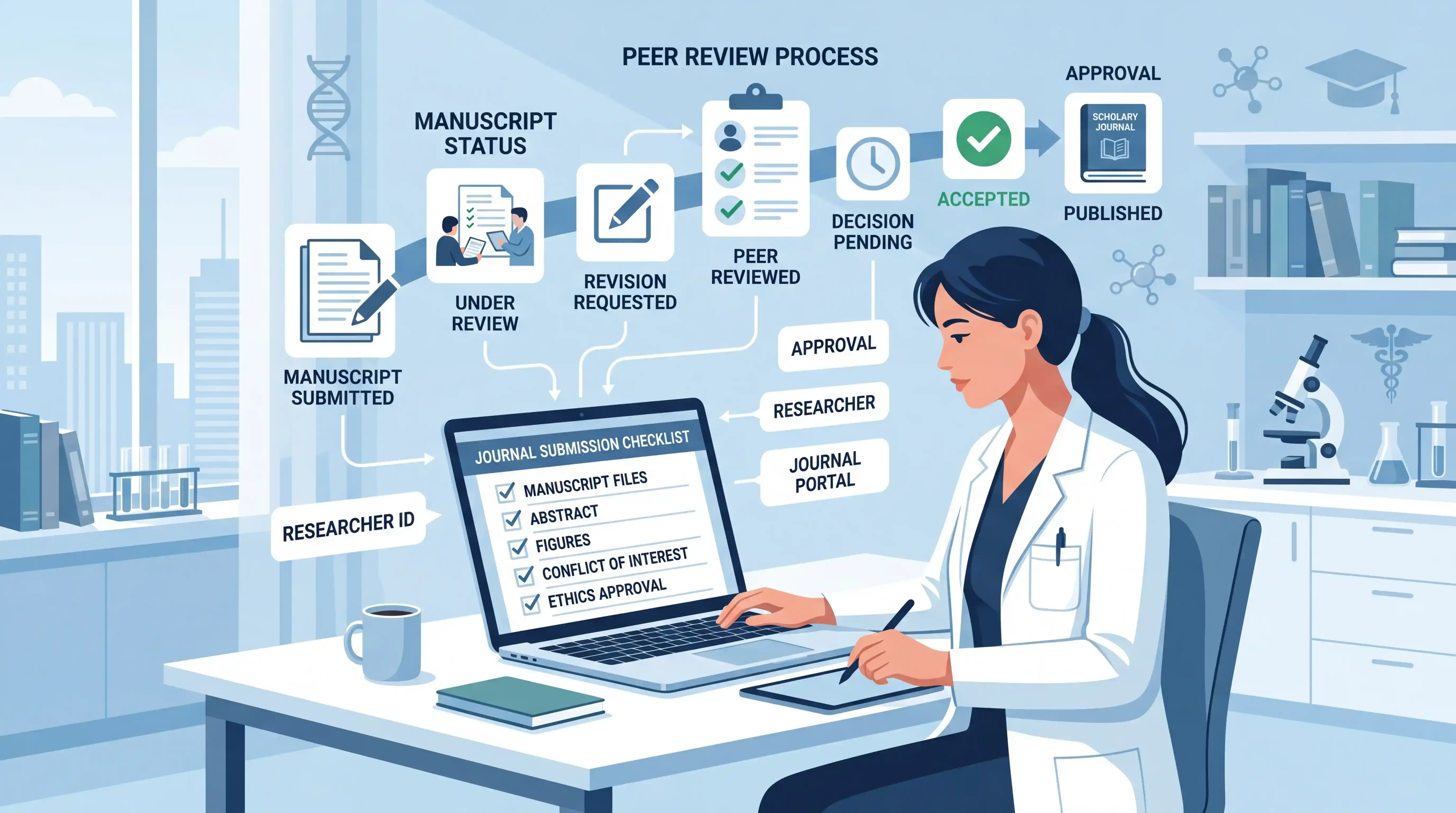
Many journals show status updates inside the submission portal. Common labels include:
- Manuscript Submitted
- Awaiting Admin Processing
- With Editor
- Reviewer Invited
- Under Review
- Major Revision
- Minor Revision
- Decision in Process
- Accept
- Reject
These terms reveal how the process works after submission. If the journal provides a status guide, read it carefully. It can help you estimate where delays may happen and what each status means.
2.3 Search for indexing and publisher details
A journal’s publisher and indexing status can provide indirect clues about quality and workflow. Reputable publishers usually have consistent policies across journals, including clear peer review descriptions. You can also compare similar journals in the same field to see whether the process is standard.
Be cautious if a journal makes vague claims such as “rapid publication” without explaining how peer review is handled. Speed alone is not enough. A trustworthy journal balances efficiency with editorial quality.
3. What to Verify Before You Submit
3.1 Confirm the review model
Before submitting your essay, identify the review model used by the journal. Ask:
- Is the review single-blind, double-blind, or open?
- Does the editor screen manuscripts first?
- How many reviewers are usually involved?
- Is the decision made by the editor, the reviewers, or both?
This matters because each model affects how you write and prepare the manuscript. For example, double-blind review may require you to remove identifying information from the main file. If you miss that detail, your paper may be returned for formatting changes.
3.2 Check the expected timeline
Many journals state an average time to first decision. In some fields, review can take about 1 to 2 months, but this varies widely. A manuscript may also sit in the “With Editor” or “Reviewer Invited” stage for longer if the editor struggles to find available reviewers.
Do not assume that a long wait means a problem. It may simply reflect reviewer availability. Still, if a journal promises unrealistic turnaround times, question it. A credible review timeline should be specific, not promotional.
3.3 Look for author responsibilities
Some journals require all authors to approve the submission before the manuscript can move forward. This is especially important for collaborative clinical or laboratory studies. If one author has not agreed, the paper may stall.
Also check whether the journal requires:
- Conflict of interest disclosure
- Ethical approval details
- Trial registration
- Data availability statements
- Preprint disclosure
These requirements are not minor. Missing information can delay review or lead to desk rejection.
4. Special Issues Medical Authors Should Check
4.1 Preprints and plagiarism screening
If your manuscript has been posted as a preprint, that usually does not prevent plagiarism screening from passing. Many journals and plagiarism-detection tools can recognize preprint content and distinguish it from copied material.
However, transparency is essential. Always tell the editor if the paper has appeared on a preprint server such as bioRxiv, medRxiv, or arXiv, and provide the link or DOI if available. Also confirm the journal’s preprint policy before submission, because acceptance rules vary.
4.2 Ethics documents and approval numbers
For human or animal research, journals often require ethics approval documentation. Some journals ask for an approval number. Others may accept an approval letter if it clearly confirms that ethical review was completed.
Do not assume every journal accepts the same format. If you only have an approval letter and no number, explain this in the cover letter and check the journal’s policy in advance. Ethics documentation should be complete, accurate, and consistent with the study design.
4.3 Relevance to the journal’s scope
A paper can be technically strong and still fail the first editorial check if it does not match the journal’s scope. Before submission, compare your topic with recent articles in the journal. If the journal mainly publishes clinical trials, for example, and your manuscript is a case-based essay, the fit may be weak.
This is one of the simplest ways to avoid rejection. Scope mismatch is one of the most common reasons for early editorial decline.
5. A Practical Checklist Before You Submit
5.1 Use a 7-point review check
Before sending your manuscript, verify these points:
- The peer review model is clearly stated.
- The submission guidelines match your manuscript type.
- The journal’s scope fits your topic.
- Ethical requirements are complete.
- Preprint status is disclosed if applicable.
- All authors have approved the submission.
- The timeline is realistic and clearly explained.
If you can answer these seven points, your submission is far less likely to be returned for avoidable reasons.
5.2 Read the journal’s decision language
Understanding decision terms helps you interpret results correctly. Common outcomes include:
- Reject: the paper will not proceed.
- Major revision: substantial changes are needed.
- Minor revision: limited changes are needed.
- Accept: the paper is approved.
In many journals, major revision does not mean failure. It often means the editor sees potential, but the manuscript needs serious improvement. A strong, point-by-point response to reviewer comments can make the difference between rejection and acceptance.
5.3 Save time with submission tools
If you submit often, using a workflow tool can reduce errors. Platforms like scifocus.ai can help you organize journal requirements, track submission-ready documents, and prepare a cleaner manuscript package. That matters when you are comparing multiple journals or handling several revisions at once.
For medical students and researchers, this is not just convenience. It is a way to reduce submission mistakes, improve consistency, and stay focused on content quality. A structured submission workflow can save time and lower the chance of preventable delays.
Conclusion
Before submitting your essay, take time to verify the journal’s peer review process, editorial workflow, ethics requirements, and author policies. A few minutes of checking can prevent weeks of delay and reduce the risk of desk rejection. For medical students, physicians, and researchers, this is a practical step, not an extra one. If you want a more efficient submission workflow, consider using scifocus.ai to organize your manuscript process and reduce avoidable errors.

Did you like this article? Explore a few more related posts.
Start Your Research Journey With Scifocus Today
Create your free Scifocus account today and take your research to the next level. Experience the difference firsthand—your journey to academic excellence starts here.