

How to Build a Logically Rigorous Core Argument in a Biomedical Essay
Introduction
Writing a biomedical essay is not only about presenting facts. The real challenge is avoiding academic misconduct while building a clear, defensible argument. Many medical students, doctors, and researchers know the literature, but their essays still feel fragmented, overly descriptive, or weak in logic. In biomedical writing, a strong core argument must link the research question, evidence, mechanism, and conclusion in a way that is precise and verifiable. This article shows how to structure that logic.
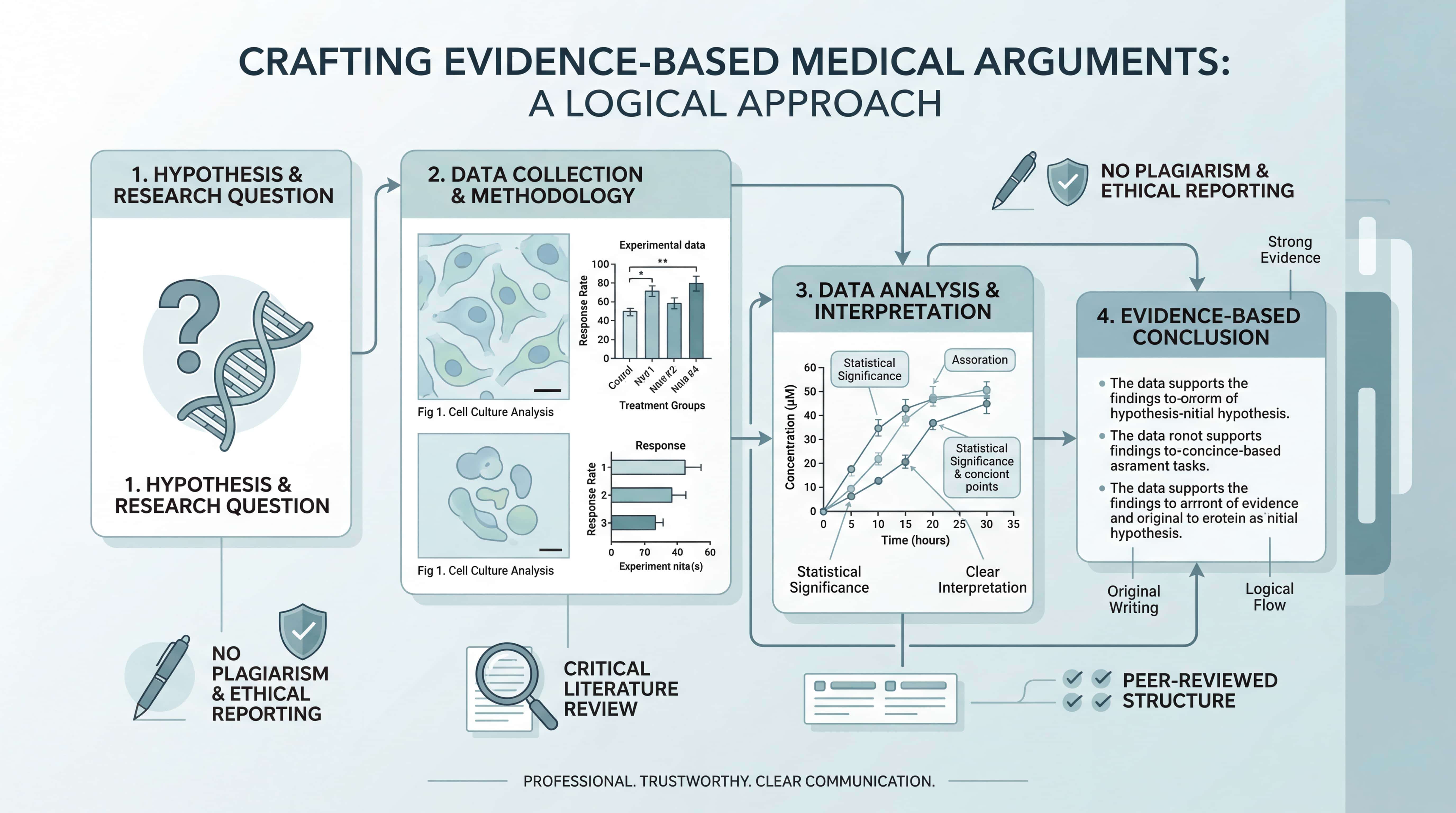
1. Start With the Scientific Question, Not the Sentence
1.1 Define the core relationship first
A rigorous biomedical essay begins with a question. What is changing, what causes it, and what result follows? This is the most stable way to avoid academic misconduct, because it forces you to build your argument from evidence instead of copying wording from sources.
In biomedical research, the central logic is usually causal. A factor affects a phenotype, or a mechanism explains a result. If you cannot state this in one sentence, your essay is not ready. A useful test is this: can you reduce the paper to one scientific claim without losing the meaning?
For example, a strong core argument usually contains:
- the disease or biological context,
- the key factor,
- the mechanism,
- the outcome.
If one of these elements is missing, the argument often becomes vague or unsafe to write.
1.2 Use the article’s logic, not its phrasing
Many writers make the mistake of repeating the article’s exact wording. That creates a plagiarism risk and weakens analysis. Instead, extract the logic. What is the observed phenomenon? What is the upstream driver? What evidence supports the link? What is the downstream effect?
This approach also improves readability. A biomedical essay should not sound like a list of copied technical terms. It should sound like a reasoned explanation built on original synthesis.
2. Build the Argument From Key Elements
2.1 Identify the essential nouns, verbs, and conclusions
A practical method from biomedical writing training is to extract six core elements:
- keywords related to the study,
- relevant supporting materials,
- a verb showing action,
- the main conclusion,
- common terminology,
- a refined version after repeated revision.
This is especially useful when you want to avoid academic misconduct. You are not reproducing the source. You are reconstructing the logic.
In practice, pay attention to:
- disease or phenotype,
- molecules, cells, or pathways,
- direction of change,
- final outcome.
The most important words are usually the ones that define causality.
2.2 Keep the argument centered on one main claim
A biomedical essay should not try to prove too many things at once. High-quality writing is centered. It selects one major thesis and supports it with layered evidence.
This is where many essays fail. They include too many background facts, but no clear argument. Or they discuss mechanisms without showing why they matter. A strong essay keeps the focus on one main scientific point and uses each paragraph to move closer to it.
A simple structure is:
- context,
- key factor,
- mechanism,
- evidence,
- conclusion.
That sequence keeps the essay logical and easier to defend.
3. Use Causal Logic to Strengthen the Thesis
3.1 Distinguish correlation from causation
Biomedical writing becomes rigorous when it clearly separates association from causation. In scientific logic, a correlation alone is not enough. You need evidence that one factor drives another.
This is why good essays often combine multiple levels of evidence. For example:
- tissue-level observations show the phenomenon,
- cell models test the mechanism,
- animal models verify the overall effect.
When different experimental levels point to the same conclusion, the argument becomes stronger and more trustworthy.
This multi-layer logic is one of the best ways to avoid academic misconduct in a broader sense, because it encourages original interpretation rather than superficial paraphrasing.
3.2 Explain the chain, not just the endpoint
Many biomedical processes are not simple one-step events. They are chained relationships. One factor affects another, which then affects a third. In logical terms, this is a serial causal chain.
A good essay should explain:
- what initiates the process,
- what intermediate mechanism changes,
- what final biological outcome appears.
For example, a study may show that a viral factor alters a transcription regulator, which then changes a production phenotype. The core argument is not just “the phenotype changed.” It is the full chain from factor to mechanism to outcome.
This kind of writing shows depth. It also helps readers follow your reasoning.
3.3 Use evidence to support necessity or sufficiency
In advanced biomedical analysis, the question is often not only “does it happen,” but also “is it necessary” or “is it sufficient.” That distinction makes an essay much more precise.
Ask:
- Is this factor enough to trigger the outcome?
- Is this factor required for the outcome?
- What experimental design proves it?
A clear answer makes the essay more scientific and less speculative.
4. Turn Data Into a Defensible Argument
4.1 Let the figures guide the structure
When reading biomedical papers, start with the figures. They show the logic faster than the text. Look for the order of evidence, the comparison groups, and the direction of regulation.
If the figures are clear, your essay should follow the same logic:
- observation,
- intervention,
- rescue or validation,
- final conclusion.
This is particularly important for complex research. The best essays do not merely describe each result. They explain why each result matters in the causal chain.
4.2 Understand rescue experiments as proof of mechanism
Rescue experiments are especially useful in mechanistic studies. They help show whether a pathway is real, not accidental. A standard rescue design usually compares multiple groups to test whether restoring a factor reverses the effect.
This kind of experiment is powerful because it tests logic directly. It does not just show change. It shows reversibility and pathway dependence.
For a biomedical essay, this means your argument can move from observation to mechanism with much higher confidence.
4.3 Avoid data dumping
A common weakness in student essays is “data dumping.” This happens when every result is described, but no interpretation is built.
To avoid that:
- summarize only the key result,
- explain what it proves,
- connect it to the main claim,
- leave out irrelevant details.
This is one of the fastest ways to improve clarity and reduce the risk of uncited borrowing from source text.
5. Write With Accuracy, Brevity, and Mainstream Terminology
5.1 Use precise and familiar terms
Biomedical writing should be accurate, but not obscure. Avoid unnecessary abbreviations and overly technical phrasing when simpler mainstream terms work better. The goal is clarity, not complexity.
A strong argument uses:
- standard terminology,
- direct verbs,
- short sentences,
- minimal ambiguity.
This makes the essay easier for reviewers, teachers, and clinicians to trust.
5.2 Keep the title and body aligned
A frequent logic error is mismatch. The title promises one thing, but the body discusses another. This breaks coherence and can make the essay look careless.
A rigorous biomedical essay keeps the same central elements throughout:
- subject,
- mechanism,
- outcome.
If your essay title highlights a pathway, the body must explain that pathway. If the title emphasizes a phenotype, the body must show how the phenotype is produced.
Consistency between title and content is a major sign of academic integrity.
6. Avoid the Common Errors That Weaken Biomedical Essays
6.1 Watch for vague, empty, or inflated claims
Common problems include:
- generic statements with no scientific value,
- unclear concepts,
- unsupported conclusions,
- poor word order,
- missing links in logic.
These problems make the essay harder to evaluate and easier to challenge. They also increase the chance of unintentional academic misconduct, because vague writing often relies too heavily on source language.
6.2 Replace imitation with synthesis
A good biomedical essay should not sound copied. It should show that you understood the paper and rebuilt the logic in your own words.
To do that, ask:
- What is the real scientific question?
- What evidence answers it?
- What is the strongest conclusion?
- What is still uncertain?
This transforms reading into analysis.
6.3 Revise repeatedly
Strong titles and arguments are rarely produced in one draft. They need repeated refinement. You may need to remove extra words, restore missing logic, or reorder the chain of reasoning.
Revision is where precision is achieved.
7. Use scifocus.ai to Build Cleaner Biomedical Arguments
7.1 Why structured support matters
Even experienced writers can lose clarity when handling complex biomedical literature. That is where scifocus.ai can help. It supports more structured reading, sharper summarization, and cleaner argument building.
Instead of struggling to turn dense findings into a coherent essay, you can use a workflow that helps identify:
- core claim,
- causal chain,
- evidence levels,
- key wording.
This can save time and improve consistency.
7.2 How it helps reduce academic misconduct risk
When you rely on a structured writing process, you are less likely to copy language by accident. scifocus.ai can help you organize notes, clarify logic, and reframe content in original language.
That makes it easier to avoid academic misconduct while still writing with scientific accuracy.
For medical students, doctors, and researchers, this is especially valuable when the source material is complex, fast-moving, or mechanistically dense.
7.3 A practical workflow
A simple workflow could be:
- extract the main question,
- list the core variables,
- map the causal chain,
- separate evidence from interpretation,
- rewrite the argument in your own words,
- check coherence against the title.
Used this way, scifocus.ai becomes a writing assistant, not a shortcut. It supports clarity, discipline, and originality.
Conclusion
A logically rigorous biomedical essay is built on one principle: clear scientific logic supported by original synthesis. Start with the question. Extract the core elements. Build the causal chain. Use evidence at multiple levels. Keep the title, body, and conclusion aligned. Most importantly, avoid academic misconduct by rebuilding the argument in your own words, not borrowing the source’s phrasing.
If you want a faster, cleaner way to organize complex biomedical ideas, try scifocus.ai. It can help you shape evidence into a coherent thesis, improve readability, and support more trustworthy academic writing.

Did you like this article? Explore a few more related posts.
Start Your Research Journey With Scifocus Today
Create your free Scifocus account today and take your research to the next level. Experience the difference firsthand—your journey to academic excellence starts here.