
How to Avoid Translationese in Academic Writing
Introduction
Translationese can make an academic essay sound correct at first glance, yet feel unnatural, vague, or hard to read. For medical students, doctors, and researchers, that is a real problem. In papers, even small language issues can weaken clarity, reduce credibility, and slow down peer review. If your English essay is translated too literally from Chinese, the science may be sound, but the writing may still fail.
1. What Translationese Looks Like in an Academic Essay
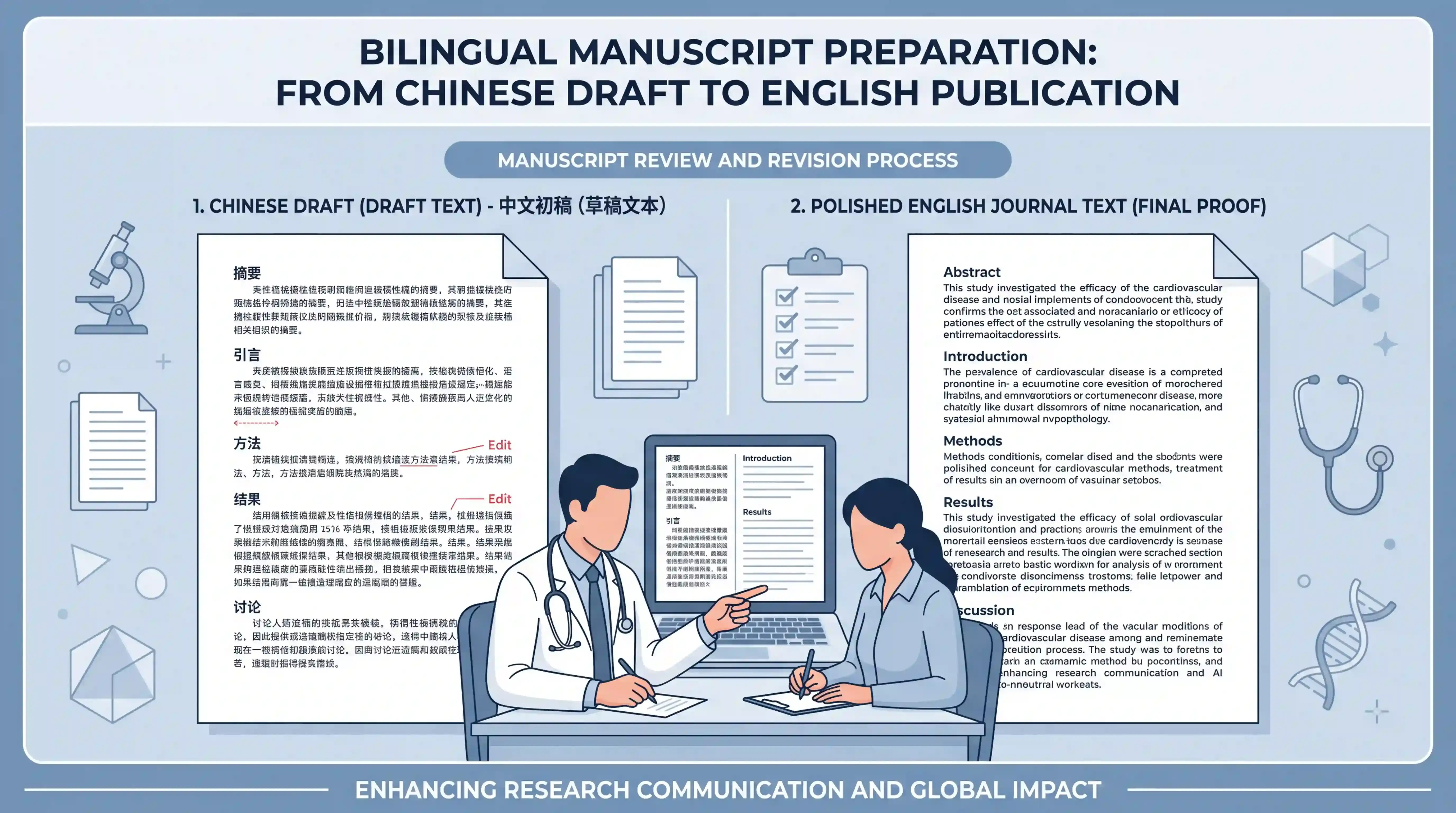
Translationese is language that follows the structure of the source language too closely. In an academic essay, this often appears as long, stacked sentences, awkward word order, and expressions that feel “translated” rather than written in English.
For medical and scientific writing, the issue is not only style. It also affects precision. English academic writing expects direct logic, clear subject-verb relations, and concise sentence flow. When writers copy Chinese sentence patterns too closely, the result may be grammatically understandable but stylistically weak.
A strong test is simple. Read the sentence aloud. If it sounds like a line-by-line translation, it probably is. Native English academic readers expect smoother transitions, cleaner syntax, and fewer unnecessary words.
1.1 Common Signs of Translationese
Several patterns appear again and again in translated academic writing:
- Overly long sentences with too many clauses.
- Repeated use of abstract nouns.
- Weak or indirect verbs.
- Unclear pronouns and antecedents.
- Rigid, Chinese-style word order.
- Unnatural passive voice.
These problems do not always create obvious grammar errors. That is why translationese is difficult to catch with software alone. It often survives spellcheck and basic grammar tools.
1.2 Why It Matters in Medical and Research Writing
In medicine, accuracy is non-negotiable. A confusing sentence can blur a method, distort a result, or make a discussion seem less reliable. That is especially important in a high-stakes academic essay, where readers expect both scientific rigor and linguistic control.
A polished manuscript can also improve the submission process. Clear writing reduces reviewer friction. It helps editors focus on the science, not the sentence structure.
2. Rewrite for English Academic Logic, Not Chinese Structure
The most effective way to reduce translationese is to reorganize ideas according to English academic logic. Do not translate sentence by sentence. Translate meaning first, then rebuild the sentence.
English academic writing usually prefers a clear subject, a direct verb, and a specific object. Chinese writing often allows more implicit logic. In English, that logic should be made explicit.
A useful rule is this: if the sentence feels too “full,” cut it in half. If it feels too thin, combine related ideas. The goal is not longer English. The goal is cleaner English.
2.1 Use Short, Direct Sentences First
Long sentences are not automatically bad. But many translated sentences become long for the wrong reason. They pack in multiple ideas without guiding the reader.
Compare these approaches:
- Weak: “Due to the fact that the patient’s condition improved significantly after treatment was given, it can be seen that the therapy had a good effect.”
- Stronger: “The patient improved significantly after treatment. This suggests that the therapy was effective.”
The second version is shorter, clearer, and more natural. It also sounds more confident.
2.2 Choose the Right Verb
English academic writing values strong verbs. Avoid turning actions into noun phrases when a verb would be clearer.
Examples:
- “make an analysis” becomes “analyze”
- “conduct an investigation” becomes “investigate”
- “reach a conclusion” becomes “conclude”
This is one of the fastest ways to improve any essay. It reduces wordiness and makes the prose more active.
2.3 Keep the Subject Visible
Another common translation problem is hidden agency. In English, the reader should know who did what.
Avoid sentences like:
- “It was observed that...”
- “There was a finding that...”
- “Results showed that...” if the structure becomes vague or awkward
When possible, name the researcher, study, or data source. Clear subjects improve accountability and readability.
3. Fix the Grammar Patterns That Expose Translationese
Even when meaning is correct, certain grammar habits make writing feel translated. These are often small errors, but in an academic essay they can damage the overall impression.
The most frequent problems include punctuation misuse, unclear pronouns, inconsistent tense, and confusion around passive voice. These are not only grammar issues. They are signs that the sentence has not yet been fully shaped into English.
3.1 Avoid Comma Splices and Run-On Sentences
A common problem in translated writing is joining two complete sentences with only a comma. English does not allow that in formal writing.
Instead, use:
- a period
- a semicolon
- a coordinating conjunction such as and, but, or
- a restructured sentence
For example:
- Incorrect: “The sample size was small, the findings should be interpreted carefully.”
- Correct: “The sample size was small. The findings should be interpreted carefully.”
This small fix can immediately improve readability.
3.2 Make Pronouns Clear
Unclear pronouns are another marker of translationese. If “it,” “this,” or “they” could refer to more than one noun, the sentence becomes unstable.
In scientific writing, clarity matters more than repetition. If needed, repeat the noun rather than risk confusion.
For example:
- Weak: “This showed that it was effective.”
- Stronger: “This study showed that the intervention was effective.”
3.3 Use Tense Consistently
English academic prose uses tense strategically. Past tense is common when reporting methods and results. Present tense is used for established knowledge, current interpretation, or what the paper shows now.
A practical pattern is:
- Methods: past tense
- Results: past tense
- General truths: present tense
- Discussion and implications: mixed, depending on context
If tense shifts randomly, the essay feels translated and unstable. Consistency signals control.
4. Remove Lexical Choices That Sound Literal
Literal translation often survives at the word level. A sentence may be grammatically correct, yet still sound non-native because the vocabulary is not natural for English academic readers.
This is especially important in a scientific essay, where readers notice unnatural collocations quickly. A single wrong phrase can make a paragraph feel artificial.
4.1 Avoid Word-for-Word Collocations
Some phrases are common in Chinese but uncommon in English academic prose. Translate meaning, not dictionary entries.
Examples of safer choices:
- “have an impact on” instead of a rigid literal phrase
- “is associated with” instead of a direct translation that sounds heavy
- “suggests” instead of repeating “indicates that...” in every sentence
Good academic English uses varied but precise wording. Repetition is fine when it serves clarity, not when it signals limited lexical range.
4.2 Be Careful with False Friends and Confusable Words
Certain words look right but are wrong in context. Grammar tools may not catch them. Manual proofreading does.
Common issues include:
- affect vs. effect
- research vs. researches
- fewer vs. less
- among vs. between
In medical writing, even one wrong term can change the meaning. That is why careful proofreading matters as much as drafting.
4.3 Avoid Unnatural Abstract Nouns
Translated writing often overuses nouns like “analysis,” “discussion,” “implementation,” and “achievement,” where a direct verb would be clearer.
For example:
- Weak: “The implementation of the protocol was done by the team.”
- Stronger: “The team implemented the protocol.”
This is more concise and more professional. It also reduces the flat, bureaucratic tone that often appears in translationese.
5. Use Professional Editing as Part of the Writing Process
A high-quality academic essay is rarely perfect in one draft. This is especially true when the writer is working between Chinese and English. A careful editing process is not optional. It is part of producing publishable work.
The strongest manuscripts usually go through multiple passes. First, the meaning is corrected. Then the structure is improved. Finally, the language is refined to match English academic conventions.
5.1 Add Native-Sounding Review
If possible, ask an English-fluent colleague, mentor, or professional editor to review the text before submission. They may notice issues that software misses, including tone, flow, and unnatural phrasing.
This matters because translationese often hides in sentences that are technically correct. A native reviewer can detect those subtle problems faster than a machine.
5.2 Follow Journal or School Guidelines
Academic writing is not only about language. It also has format rules. Follow the target journal’s instructions for structure, references, tables, and figures.
A manuscript that is linguistically polished but formatted poorly still creates friction. Good presentation supports good science.
5.3 Use AI Carefully, Not Blindly
AI tools can help rewrite awkward sentences, but they should not replace judgment. Use them to identify repetition, simplify structure, and suggest alternatives. Then check the output yourself.
That is where scifocus.ai can help. It supports researchers who need clearer academic English, faster revision, and more consistent phrasing. For a busy medical student or doctor, that means less time spent fixing sentence-level problems and more time spent refining the argument. The right tool should improve clarity without changing your scientific meaning.
Conclusion
Avoiding translationese is not about making your writing “more foreign.” It is about making it more readable, precise, and credible for an English academic audience. In every essay, focus on clear logic, direct verbs, natural collocations, and clean grammar. Shorter sentences often work better. So do active structures and explicit subjects.
If you are preparing a manuscript, thesis section, or research essay, do not rely on literal translation alone. Revise for English logic. Proofread for grammar. Ask for expert feedback. And if you want a faster, more reliable way to polish academic English, try scifocus.ai to support your revision workflow and strengthen the final draft.
Did you like this article? Explore a few more related posts.
Start Your Research Journey With Scifocus Today
Create your free Scifocus account today and take your research to the next level. Experience the difference firsthand—your journey to academic excellence starts here.