
How to Avoid Plagiarism in Research Papers
Introduction
Plagiarism is one of the fastest ways to damage a research career. For medical students, doctors, and researchers, even a well-written essay can lose credibility if it repeats ideas, phrasing, or data without proper attribution. In research papers, originality is not optional. It is a basic academic standard. Knowing how to avoid plagiarism in research papers protects your reputation, strengthens your manuscript, and improves your chances of publication.
1. Understand What Plagiarism Really Means
1.1 Copying Is Not the Only Risk
Plagiarism is not limited to copying a full paragraph word for word. It also includes close paraphrasing, uncredited ideas, and reused structure that is too similar to the source. In academic writing, even if the wording changes slightly, the original source still matters.
A common risk appears in the essay sections of a paper, especially the introduction and methods. Writers often rely too closely on source language when explaining background knowledge or experimental steps. That is where similarity scores rise.
A safe rule is simple: if the idea, wording, or structure came from another source, it needs to be handled carefully.
1.2 Why Researchers Should Take It Seriously
In biomedical publishing, plagiarism can lead to rejection, correction, or retraction. Retractions damage trust. They can affect the author, the institution, and future submissions. This is especially serious in medicine, where accuracy and integrity are tied to patient care and scientific confidence.
Many journals now use software such as iThenticate or similar tools to screen manuscripts. Some journals also examine whether a paper contains repeated patterns in methods, background, or discussion. Originality is not only about ethics. It is also about publication quality.
2. Build a Paper on Your Own Thinking
2.1 Start with the Research, Not the Sentence
The best way to avoid plagiarism is to think first and write later. Read the source material until you understand the logic. Then close it and explain the idea in your own words. This works better than line-by-line substitution.
For a strong essay, use this process:
- Read the source carefully.
- Identify the main point.
- Write a short note in your own language.
- Compare your version with the original.
- Revise if the structure still feels too close.
This method helps you write more naturally and reduces accidental copying.
2.2 Separate Your Voice from the Source
A research paper should show your interpretation. It should not sound like a stitched collection of published sentences. That is why researchers should avoid copying the rhythm or sentence pattern of a source, even when they are paraphrasing.
Instead of imitating the original text, focus on the meaning. Change the sentence structure. Change the order of ideas. Use discipline-specific language where appropriate. Your goal is not to hide the source. Your goal is to show independent understanding.
3. Use Citations Correctly and Completely
3.1 Cite Every Borrowed Idea
If a fact, method, or interpretation is not yours, cite it. This includes direct quotations, paraphrased claims, and data points. A missing citation can turn a harmless reference into a plagiarism problem.
In medical and scientific writing, this is especially important for epidemiological figures, molecular mechanisms, clinical outcomes, and trial results. If you used those ideas to shape your essay, the reader must be able to trace them back to the source.
Good citation practice is one of the strongest defenses against plagiarism.
3.2 Do Not Rely Only on Review Articles
Review articles are useful, but they should not be your only evidence base. A paper built only on reviews can look weak to editors because it does not show direct engagement with original studies. It can also make it harder to distinguish established evidence from interpretation.
A better approach is to combine review articles with primary studies. This gives your paper stronger academic depth and clearer support. It also helps you explain background, methods, and significance with more precision.
3.3 Keep Reference Management Clean
Reference tools such as EndNote can help you organize sources and reduce citation errors. They are useful when you need to switch citation styles or update the bibliography. But software does not replace careful checking.
Before submission, confirm that:
- every in-text citation appears in the reference list,
- every listed reference is cited in the text,
- the citation style is consistent,
- the source matches the statement it supports.
A mismatch between text and references may not always count as plagiarism, but it can still create serious credibility problems.
4. Reduce Similarity in the Most Problematic Sections
4.1 Methods Need Careful Rewriting
The methods section is often the most repetitive part of a research paper. That is because many procedures use standard terminology. Still, copying another paper’s sentence structure can create unnecessary similarity.
To avoid this, describe the method according to what you actually did. Focus on:
- sample source,
- instruments or reagents,
- procedure order,
- measurement conditions,
- statistical analysis.
If a method is standard and previously published, cite the source rather than rewriting it too closely. A standard method can be described clearly without copying its original prose.
4.2 Use Sentence Restructuring, Not Word Swapping Alone
Changing a few synonyms is not enough. Many plagiarism checks detect near-identical structure, not just exact words. A better strategy is to rebuild the sentence.
You can:
- switch from active to passive voice,
- split one long sentence into two short ones,
- move the key point to the front,
- change the order of clauses,
- use a more precise term when needed.
For example, if a source says a factor “plays a critical role in cell migration and invasion,” you can explain the same idea by describing the biological process, then linking it to the mechanism in your own framework. The meaning stays accurate, but the writing becomes original.
5. Manage Quotations, Paraphrasing, and Data Responsibly
5.1 Quote Only When the Exact Wording Matters
Direct quotations should be rare in scientific writing. In most cases, paraphrasing is better. If you do quote a sentence exactly, use quotation marks and cite it properly. This makes the source visible and removes confusion about authorship.
This applies to policy statements, definitions, or especially precise wording. Do not use quotation marks casually. They should serve a real purpose.
5.2 Be Careful with Figures, Tables, and Images
Plagiarism can also happen with visual materials. Reusing a figure, table, or image without permission or citation is a serious issue. Even if you redraw the figure, the underlying data and design may still belong to the original author.
When using external visual content:
- check copyright rules,
- cite the original source,
- obtain permission if required,
- clearly note if the figure is adapted.
For researchers preparing a publication-ready essay, this step is often overlooked. It should not be.
5.3 Summarize Data, Do Not Recycle Language
When discussing results, summarize the findings in a new way. Do not copy the sentence pattern from the source paper. Instead, state what the data show, what it may mean, and why it matters.
A good results summary should answer three questions:
- What was found?
- How strong is the finding?
- Why does it matter to this field?
That is the kind of academic writing editors expect.
6. Check Similarity Before Submission
6.1 Use a Reliable Similarity Checker
Before submitting, run a similarity check with a trusted tool. Many authors use iThenticate for journal-style screening. Grammarly or other tools can also help catch wording problems, though they are not a substitute for editorial review.
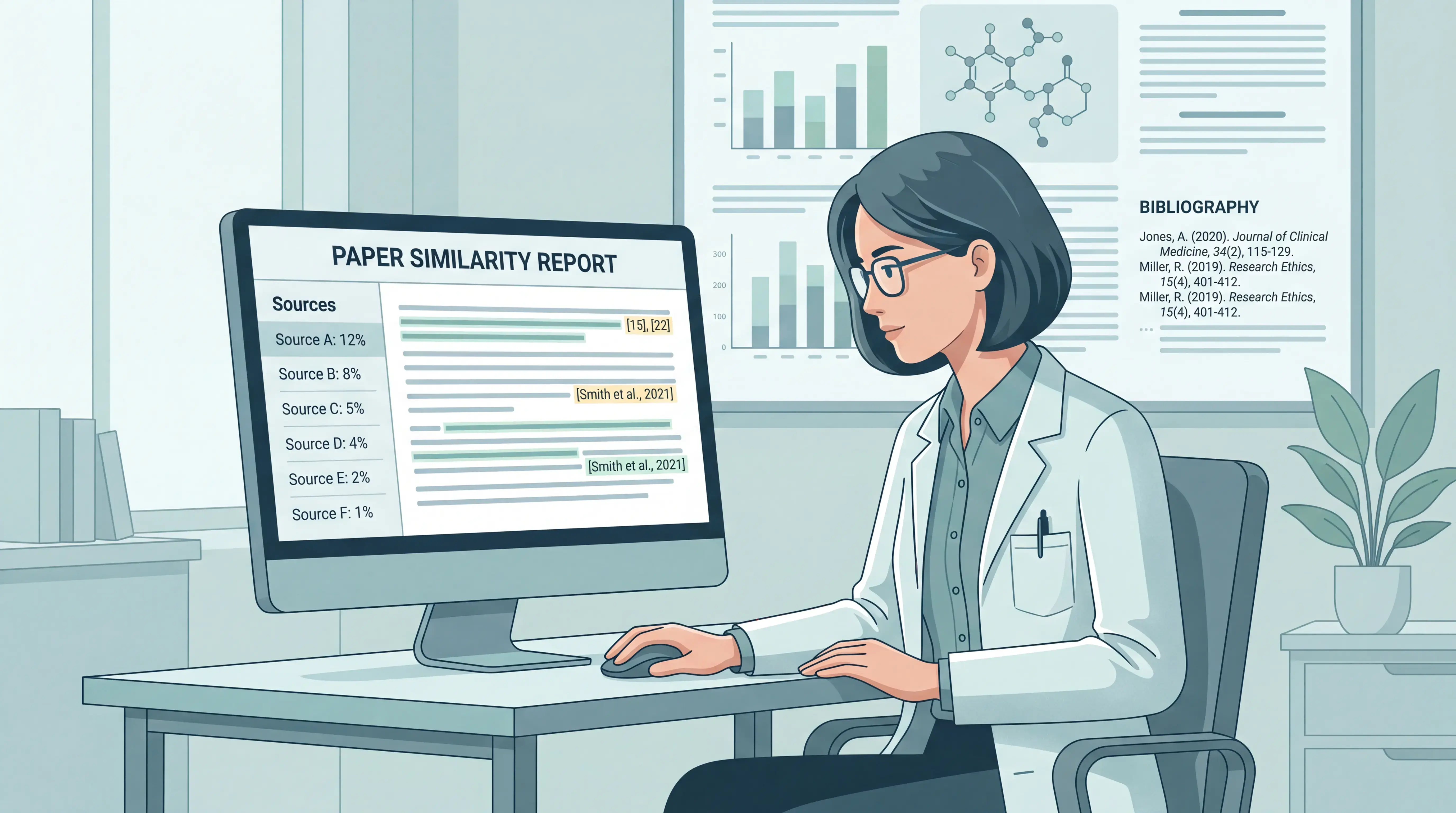
A similarity report is not just a number. It is a diagnostic tool. It shows where the manuscript may be too close to existing text. Focus especially on:
- introduction,
- methods,
- literature-based discussion,
- repeated definitions.
A lower similarity score is useful only if the paper still reads clearly and accurately.
6.2 Revise Based on the Report, Not Guesswork
Do not rewrite the whole paper blindly. Review each highlighted section and ask whether the issue is:
- missing citation,
- overly close paraphrase,
- boilerplate language,
- legitimate technical overlap.
Then revise accordingly. Some terms cannot be changed because they are standard scientific language. That is acceptable if the source is cited and the text is not copied in large blocks.
7. Use Tools That Support Original Writing
7.1 Let Smart Writing Support Improve Your Draft
Many researchers struggle with similarity because they spend too much time translating source text into another version of the same sentence. A better workflow is to draft from understanding, then refine with support tools.
Platforms like scifocus.ai can help streamline academic drafting, structure ideas more clearly, and support cleaner original writing. For busy medical students, clinicians, and researchers, this can reduce the risk of accidental overlap while saving editing time.
7.2 Why This Matters for Publication Quality
Originality is not only about avoiding penalties. It also improves readability, logic, and trust. A manuscript that is clearly written, properly cited, and structurally sound is easier for reviewers to assess.
If your goal is to submit a stronger essay or research manuscript, use tools that support accuracy and academic discipline. Scifocus.ai can be part of that workflow by helping you produce cleaner, more original drafts before submission.
Conclusion
Avoiding plagiarism in research papers requires more than changing a few words. It takes careful reading, accurate citation, responsible paraphrasing, and a disciplined review process. For medical students, doctors, and researchers, these habits protect both your work and your reputation. A well-written, original essay is stronger, safer, and more publishable.
If you want to reduce similarity risk and improve your academic writing workflow, consider using scifocus.ai as part of your drafting and revision process. It can help you structure ideas, refine language, and move toward a cleaner final manuscript with greater confidence.
Did you like this article? Explore a few more related posts.
Start Your Research Journey With Scifocus Today
Create your free Scifocus account today and take your research to the next level. Experience the difference firsthand—your journey to academic excellence starts here.