

How to Avoid First Person in Research Papers
Introduction
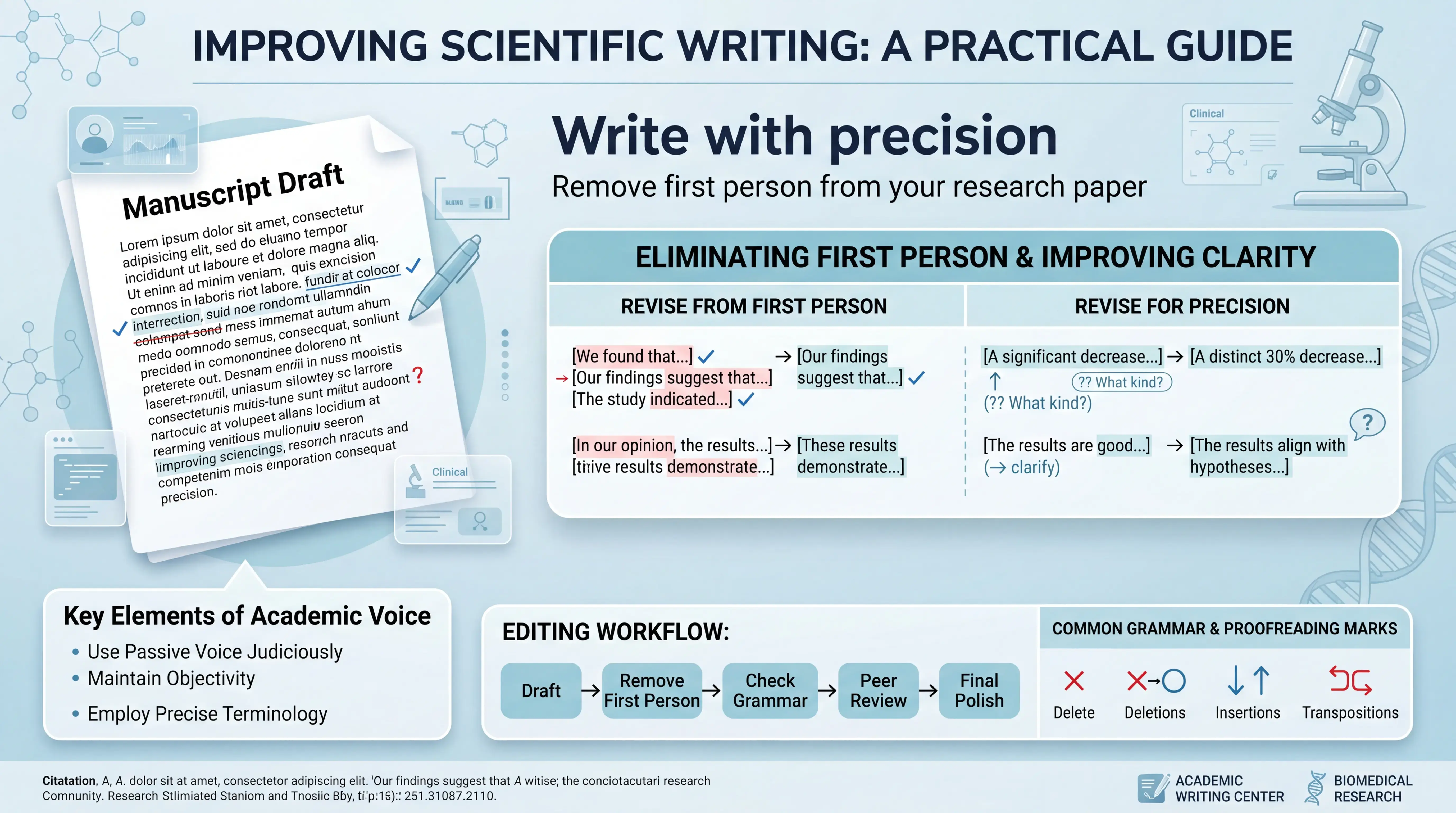
Writing an essay for a medical or scientific journal is not the same as writing a personal reflection. Many authors still slip into first-person language, especially in Methods, Results, and Discussion. That can weaken tone, reduce perceived objectivity, and distract reviewers. This guide explains how to avoid first person in research papers with practical rules, examples, and submission-focused tips for medical students, physicians, and researchers.
1. Why first person is a problem in academic writing
1.1 Objectivity matters in scientific writing
In most research contexts, the goal is to present evidence, not the author’s personal role. That is why how to avoid first person in research papers is a common concern in academic editing. Reviewers often expect a formal, neutral style, especially in clinical and biomedical writing.
First-person language is not always wrong. But overuse can make a manuscript sound subjective. For example, “I believe the results show…” is weaker than “The results show…”. In an essay or article aimed at publication, the second version is more direct and more scientific.
1.2 Journals often prefer concise, impersonal phrasing
Many journals allow first person in limited cases, such as when the author explains a decision or contribution. Still, the default rule is to keep the prose focused on the study, not the writer. This is especially important in retrospective studies, where reviewers care more about design, data quality, and clarity than about author presence.
A useful principle is simple: if the sentence still works without “I,” “we,” or “our,” remove them. That often improves readability immediately.
2. Replace first person with stronger academic structures
2.1 Use the subject of the study
One of the best ways to avoid first person is to make the study, dataset, or outcome the subject of the sentence.
Instead of:
- “We analyzed 120 patients.”
Write: - “The study analyzed 120 patients.”
Instead of:
- “We found that mortality was lower.”
Write: - “Mortality was lower in the intervention group.”
This shift makes the writing more formal. It also helps readers track the research question faster.
2.2 Use passive voice carefully
Passive voice can help in some sections, especially Methods. For example:
- “Data were collected from electronic records.”
- “Samples were stored at -80°C.”
- “The protocol was approved by the ethics committee.”
These are standard forms in medical publishing. But do not overuse passive voice. Too much passive construction can make text flat or difficult to read. The best approach is balance. Use passive voice when the actor is irrelevant. Use active voice when clarity improves.
2.3 Use impersonal phrasing for interpretation
When discussing findings, you can replace first person with phrases such as:
- “The findings suggest…”
- “This may indicate…”
- “The present study demonstrates…”
- “The results support…”
These phrases keep the focus on the evidence. They are also useful in an essay that must sound polished and disciplined.
3. Section-by-section strategies for research papers
3.1 Introduction: keep the focus on the field
The Introduction should explain the gap, the clinical relevance, and the study purpose. Avoid writing:
- “We want to study this problem because…”
Use:
- “This study addresses an important clinical gap.”
- “Little is known about…”
- “The present study aimed to…”
For medical audiences, this structure is effective because it frames the paper around a problem, not the author.
3.2 Methods: state what was done, not who did it
Methods sections are often the easiest place to remove first person. Write:
- “Patients were recruited from January 2020 to December 2022.”
- “Variables were extracted from hospital records.”
- “Statistical analysis was performed using SPSS.”
These formulations are standard in clinical research. They are also safer for journal submission because they sound objective and procedural.
If you need to describe a unique author action, keep it brief and factual:
- “A senior radiologist reviewed all scans independently.”
No need for “we had a senior radiologist review all scans.” The impersonal version is cleaner.
3.3 Results: let the data speak
Results should be the most impersonal section of all. Avoid:
- “We observed a significant increase in survival.”
- “We found no difference between groups.”
Use:
- “Survival increased significantly.”
- “No significant difference was observed between groups.”
When a sentence starts to sound like interpretation rather than reporting, check it again. Results should present outcomes, not opinions. This is a core rule in any strong scientific essay.
3.4 Discussion: use measured interpretation
Discussion is where first person often appears again. Authors write:
- “We think this may be because…”
- “We believe our data suggest…”
A better alternative is:
- “This may be due to…”
- “The data suggest…”
If you need to state contribution, use:
- “This study adds evidence that…”
- “These findings extend previous work by…”
- “The present results may inform clinical decision-making.”
That keeps the tone professional while still highlighting novelty.
4. Common first-person mistakes to avoid
4.1 Avoid unnecessary personal framing
Phrases like these often weaken manuscripts:
- “In our opinion…”
- “We feel that…”
- “We think that…”
- “We would like to point out…”
In research writing, these can sound informal or speculative. Replace them with evidence-based language.
4.2 Avoid overclaiming originality
A common problem in scholarly writing is claiming a “first” or “gap” without support. That can frustrate reviewers. If you say your study is the first of its kind, you should explain why it matters clinically, methodologically, or scientifically.
A stronger approach is:
- explain the clinical need,
- show the methodological advantage,
- and state the practical implication.
That is more persuasive than simply saying, “We are the first.”
4.3 Avoid awkward sentence rewriting
Trying too hard to remove first person can damage grammar. For example:
- Weak: “Was analyzed the data from 200 cases.”
- Better: “The data from 200 cases were analyzed.”
The goal is not just removing pronouns. The goal is producing clear, grammatical, publication-ready prose.
5. Practical editing workflow for medical writers
5.1 Use a three-step revision method
A reliable method is:
- Highlight every “I,” “we,” and “our.”
- Decide whether the pronoun is necessary.
- Rewrite for subject focus, passive voice, or impersonal phrasing.
This takes only a few minutes per page and often improves the manuscript substantially.
5.2 Check the journal style guide
Some journals are more permissive than others. Before submission, read the author instructions carefully. Look for guidance on:
- first-person usage,
- passive voice,
- Methods style,
- personal contribution statements.
This step matters because a well-written manuscript can still face avoidable revisions if it ignores journal conventions. In academic publishing, presentation is part of the product.
5.3 Use software, but do not rely on it fully
Grammar tools can flag some first-person phrasing, but they do not understand research context as well as a trained editor. For medical and scientific manuscripts, human review remains essential.
This is where a specialized writing platform like scifocus.ai can help. It can support clearer academic phrasing, improve sentence structure, and reduce time spent on repetitive editing. For busy clinicians and researchers, that means faster revision with more consistent style.
6. When first person is acceptable
6.1 Use it only when attribution is necessary
First person can be acceptable in limited situations, such as:
- explaining a personal methodological decision,
- describing author contribution in some journals,
- responding to reviewer comments,
- or writing reflective academic content.
Even then, use it sparingly.
6.2 Follow discipline and journal expectations
Some fields tolerate first person more than others. In clinical and biomedical publishing, restraint is usually better. If your target journal publishes many highly structured papers, a neutral style is often preferred.
The best rule is not “never use first person.” The best rule is use it only when it adds clarity that cannot be achieved another way.
Conclusion
Learning how to avoid first person in research papers is not about making writing cold. It is about making it precise, objective, and publication-ready. Use subject-focused phrasing, controlled passive voice, and evidence-based language. Keep the manuscript centered on the study, not the writer. For authors preparing a medical essay or journal submission, tools like scifocus.ai can streamline revision and improve clarity. If you want cleaner academic writing and faster editing, this is the right time to try it.
Did you like this article? Explore a few more related posts.
Start Your Research Journey With Scifocus Today
Create your free Scifocus account today and take your research to the next level. Experience the difference firsthand—your journey to academic excellence starts here.