
Introduction
Essay writing in formal settings demands precision, consistency, and control. One of the fastest ways to weaken that tone is the use of contractions. In medical essays, clinical reports, and research papers, contractions can make writing sound too conversational. This guide explains how to avoid contractions in formal writing, when to replace them, and how to keep your essay clear, professional, and academically credible.
1. Why Contractions Matter in Formal Writing
1.1 Contractions Can Reduce Academic Tone
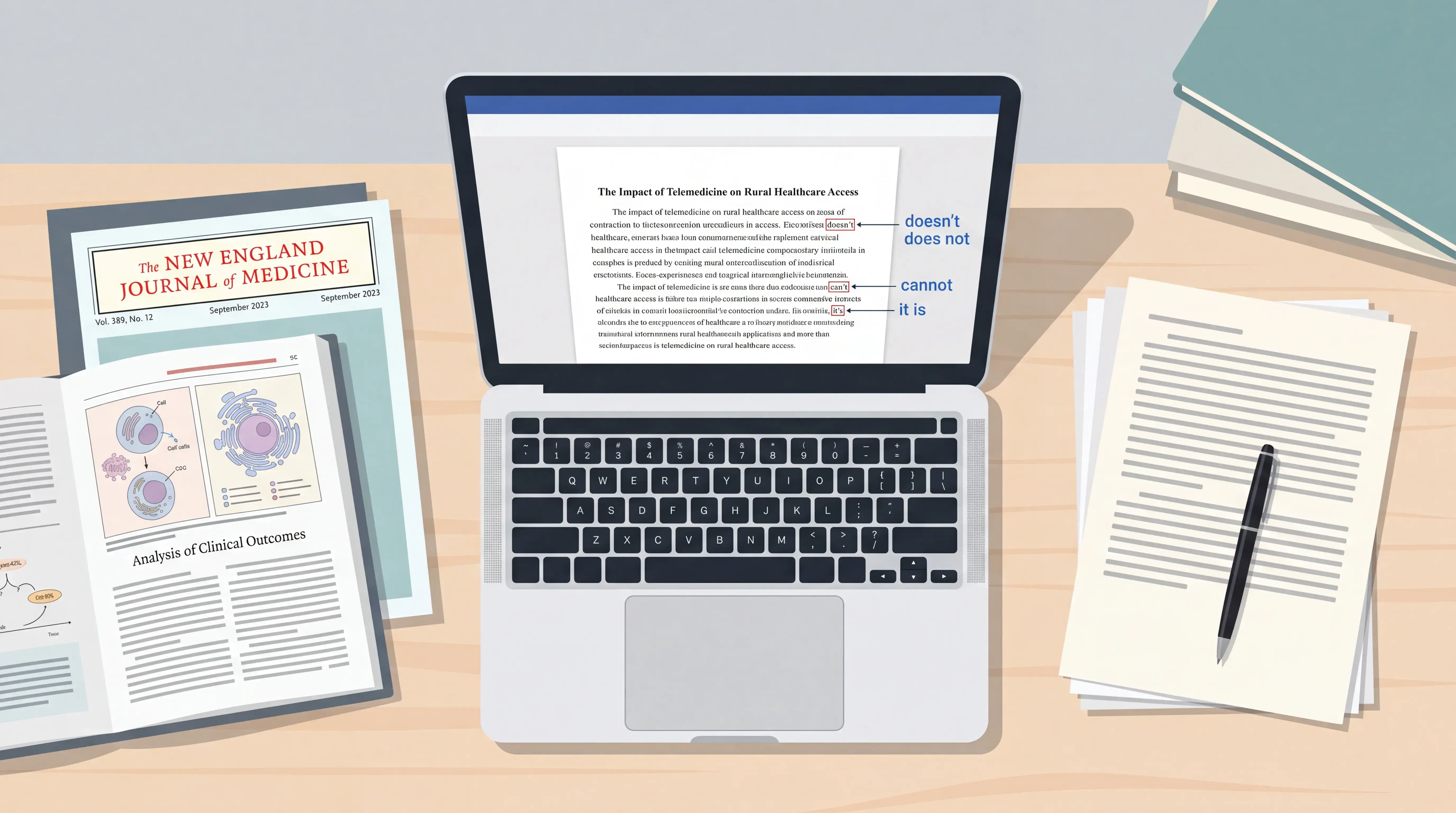
Contractions are shortened forms such as “don’t,” “can’t,” and “it’s.” They are common in speech and informal writing. In a formal essay, they can make the text feel less authoritative.
For medical students, doctors, and researchers, tone matters. A paper should sound measured and objective. Using full forms such as “do not,” “cannot,” and “it is” helps maintain a professional voice.
1.2 Formal Contexts Usually Prefer Full Forms
Academic essays, literature reviews, case analyses, grant proposals, and journal submissions usually expect standard written English. While some style guides allow contractions in limited contexts, most formal scientific writing avoids them.
This is especially important in the body of an essay, where argument structure and clarity carry more weight than conversational flow. A consistent formal register supports readability and trust.
1.3 Contractions Can Create Inconsistency
A single contraction may not ruin a paper. But repeated use can create an uneven style. Readers may notice shifts between academic and casual language.
Consistency is one of the simplest markers of polished writing. If your essay begins formally, it should stay formal throughout.
2. How to Replace Contractions Correctly
2.1 Use the Full Verb Form
The most direct method is simple substitution. Replace each contraction with its expanded form.
Examples:
- do not
- cannot
- it is
- she is
- they have
- would not
This works well in nearly all formal essays. It is fast, clear, and safe.
2.2 Watch for Common Problem Cases
Some contractions are easy to miss because they appear natural in first drafts. Common examples include:
- I’m → I am
- we’re → we are
- isn’t → is not
- there’s → there is or there has
- hasn’t → has not
Be careful with “there’s,” because it may mean either “there is” or “there has.” Choose the correct full form based on grammar and meaning.
2.3 Revise with a Consistent Editing Pass
A useful workflow is to draft freely, then edit for formality. During revision, search for apostrophes and check each one.
A simple checklist helps:
- Find all contractions.
- Expand them to full forms.
- Read the sentence aloud.
- Confirm the tone still sounds academic.
This step is especially useful in long essays, where contractions may appear in quotations, transitions, or conclusions by accident.
3. Practical Strategies for Essay Drafting
3.1 Build Formal Language into the First Draft
The easiest way to avoid contractions in formal writing is to draft in formal style from the beginning. If you naturally write “don’t,” replace it immediately with “do not.”
This reduces the amount of editing later. It also keeps the structure of the essay more consistent across paragraphs.
3.2 Use Templates for Scientific and Academic Sections
Medical and research writing often follows predictable structures. Abstracts, introductions, methods, results, and discussions usually use standard phrasing. Create reusable sentence patterns with full forms.
For example:
- “The data do not support this claim.”
- “It is important to note that…”
- “The findings are not conclusive.”
These patterns help you write efficiently without losing formality.
3.3 Pay Attention to Quoted Material
When an essay includes quotations, contractions may appear inside the source text. In most cases, quoted text should remain unchanged unless you are using brackets or editing for clarity according to style rules.
Outside quotations, however, keep your own writing contraction-free. That distinction preserves academic integrity and avoids confusion.
4. Common Mistakes to Avoid
4.1 Do Not Replace Only Some Contractions
A partial cleanup is not enough. If one paragraph uses “cannot” while another uses “can’t,” the tone becomes uneven. The goal is a uniform style across the entire essay.
4.2 Do Not Confuse Formality with Complexity
Avoiding contractions does not mean using overly long or complex sentences. Formal writing should be clear, not inflated.
For example:
- Weak: “The results cannot be interpreted in a simple way.”
- Better: “The results cannot be interpreted clearly.”
The second version is more direct. It is also easier to read.
4.3 Do Not Overuse Passive Voice
Some writers remove contractions and then make the essay harder to read by relying too much on passive voice. That is not necessary. You can write formally and still stay concise.
A strong essay balances precision with readability. The best formal writing is controlled, not cluttered.
5. How to Edit Faster and More Accurately
5.1 Use Search Tools in Your Editor
Most writing tools allow you to search for apostrophes. This is one of the fastest ways to locate contractions in a draft.
Search for:
- apostrophes
- common forms like “don’t” or “it’s”
- “n’t” endings
This method works well for long academic essays and article drafts.
5.2 Read for Tone, Not Just Grammar
A sentence can be grammatically correct and still sound too casual. When revising, ask whether the sentence would fit in a journal article, clinical report, or formal presentation.
If the answer is no, revise the wording. Tone is as important as grammar in professional essay writing.
5.3 Use AI Support Carefully
Tools like scifocus.ai can help streamline revision for formal writing. For medical students, doctors, and researchers, this matters because time is limited and accuracy is non-negotiable. A strong writing assistant can help identify contractions, improve academic tone, and keep your essay aligned with formal standards.
Used well, scifocus.ai can support faster drafting and cleaner editing. It is especially useful when you need to refine multiple sections, standardize terminology, or check whether your essay sounds appropriately formal before submission.
Conclusion
Avoiding contractions in formal writing is a small edit with a large impact. It improves tone, strengthens credibility, and helps your essay meet academic expectations. The key is consistency. Draft carefully, replace contractions with full forms, and review your text for formal style.
If you write essays for medical school, clinical work, or research, a structured workflow will save time and reduce errors. For faster, more reliable editing support, explore scifocus.ai and use it to produce cleaner, more professional writing.

Did you like this article? Explore a few more related posts.
Start Your Research Journey With Scifocus Today
Create your free Scifocus account today and take your research to the next level. Experience the difference firsthand—your journey to academic excellence starts here.