

How to Assess Risk of Bias in a Systematic Review
Introduction
In every systematic review, the quality of the evidence depends on one core issue: bias. If you cannot assess bias correctly, your essay becomes weak, even if the search is broad and the writing is polished. This is especially important for medical students, clinicians, and researchers who work with prediction models, diagnostic studies, or prognostic research. A rigorous risk of bias assessment is not optional. It is the backbone of a trustworthy systematic review.
1. Why Risk of Bias Matters in a Systematic Review
1.1 Bias changes the meaning of evidence
A systematic review does not simply collect studies. It judges how reliable those studies are. Bias can distort effect estimates, weaken conclusions, and make a treatment or prediction model look better than it really is.
In medical research, even a small methodological flaw can affect clinical decision-making. For example, if patient selection is not representative, the review may overestimate performance. If outcomes are poorly defined, the findings may not apply to real patients.
This is why risk of bias assessment must be built into the review process from the start, not added at the end.
1.2 Risk of bias is different from reporting quality
A study can be well written and still be biased. It can also be poorly reported but methodologically sound. That distinction matters.
Reporting quality asks whether information is described clearly. Risk of bias asks whether the design and conduct of the study could systematically distort the results. A systematic review should judge both, but they are not the same.
For prediction model studies, the distinction is especially important. The original research may look complete, yet still contain bias in participant selection, predictor measurement, outcome definition, or statistical analysis.
2. Choose the Right Appraisal Tool
2.1 Match the tool to the study type
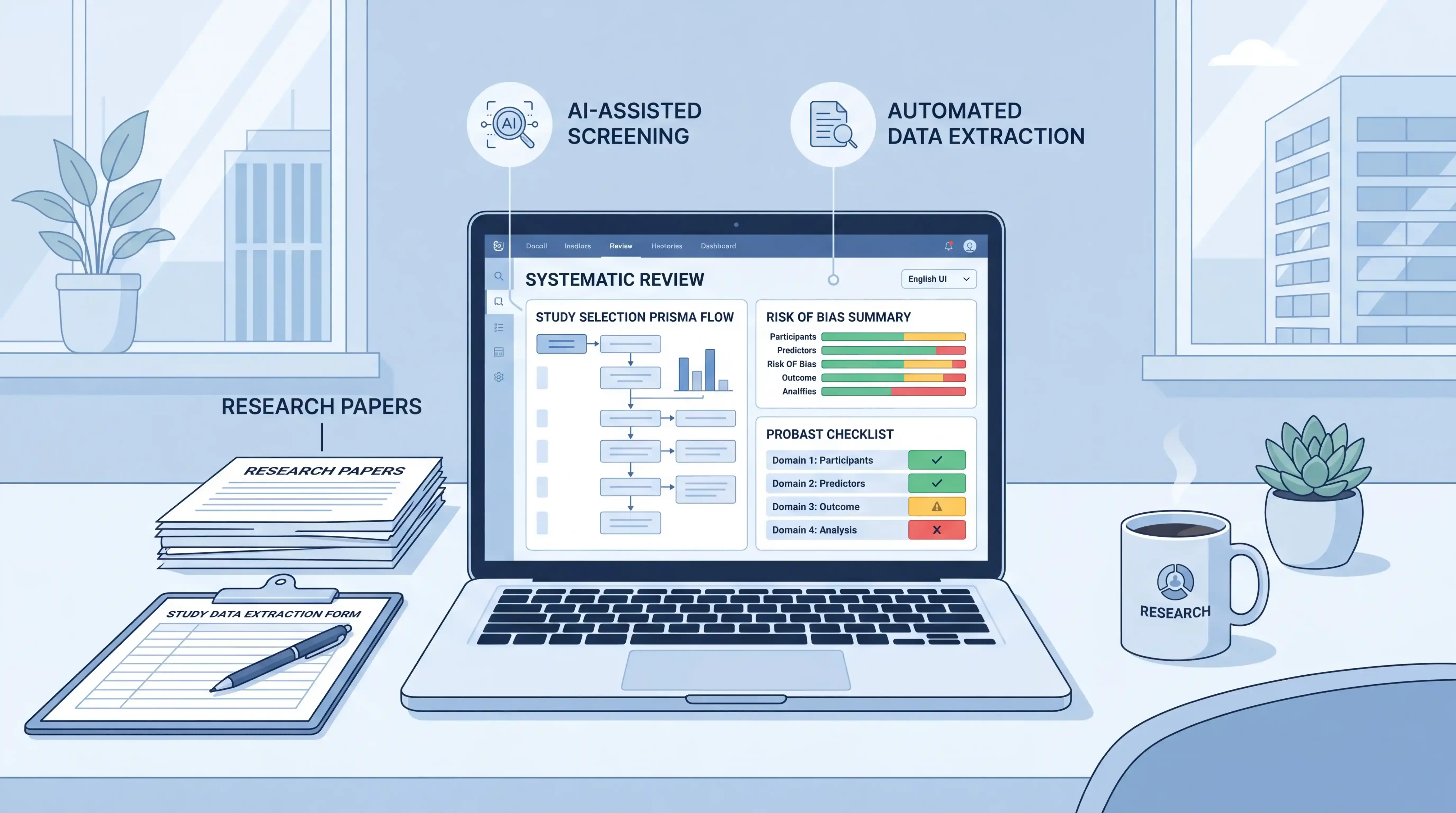
There is no universal tool for every review. The assessment method should fit the type of evidence being reviewed. For prediction model studies, PROBAST is the key instrument. It was designed to assess risk of bias and applicability in studies of diagnostic or prognostic prediction models.
PROBAST is especially useful when the review includes model development, validation, or model updating studies. It is not just a checklist. It forces the reviewer to think through design, conduct, and applicability in a structured way.
2.2 Know what PROBAST evaluates
PROBAST covers four domains:
- Participants
- Predictors
- Outcome
- Analysis
For the first three domains, it also evaluates applicability. Each signaling question helps the reviewer decide whether the study is likely to be biased or not.
The tool uses judgments such as:
- Low risk
- High risk
- Unclear risk
A strong essay should not treat these labels as mechanical outputs. They require clinical and methodological reasoning.
3. Step-by-Step Process to Assess Risk of Bias
3.1 Define the review question first
Before judging bias, define the review question clearly. The research question determines which studies should be included and which tool judgments are relevant. A prediction model review, for example, must specify the target population, predictors, and outcomes.
For systematic reviews of prediction modeling studies, the CHARMS checklist is often used to help structure the question and extract data. This improves consistency and makes later bias assessment more defensible.
3.2 Classify the study type
Not all prediction model studies are the same. You should classify each study before assessment.
Common categories include:
- Model development studies
- Validation studies
- Development and validation studies
This distinction matters because some PROBAST signaling questions do not apply to validation studies. For example, certain analysis questions used in model development are not relevant when the study only validates an existing model.
If you do not classify the study correctly, your risk of bias judgment may be invalid.
3.3 Assess each domain separately
In PROBAST, each domain is judged through signaling questions. The reviewer answers based on the information reported in the original study.
Typical response options are:
- Yes
- Probably yes
- Probably no
- No
- No information
A “yes” generally supports lower risk. A “no” suggests higher risk. “No information” should not be guessed. It should be recorded when the paper does not provide enough detail.
For the analysis domain, common concerns include:
- Too few outcome events relative to candidate predictors
- Dichotomizing continuous variables
- Using univariable selection only
- Automatic forward or backward selection without proper validation
When these problems appear, internal validation and coefficient shrinkage may be needed.
4. How to Judge Each PROBAST Domain
4.1 Participants domain
This domain asks whether the study population matches the review question.
A high-quality study should include participants that are representative of the target population. If the sample is too selective, the model may not work well in practice. Studies based on randomized trials may have stricter inclusion criteria and fewer predictors, which can reduce generalizability. Registry-based studies may be more applicable in some settings.
Ask whether the participants in the original study reflect the patients your review is meant to address. If not, applicability may be limited.
4.2 Predictors domain
Predictors must be defined and measured consistently. Bias can arise when predictor definitions differ across studies or when the timing of measurement varies.
For example, a predictor measured at admission is not the same as one measured after treatment starts. A systematic review should check whether the predictor assessment was standardized and available at the time the model would be used clinically.
This domain is also important for applicability. If the predictor cannot be measured in the intended setting, the model may not be useful even if the study is methodologically sound.
4.3 Outcome domain
Outcomes must be clearly defined and measured without knowledge of the predictors when possible. This is a critical source of bias.
In prediction research, outcome terminology differs by model type:
- Diagnostic models often use a reference standard or gold standard
- Prognostic models often use events such as death, recurrence, complications, or treatment response
A reviewer should check whether outcome assessors had access to predictor information. If they did, or if this is unclear, the risk of bias may increase. The impact of this issue can be greater than a simple checklist score suggests.
4.4 Analysis domain
This is often the most difficult domain. It examines how the data were handled and whether the statistical analysis could bias the results.
Important issues include:
- Overfitting
- Missing data handling
- Inappropriate predictor selection
- Lack of internal validation
- Poor handling of model performance measures
For model development studies, poor event-to-predictor ratios are a common warning sign. If the sample is too small for the number of predictors, the model may look better in development than it will in real-world use.
A model may appear statistically impressive and still be unreliable if the analysis is weak.
5. How to Combine Domain Judgments into an Overall Rating
5.1 Use the “weakest link” principle
Overall risk of bias is not an average. It follows a weakest-link logic. If one domain is judged high risk, the whole study is usually considered high risk.
For example:
- All domains low risk, overall low risk
- One domain high risk, overall high risk
- One domain unclear and others low risk, overall unclear
This approach prevents a strong domain from masking a major flaw elsewhere.
5.2 Do not ignore domain weight
Not every signaling question has the same importance. Some issues affect the final judgment more strongly than others. For example, if clinical outcomes were determined with access to predictor information, that may carry more weight than a minor reporting gap.
A careful reviewer should interpret each domain in context. Risk of bias assessment is not a box-ticking exercise. It requires methodological judgment.
6. Common Mistakes in Risk of Bias Assessment
6.1 Confusing unclear reporting with low bias
If a paper does not describe a method clearly, you should not assume it was done correctly. “Unclear” is not the same as “low risk.”
6.2 Applying the tool without study-type adjustment
Validation studies are not the same as development studies. Some questions in PROBAST do not apply to validation research. If you ignore that, the appraisal becomes inaccurate.
6.3 Treating all domains as equally important
Some reviewers score domains mechanically and then average them. That is not how PROBAST works. One serious problem can outweigh several minor strengths.
6.4 Ignoring applicability
A study may have low bias but still be poorly applicable to your target population. For clinicians, this matters as much as internal validity.
7. How to Write the Bias Assessment in Your Essay
7.1 Be specific and transparent
In your systematic review write-up, explain:
- Which tool you used
- Why it fits the study type
- How many reviewers assessed the studies
- How disagreements were resolved
- How the overall judgment was made
This makes the review more credible and easier to reproduce.
7.2 Use concise, evidence-based language
Avoid vague wording such as “the study seems reliable.” Instead, write:
- “The study was judged at high risk of bias due to inappropriate predictor selection.”
- “Applicability was unclear because the outcome definition differed from the review question.”
- “The analysis domain raised concern because no internal validation was reported.”
These statements show precision and support E-E-A-T standards.
7.3 Present the findings visually
A table or traffic-light plot helps readers understand the pattern of bias across studies. This is especially useful in medical reviews, where readers need fast, structured interpretation.
8. Practical Workflow for Review Teams
8.1 Use a two-reviewer process
To improve reliability, at least two reviewers should assess risk of bias independently. Then discuss disagreements and reach consensus. If needed, involve a third reviewer.
8.2 Document all decisions
Keep a record of why each judgment was made. This is useful during peer review and strengthens transparency.
8.3 Standardize the process with software support
Because PROBAST can be detailed and time-consuming, many teams benefit from workflow tools that organize screening, extraction, and appraisal. For example, scifocus.ai can help streamline evidence handling, reduce manual errors, and support a more efficient systematic review process. That saves time while keeping the assessment structured and reproducible.
Conclusion
Assessing risk of bias in a systematic review requires more than reading abstracts and assigning labels. It demands a structured method, the right tool, and careful judgment. For prediction model studies, PROBAST offers a clear framework across participants, predictors, outcome, and analysis. When applied correctly, it helps you distinguish trustworthy evidence from results that only appear strong. If you want to make your review process faster and more organized, consider using scifocus.ai to support literature handling, data extraction, and quality assessment.
Did you like this article? Explore a few more related posts.
Start Your Research Journey With Scifocus Today
Create your free Scifocus account today and take your research to the next level. Experience the difference firsthand—your journey to academic excellence starts here.