
How to Answer Reviewer Comments on a Grant Application
Introduction
Reviewer comments can feel discouraging, especially after months of work on a grant application. But a revision request is often a sign that your proposal still has a real chance. The key is to answer every point with structure, precision, and respect. In this guide, you will learn how to write a strong essay-style response, revise efficiently, and protect the scientific value of your application.

1. Understand What Reviewer Comments Really Mean
1.1 Treat revision as an opportunity
A major revision usually means the funder sees potential. The application is not rejected outright. That matters. Your goal is not to argue. Your goal is to improve the proposal and make the science easier to trust.
In medical and research funding, reviewers often focus on logic, feasibility, and evidence. If they ask for more data, clearer methods, or stronger justification, they are usually pointing to what blocks confidence. A good response should show that you understood the concern and addressed it directly.
1.2 Separate major and minor issues
Not every comment has the same weight. Some points affect the core hypothesis. Others are about wording, structure, or presentation. You should deal with them separately.
A practical approach is:
- Identify the most serious scientific concerns first.
- Group similar comments together when possible.
- Respond to each item one by one.
- Keep the same order as the reviewer’s list.
Do not skip any point, even if you think it is small. Reviewers notice omissions fast.
2. Build a Clear Point-by-Point Response
2.1 Use a structured response letter
A strong response letter should be easy to scan. It should include:
- a respectful opening,
- a brief statement of appreciation,
- a point-by-point reply to each reviewer,
- a clear note on where revisions were made.
This is where many applicants lose time. They write long paragraphs, but the reviewer cannot quickly see what changed. A better essay structure is direct and organized.
A useful format is:
- Reviewer comment in regular text.
- Your response immediately below it.
- A short note on manuscript changes, if relevant.
Clarity matters more than length.
2.2 Match each comment with an exact response
When replying, do not use vague language such as “we revised the manuscript accordingly.” That is too general. Instead, explain what you changed and why.
For example, if a reviewer asks for more support for a conclusion, your response should say whether you added data, cited higher-quality literature, or softened the claim. If you could not add a new experiment, explain the limitation honestly and show how existing evidence supports the conclusion.
Common response strategies include:
- adding or reanalyzing data,
- clarifying the study design,
- rewriting unclear sentences,
- strengthening citations,
- moderating claims that were too broad.
A precise response is more persuasive than a defensive one.
3. Revise the Grant Application Thoroughly
3.1 Make substantial changes when needed
If the reviewers suggest major revision, the manuscript or grant should be revised deeply, not cosmetically. Strong applications are often improved through revision. In research writing, this means more than editing grammar. It means improving the logic of the argument.
If experiments are feasible, add them. If new data cannot be generated, support the interpretation with stronger literature and a more careful discussion. In some cases, a revised application becomes stronger because the author narrows the claims and strengthens the rationale.
A good revision should show:
- better alignment between question and method,
- stronger support for expected outcomes,
- clearer feasibility,
- tighter connection between aims and evidence.
3.2 Track changes in a readable way
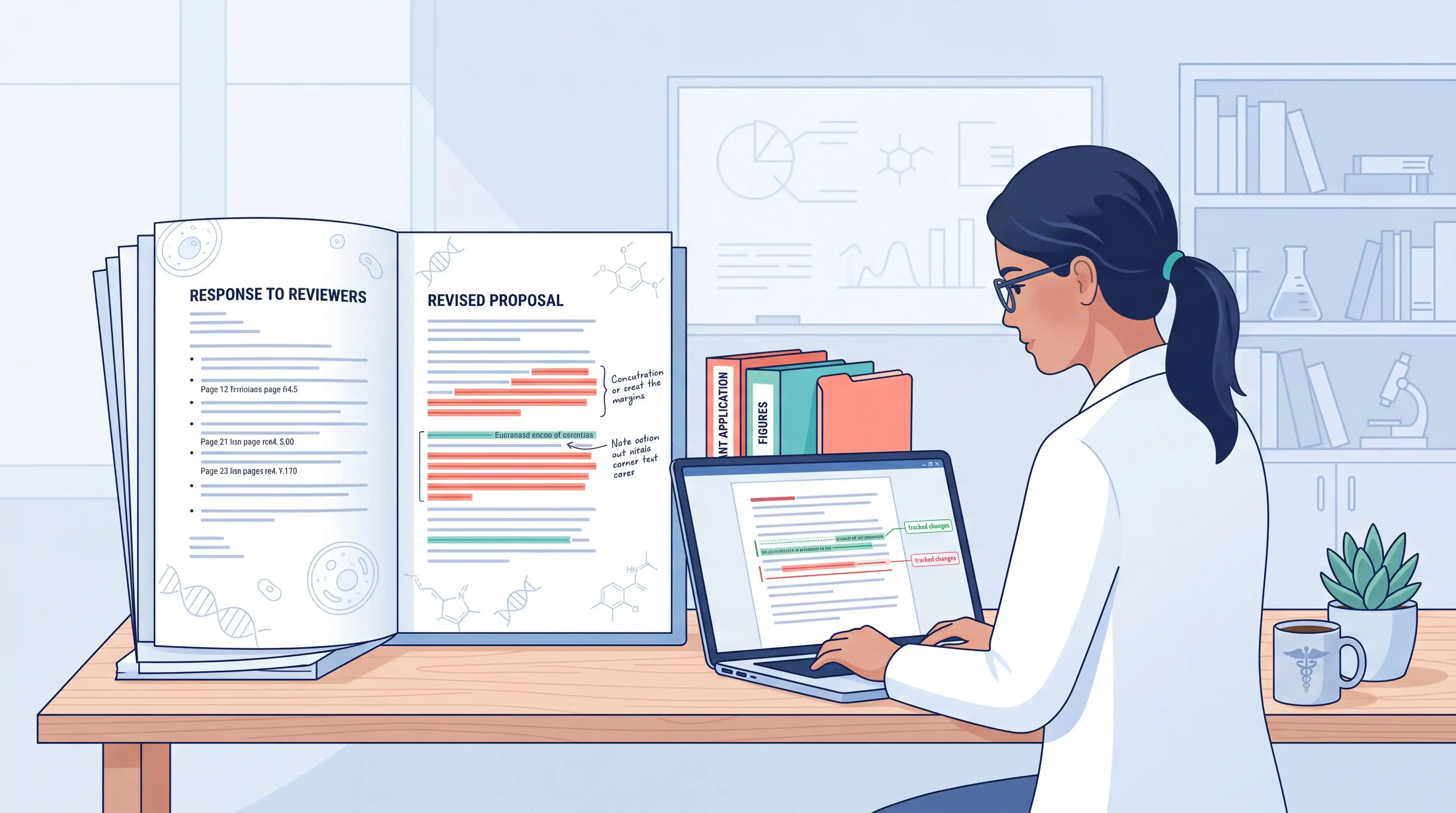
If the revision is light, track changes in Word can work well. If the manuscript has been heavily rewritten, a clean version may be easier to read. In that case, highlight revised sections in a consistent color, such as red or blue, and keep the response letter separate.
This makes it easier for the reviewer to check your changes quickly. It also reduces confusion when multiple sections have been edited.
The best revision is one that is easy to verify.
4. Write in a Professional and Respectful Tone
4.1 Follow academic email etiquette
Many applicants focus on content and forget the basics of communication. That is a mistake. A revision package should include a proper subject line, a respectful salutation, correct names and titles, and a professional closing.
A good opening usually includes:
- appreciation for the editor and reviewers,
- a polite reference to the manuscript title and ID,
- a calm and confident tone.
Avoid sounding emotional, even if the comments were harsh. A professional reply should never read like a complaint. It should read like a scientific update.
4.2 Use polite but firm language
You do not need to agree with every reviewer point in full. But you should always respond respectfully. If the reviewer misunderstood something, explain it clearly. If the reviewer is correct, admit it and revise.
Useful phrases include:
- “We are very sorry for this oversight.”
- “As the reviewer suggested, we have revised this section.”
- “We appreciate this helpful comment.”
- “We have now clarified this point in the manuscript.”
These phrases are simple, but they create trust. Tone is part of the evidence of professionalism.
5. Handle Missing Data or Unfinished Experiments
5.1 Be honest about limitations
Sometimes you cannot complete every requested experiment. Time, funding, samples, or ethics may limit what is possible. In that case, do not pretend the issue does not exist. Address it directly.
You can explain:
- why the experiment could not be added,
- what supporting evidence you used instead,
- how the interpretation remains valid.
If the evidence base is strong enough, cite high-quality literature to support the point. If the claim must be narrowed, narrow it. Reviewers usually respond better to honesty than to overstatement.
5.2 Strengthen the logic with existing evidence
A strong revision does not always require new experiments. Sometimes it requires better reasoning. You may need to explain the mechanism more clearly, define the population better, or show why the design is still sufficient.
This is especially important in medical and translational research, where feasibility is often judged through available samples, technical access, and prior data. A well-supported argument can often reduce reviewer concern even without new lab work.
Good responses protect scientific integrity while improving persuasion.
6. Use a Clean Response Structure That Reviewers Can Follow
6.1 Organize by reviewer, then by comment
A simple and reliable structure is:
- Reviewer 1
- Comment 1
- Response 1
- Comment 2
- Response 2
- Reviewer 2
- Comment 1
- Response 1
This format prevents omissions. It also helps editors see that you handled the revision carefully. If a reviewer’s comment is long, split it into smaller parts before responding. That makes the reply more precise.
You can also use formatting to improve readability:
- bold the reviewer comment,
- keep the response in standard text,
- mark manuscript changes clearly.
This is not decoration. It is usability.
6.2 End with gratitude and confidence
At the end of the response, thank the editor and reviewers again. Keep the message concise. You want to show that you value the feedback and have worked carefully to improve the submission.
A brief closing can say that the revised version has been thoroughly checked and that you hope the changes address all concerns. This keeps the tone professional and positive.
7. Improve Your Workflow with Smart Writing Tools
7.1 Save time without losing precision
Responding to reviewer comments is repetitive, especially when a grant application has multiple reviewers and many line-level edits. A structured writing workflow helps. You need a system that can organize comments, draft responses, track revisions, and keep the language consistent.
That is where a platform like scifocus.ai can help. It can support researchers who need to turn complex reviewer feedback into a clear, organized response. For busy medical students, clinicians, and scientists, this means less time spent formatting and more time spent improving the science.
7.2 Turn revision into a stronger submission
The real value of a good tool is not just speed. It is consistency. When the response letter, revised text, and supporting argument all match, your application becomes much easier to review. That reduces friction and improves the chance of a favorable decision.
If you are preparing a resubmission, consider using scifocus.ai to streamline drafting, organize responses, and refine the final essay-style letter. The goal is simple: make your revision clearer, faster, and more persuasive.
Conclusion
Answering reviewer comments on a grant application is a scientific task, not a defensive one. The best response is structured, respectful, and specific. Address every point. Revise deeply when needed. Be honest about limitations. And make it easy for reviewers to verify what changed. If you want to work faster without sacrificing quality, scifocus.ai can help you manage reviewer feedback and produce a cleaner, stronger revision package.
Did you like this article? Explore a few more related posts.
Start Your Research Journey With Scifocus Today
Create your free Scifocus account today and take your research to the next level. Experience the difference firsthand—your journey to academic excellence starts here.