
How Many Words Is a College Admission Essay
Introduction
A college admission essay is often the last thing between a strong applicant and a completed application. Yet one question causes constant stress: how long should it be? If you write too little, you may seem careless. If you write too much, you may violate the rules. For applicants in medicine, research, or clinical training, where precision already matters, the same rule applies here: a college admission essay must be concise, relevant, and deliberate. The right word count is not just a limit. It is part of the strategy.

1. What Is the Typical Word Count for a College Admission Essay?
1.1 The most common range
Most college admission essay prompts ask for 250 to 650 words. The exact range depends on the application platform and the school. For example, many personal statement prompts on shared application systems sit near the middle of that range. Supplemental essays are often shorter, sometimes only 100 to 300 words.
In practice, the safest approach is to follow the stated limit exactly. Admissions readers notice when applicants ignore instructions. A strong essay does not win by being longer. It wins by being focused.
1.2 Why word count matters
Word count is not a technical detail. It tests judgment. Schools want to know whether you can communicate clearly under constraints. That matters in medicine and research, too, where clarity, brevity, and accuracy are essential.
A well-structured essay should do three things:
- Answer the prompt directly.
- Show your voice and perspective.
- Stay within the required range.
If a school asks for 500 words, do not submit 700. If it asks for 300, do not submit 150. Respecting the limit signals discipline.
2. Why College Admission Essays Are Usually Short
2.1 Admissions teams read thousands of files
Admissions officers review large volumes of applications. A shorter essay helps them evaluate each student efficiently. That is one reason the college admission essay is usually concise.
This format also pushes you to prioritize. You cannot include everything. You must choose one story, one turning point, or one clear message. That restriction often improves writing quality.
2.2 Short does not mean shallow
A short essay still needs depth. A 250-word response can be powerful if every sentence earns its place. The best essays use specific details, not broad claims.
For example, instead of saying you are “passionate about medicine,” show:
- A patient interaction that changed your thinking.
- A research question that sharpened your curiosity.
- A leadership moment that revealed your values.
Specificity is what makes a short essay memorable.
3. What Should Be Included in the Essay?
3.1 Core information admissions officers expect
According to common application guidance, a strong essay often includes:
- Personal background and experiences.
- Academic interests and achievements.
- Extracurricular activities and leadership.
- Personal values such as integrity, persistence, and empathy.
- Future goals and how the school fits those goals.
This does not mean you must cover all of these in one essay. It means your chosen topic should help the reader understand who you are and where you are going.
3.2 Details that strengthen the narrative
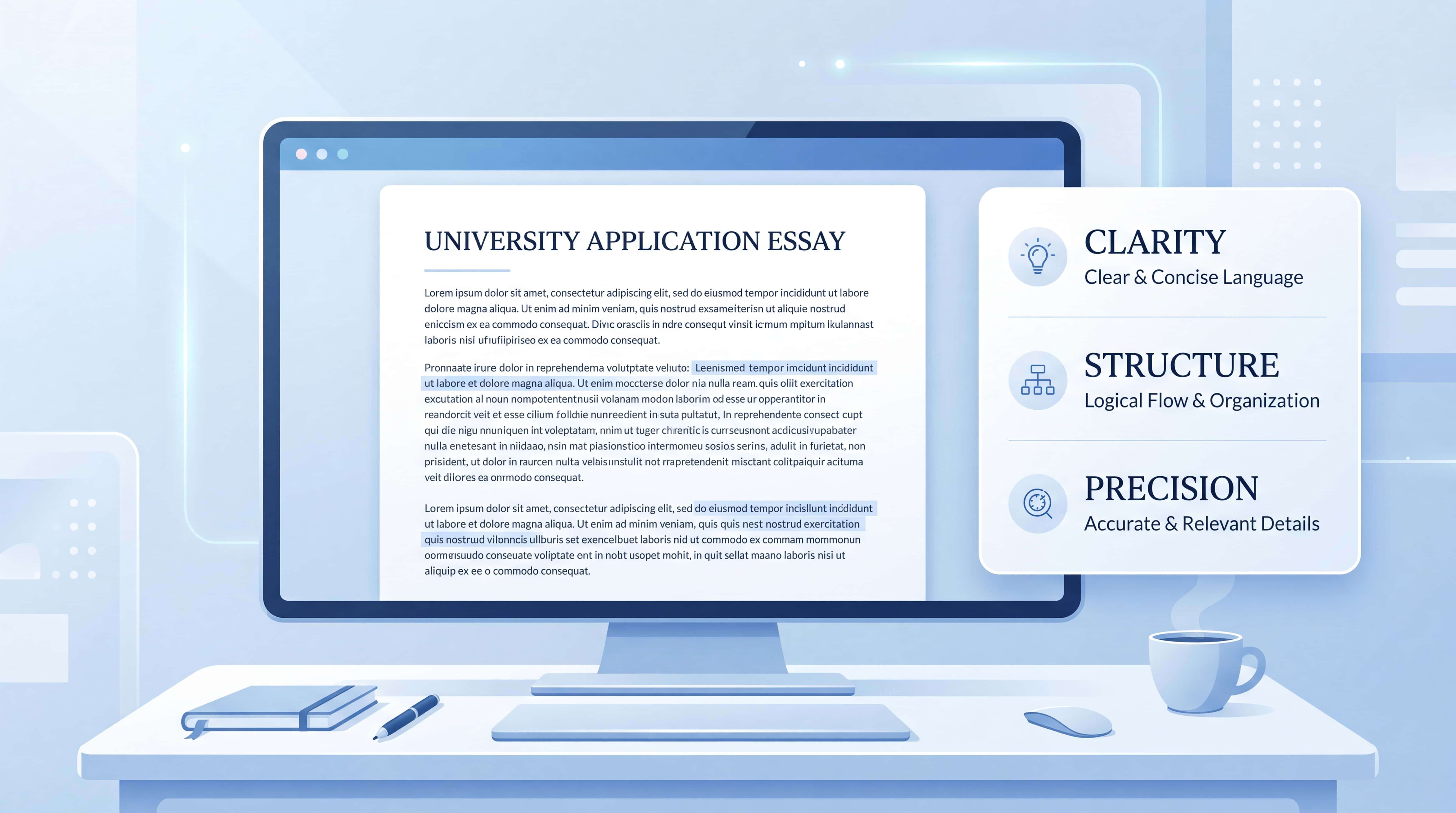
A strong college admission essay often includes a unique personal story, a clear connection to the school or program, and evidence of reflection. For medical students or researchers, that reflection is especially important.
Ask yourself:
- What did I learn from this experience?
- How did it shape my goals?
- Why does this story matter now?
Reflection is more valuable than self-praise. A good essay shows growth, not just achievement.
4. How to Stay Within the Word Limit Without Losing Impact
4.1 Use one main idea
Do not try to write your entire life story. Choose one central idea and build around it. If the prompt asks about motivation, focus on one experience that reveals your motivation clearly.
A practical structure is:
- Open with a specific scene or fact.
- Explain what happened.
- Connect it to your values or goals.
- End with a forward-looking conclusion.
This structure works well because it keeps the essay organized and easy to follow.
4.2 Cut repetition and filler
Many applicants lose word count on unnecessary phrases. Remove:
- Repeated ideas.
- Empty introductions.
- Vague adjectives.
- Overexplained background.
Replace long sentences with precise ones. For example, “I have always been deeply interested in the field of medicine” can become a more direct, concrete sentence tied to an actual experience.
Concise writing looks more confident.
4.3 Revise with a counting strategy
Draft first, then edit aggressively. A practical revision process is:
- Write 10 to 20 percent over the limit.
- Cut repeated ideas.
- Replace general statements with examples.
- Check whether each sentence advances the purpose.
This is especially useful if your first draft feels emotionally strong but structurally loose.
5. Common Mistakes to Avoid
5.1 Ignoring the prompt
A strong essay must answer the actual question. If the prompt asks about a challenge, do not write only about success. If it asks about a meaningful activity, do not turn it into a full autobiography.
5.2 Sounding generic
Admissions readers can quickly spot essays that sound copied, formulaic, or overly polished without substance. The knowledge base specifically warns against formulaic, template-driven writing, which constitutes a critical flaw.
Avoid overused themes unless you can make them deeply personal. What matters is not the topic alone. It is the angle, detail, and honesty.
5.3 Mismatch between essay and application
Your essay should align with your activity list, awards, and overall application. If your essay presents you as a committed researcher, but your record shows no sustained research involvement, the application feels inconsistent.
Consistency builds trust. Inconsistent narratives weaken credibility.
6. How Scifocus.ai Can Help You Write a Better Essay
6.1 A better workflow for busy applicants
For students in medicine, clinical practice, or research, time is limited. Drafting and refining an application essay can be difficult when you are already managing exams, patients, experiments, or publications.
This is where scifocus.ai can help. It supports a more structured writing process, so you can:
- Organize your ideas faster.
- Keep your essay aligned with the prompt.
- Refine clarity, tone, and structure.
- Reduce the risk of weak or inconsistent messaging.
6.2 Why structure matters for conversion
A strong application essay is not just about writing skill. It is about presenting a coherent story under strict limits. Scifocus.ai can help you turn scattered notes into a focused narrative that fits the word count and the admissions context.
When the essay is sharp, the application becomes stronger. That is especially important for applicants competing in selective programs where every detail matters.
7. Final Checklist Before You Submit
7.1 Review these points
Before submitting your college admission essay, confirm that:
- It follows the word limit exactly.
- It answers the prompt directly.
- It shows your personal voice.
- It includes specific evidence.
- It matches the rest of your application.
- It has been proofread for grammar and clarity.
7.2 What a strong essay should accomplish
A good essay does not try to impress with volume. It impresses with control. It helps the admissions team understand your background, your motivation, and your potential.
For medical students, doctors, and researchers, that means writing with the same discipline expected in professional work: accurate, concise, and purposeful.
Conclusion
So, how many words is a college admission essay? Usually 250 to 650 words, depending on the prompt. But the real answer is not just the number. The real goal is to write an essay that is clear, specific, and fully aligned with the application. If you want to reduce stress and improve your draft quality, use a structured workflow and consider scifocus.ai as a writing support tool. A strong essay does not waste words. It makes every word count.
Did you like this article? Explore a few more related posts.
Start Your Research Journey With Scifocus Today
Create your free Scifocus account today and take your research to the next level. Experience the difference firsthand—your journey to academic excellence starts here.