

How Many Paragraphs in an Essay?
Introduction
If you have ever stared at a blank page and asked, “How many paragraphs in an essay should I write?”, you are not alone. For medical students, doctors, and researchers, the answer matters because clarity, speed, and structure affect both academic performance and scientific communication. The best essay is not the longest one. It is the one that matches the purpose, audience, and evidence. In this guide, you will learn the standard paragraph ranges, when to use each structure, and how to write an essay that feels precise, professional, and readable.
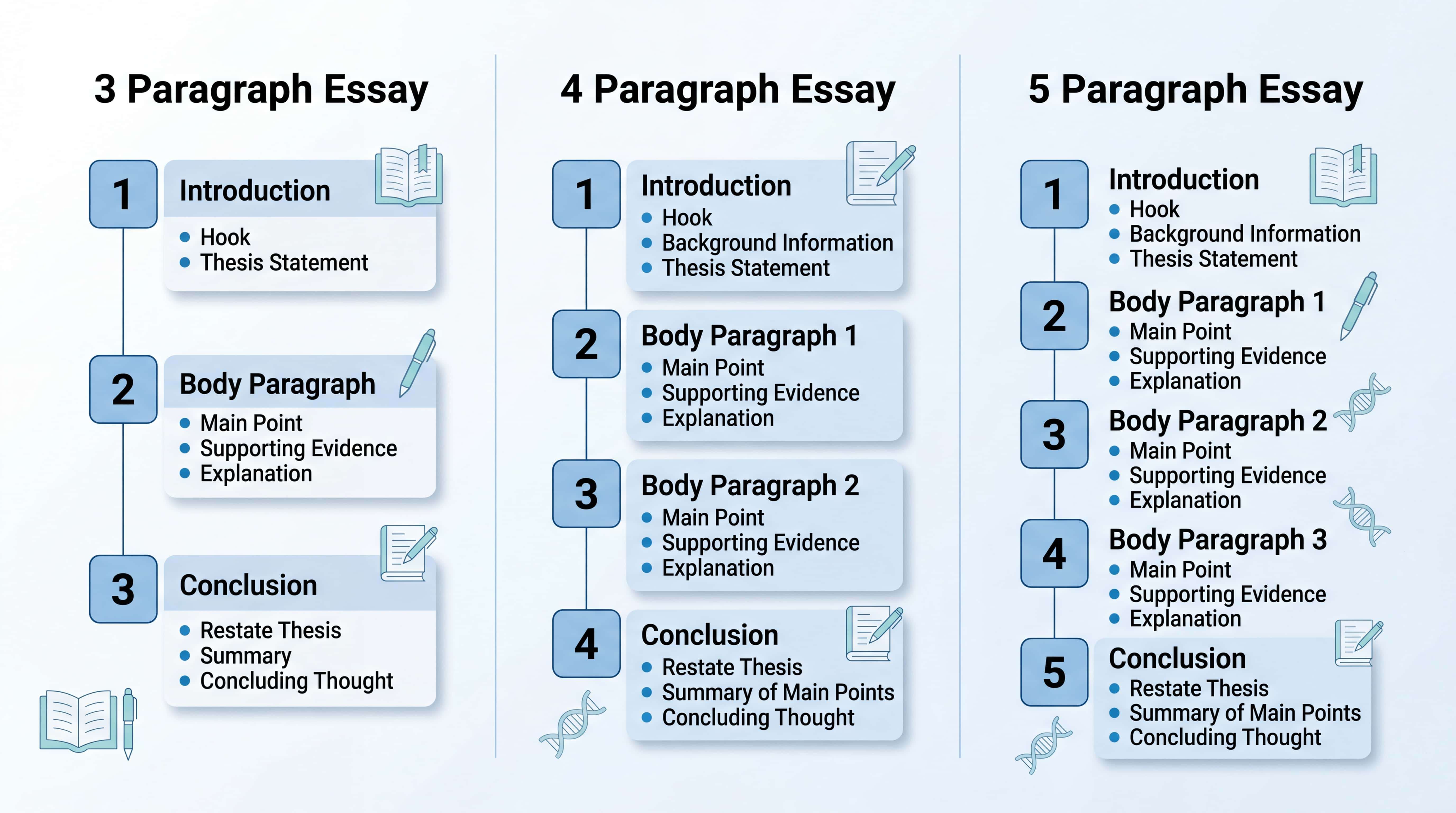
1. The Short Answer: Most Essays Use 3 to 5 Paragraphs
1.1 The standard academic structure
In most cases, an essay has three core parts: introduction, body, and conclusion. That means a simple essay can be written in three paragraphs. This is often the minimum structure when the topic is narrow and the argument is direct.
For more complex topics, especially in medicine and research, an essay often expands to five paragraphs. This is the classic format taught in academic writing: one introduction, three body paragraphs, and one conclusion. It works well because it creates a clear logic flow.
In practice, the right number of paragraphs depends on how many main points you need to prove. If your essay has one central claim and two supporting ideas, three paragraphs may be enough. If it has three major claims, five paragraphs is often better.
1.2 Why paragraph count matters
Paragraph count is not only about length. It affects readability, argument strength, and scoring. A paragraph should usually develop one main idea. If you put too many ideas into one paragraph, the structure becomes weak. If you split one idea across too many short paragraphs, the writing feels fragmented.
For students in medical education or scientific training, this matters even more. Reviewers and instructors expect logical progression. A well-built essay makes it easier to follow your argument. Good structure reduces cognitive load for the reader.
2. When a 3-Paragraph Essay Works
2.1 Best for short, focused responses
A three-paragraph essay is useful when the assignment is brief or the question is highly specific. For example, a short reflective response, a discussion post, or a basic explanation may only need:
- One introduction paragraph
- One body paragraph
- One conclusion paragraph
This format is efficient. It is also useful when you need to write quickly under time pressure. In exams, concise essays often perform better than long but unfocused ones.
For medical students, this format can be ideal for explaining a single mechanism, a clinical observation, or a brief interpretation of a result. The key is to stay focused. One paragraph should not try to do the work of three.
2.2 Limits of the 3-paragraph format
The main risk is oversimplification. If your topic involves evidence, comparison, or critique, three paragraphs may be too tight. You may not have enough space to define the issue and support it properly.
This is especially true in scientific writing. A good essay often needs context before the argument becomes clear. If the topic includes disease mechanisms, pathways, or experimental logic, one body paragraph may not be enough. In that case, expand the structure rather than forcing everything into a minimal format.
3. When a 5-Paragraph Essay Is the Best Choice
3.1 The classic academic model
The five-paragraph essay remains one of the most reliable structures for formal writing. It usually includes:
- Introduction
- Body paragraph 1
- Body paragraph 2
- Body paragraph 3
- Conclusion
This model works well because it creates balance. Each body paragraph can develop one main point. That makes the essay easier to organize and easier to read.
For many academic tasks, five paragraphs is the safest default. It gives you enough room to define the topic, support the argument, and close with a clear conclusion. It is also easier to revise because the logic is visible from the start.
3.2 Why it suits medical and research readers
Medical and research audiences value precision. They want claims tied to evidence. They also expect a clear sequence. The five-paragraph essay supports that style because it encourages:
- A focused thesis
- Distinct supporting points
- Controlled paragraph length
- A clear final takeaway
If you are writing about a clinical problem, a research trend, or a scientific concept, this structure helps you avoid digression. Each paragraph has a job. That makes the essay more persuasive.
4. When You Need More Than 5 Paragraphs
4.1 Complex topics need more space
Not every essay fits into five paragraphs. Longer academic essays often need six, eight, or more paragraphs. This is common when you must compare multiple studies, explain a mechanism step by step, or analyze conflicting evidence.
In medical writing, complexity is normal. A topic may require background, epidemiology, pathophysiology, intervention, limitations, and implications. Each of those may deserve its own paragraph. If one paragraph contains more than one major idea, the essay may already be too compressed.
A useful rule is this: one paragraph should answer one question. If your essay has four or five real questions to cover, then four or five body paragraphs may be necessary.
4.2 Signs you should expand the essay
You probably need more paragraphs if:
- Your topic has multiple layers
- Your evidence comes from several studies
- You need to explain a process in steps
- Your reader needs background before the argument
- Your conclusion depends on comparing alternatives
In research-focused writing, this is common. A topic may move from disease context to molecular target to signaling pathway to experimental implication. That is not a weakness. It is a sign that the essay deserves more structure.
5. How to Decide the Right Number of Paragraphs
5.1 Start with the thesis and major points
The easiest way to decide paragraph count is to map your main points first. Write your thesis in one sentence. Then list the supporting ideas. Each major point usually becomes one body paragraph.
For example:
- Point 1: Define the problem
- Point 2: Explain the evidence
- Point 3: Discuss the implications
That structure naturally leads to a five-paragraph essay. If you only have one supporting point, a three-paragraph essay may be enough. If you have four or five points, you need a longer essay.
This is the same logic used in strong scientific writing. Structure follows argument. Not the other way around.
5.2 Use paragraph purpose, not paragraph count
A professional writer does not count paragraphs first. A professional writer assigns purpose first. Ask:
- What does this paragraph do?
- Is it introducing, proving, comparing, or concluding?
- Does it contain one main idea?
- Can it stand alone clearly?
If the answer is no, restructure it. A clean essay should feel like a sequence of controlled steps. That is true whether you write 3 paragraphs or 10.
6. A Practical Formula for Medical Students and Researchers
6.1 A simple planning method
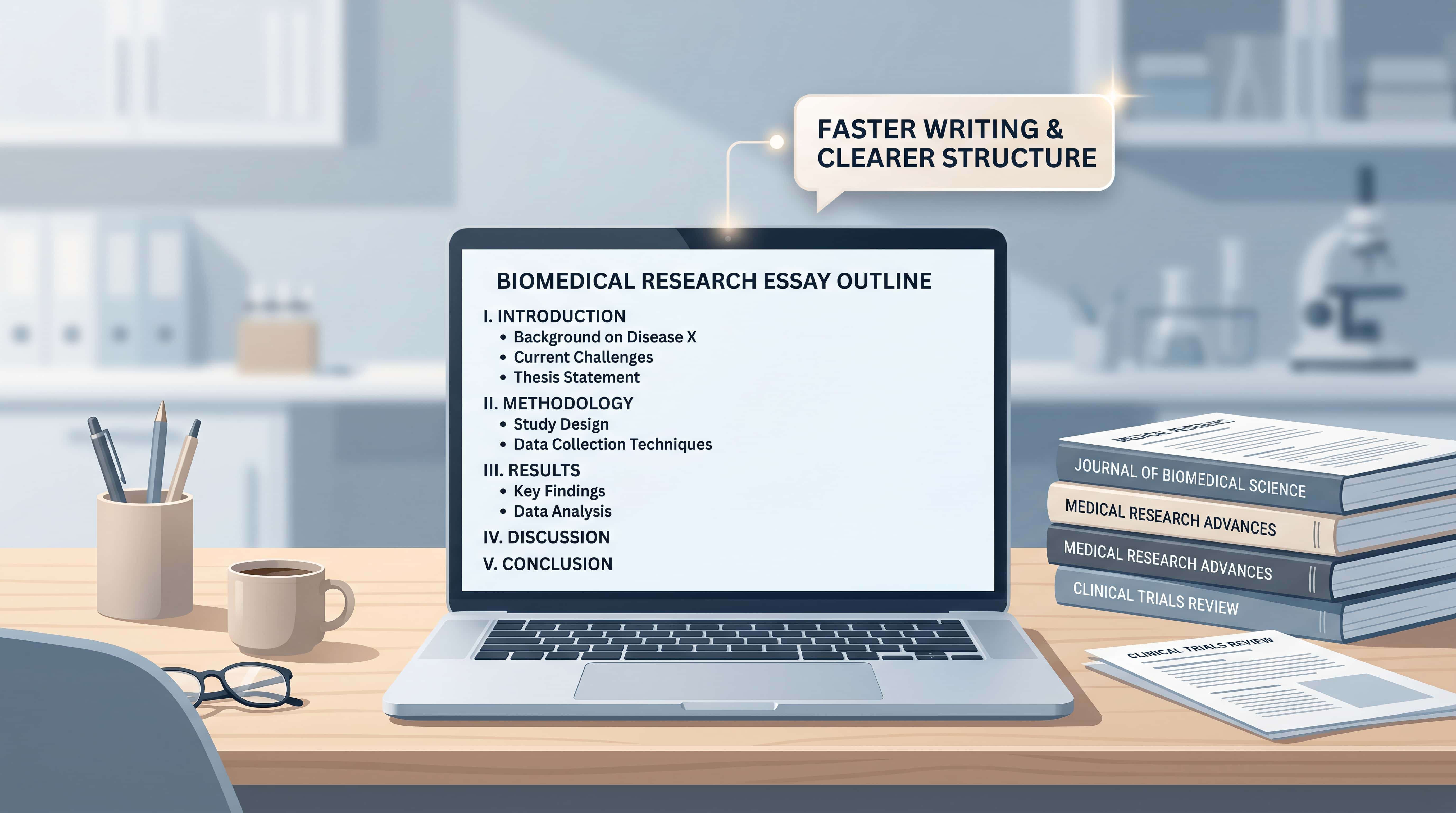
Before writing, build a mini outline. This takes only a few minutes and can save much more time later.
Try this:
- Write the topic.
- Write the thesis.
- List 2 to 4 supporting points.
- Assign one paragraph to each point.
- Add an introduction and conclusion.
This method is especially useful when you are under deadline. It keeps the essay focused and prevents repetition. It also improves drafting speed, which matters in academic work.
If you often struggle with structure, tools like scifocus.ai can help you organize ideas faster. It is especially useful when you need to move from raw notes to a clean, evidence-based outline. For medical and research writing, that can save time and reduce revision burden.
6.2 A professional writing standard
A strong essay should feel coherent from first sentence to final sentence. That means each paragraph must connect clearly to the thesis. It also means transitions should be smooth.
A simple professional check is this:
- Does the introduction state the problem?
- Does each body paragraph support one point?
- Does the conclusion answer the main question?
If yes, your paragraph count is probably appropriate. If not, the issue is not length. The issue is structure.
7. Common Mistakes to Avoid
7.1 Forcing the wrong format
One common mistake is using a five-paragraph template for every topic. That can weaken your writing. Some topics need less. Others need more. Forcing the same pattern everywhere can make the essay feel artificial.
Another mistake is writing paragraphs that are too long. If a paragraph contains several unrelated ideas, the reader loses the thread. In academic writing, clarity matters more than density.
7.2 Ignoring audience expectations
Your audience matters. A classroom essay may tolerate a simple structure. A research-oriented essay usually requires more nuance. For medical students, doctors, and scientists, the expected level of detail is higher.
So the right question is not only “How many paragraphs in an essay?” The better question is “How many paragraphs are needed to make the argument complete, accurate, and readable?”
Conclusion
The answer to how many paragraphs in an essay is simple in principle and flexible in practice. A short essay may use three paragraphs. A standard academic essay often uses five. A complex medical or research topic may require more. The best structure is the one that matches your thesis, evidence, and audience.
If you want to write faster and structure better, start with an outline and let the argument define the paragraph count. For medical, doctoral, and research-level writing, that approach is more reliable than guessing. If you need help turning ideas into a clear academic essay, explore scifocus.ai and streamline your writing workflow.
Did you like this article? Explore a few more related posts.
Start Your Research Journey With Scifocus Today
Create your free Scifocus account today and take your research to the next level. Experience the difference firsthand—your journey to academic excellence starts here.