

How Many Pages Is 2000 Words
Introduction
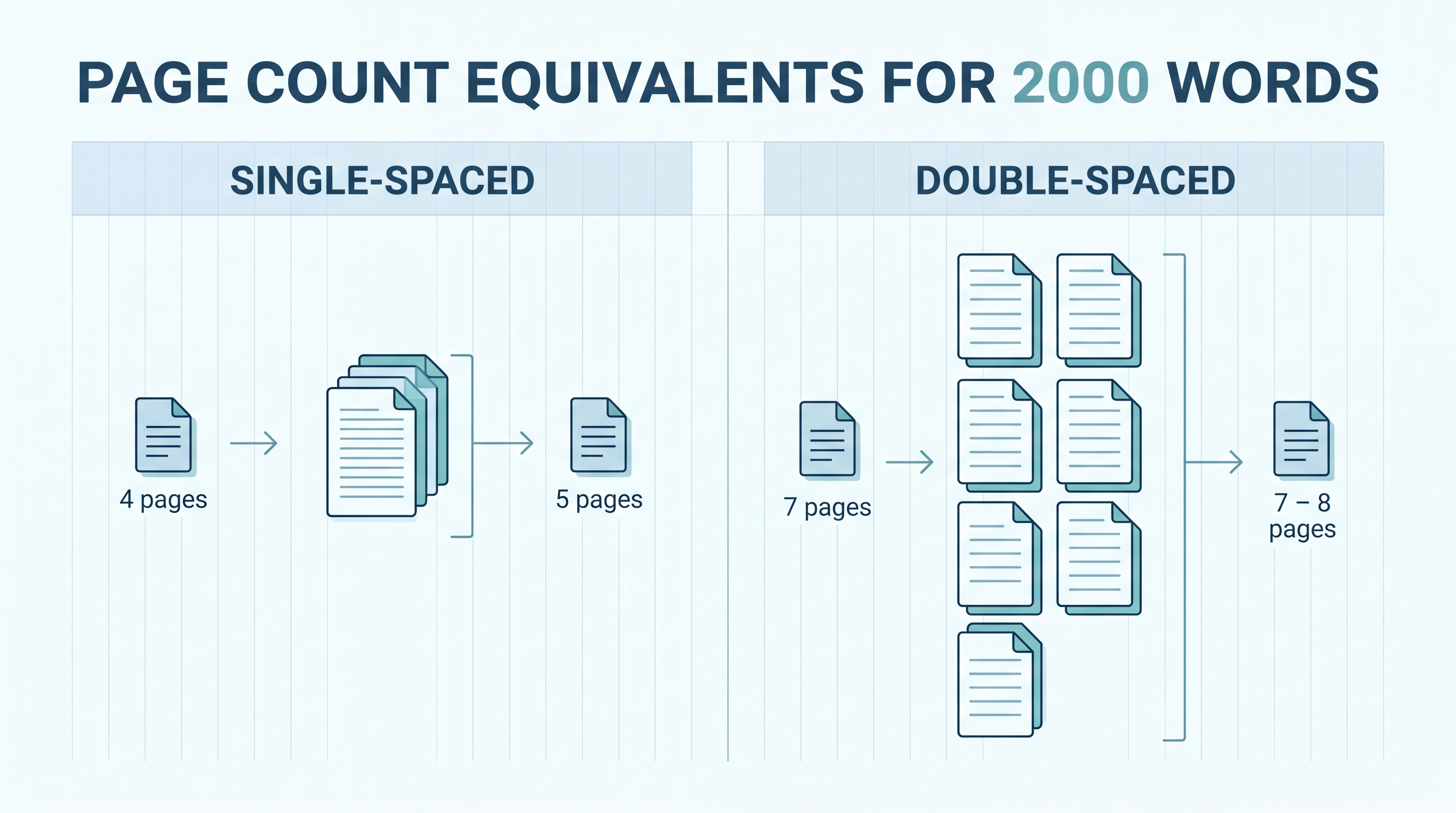
If you are writing an essay, one of the first practical questions is simple: how many pages is 2000 words? The answer matters for medical students, doctors, and researchers who need to plan time, manage structure, and meet submission rules. The short answer is that the page count depends on font, spacing, margins, and formatting. A 2000-word essay is usually about 4 pages single-spaced or 8 pages double-spaced in standard academic format.
1. What 2000 Words Usually Looks Like on the Page
1.1 Standard page count by formatting
The most common estimate for a 2000-word essay is based on Times New Roman, 12-point font, 1-inch margins.
- Single-spaced: about 4 pages
- Double-spaced: about 8 pages
- 1.5 spacing: about 5 to 6 pages
These are practical estimates, not fixed rules. The final page count changes when your essay includes headings, tables, references, figures, or long quotations. For medical writing, that difference can be meaningful because journal-style formatting often compresses or expands text differently.
1.2 Why the number is never exact
A 2000-word essay is not a fixed page number because page layout is a visual format, while word count is a text measure. Two documents with the same word count can differ by one or more pages.
Common factors include:
- Font type, such as Arial, Calibri, or Times New Roman
- Font size
- Line spacing
- Margin width
- Paragraph breaks
- Block quotes
- Footnotes and references
This is why the same 2000-word essay can look short in one document and long in another. For researchers and clinicians preparing structured academic writing, understanding this helps avoid formatting mistakes before submission.
2. How Formatting Changes the Page Count
2.1 Font and spacing matter most
Among all formatting variables, line spacing has the biggest impact. Double spacing nearly halves the amount of text per page compared with single spacing. That is why a 2000-word essay commonly becomes around 8 pages when double spaced.
Font also matters. For example:
- Times New Roman usually takes less space than Arial
- Larger fonts increase page count
- Narrow margins reduce page count
If you are drafting an essay for a medical course, always check the required style guide first. APA, MLA, Chicago, and institutional formats do not always use the same layout rules.
2.2 References can change the count
In academic writing, references may or may not be included in the word count. That policy changes the final length of the paper. Some schools count only the body text. Others include in-text citations but exclude the reference list.
This matters because a 2000-word essay with a full reference list may occupy more pages than expected, even if the main argument is concise. For evidence-based writing in medicine, references are essential, but they still need clean organization.
A practical rule is this:
- Write the main content first.
- Check whether references are counted.
- Format the bibliography last.
- Recheck the final page count after editing.
3. How to Plan a 2000-Word Essay Efficiently
3.1 Use a modular structure
A strong essay is easier to write when broken into sections. This is especially useful for medical students, doctors, and researchers who often work under time pressure. A modular approach also improves clarity and helps maintain logical flow.
A simple structure for a 2000-word essay is:
- Introduction: 150 to 250 words
- Main body: 1500 to 1700 words
- Conclusion: 100 to 150 words
This structure keeps the essay focused and prevents word-count drift. It also helps you allocate space to the most important points instead of overwriting background material.
3.2 Draft from evidence, not from decoration
In professional writing, especially in scientific or clinical contexts, the goal is not to fill pages. The goal is to build a clear argument supported by evidence. That is why a well-written 2000-word essay should feel dense, not padded.
A useful writing workflow is:
- Collect key sources first
- Extract the core argument
- Write topic sentences before drafting details
- Add only relevant supporting evidence
- Edit for clarity and redundancy
This approach saves time and improves readability. A concise essay with strong structure is usually more persuasive than a longer essay with weak logic.
4. Common Mistakes That Affect Essay Length
4.1 Overexplaining background information
Many writers spend too much space on general background. In academic essays, that weakens the central argument and makes the paper look longer without adding value. This is a common problem in medical writing, where the temptation to explain every concept is strong.
Instead, keep background brief and purposeful. Each paragraph should support the main thesis. If a sentence does not move the argument forward, remove it.
4.2 Ignoring the final formatting pass
Many people estimate page count before they finish editing. That is risky. Editing can add or remove several hundred words. Tables, bullet points, and citation style can also change the layout.
Before submission, check:
- Actual word count
- Spacing
- Margin settings
- Heading levels
- Citation format
- Reference list length
A final formatting review is essential if you need a precise page count for an essay. This is especially true for busy clinicians and researchers who cannot afford avoidable submission errors.
5. A Better Way to Write Faster and More Accurately
5.1 Reduce friction in the writing process
For many medical students and researchers, the real challenge is not only writing an essay. It is organizing evidence, building structure, and keeping the argument coherent under time limits. A tool like scifocus.ai can help streamline that process.
It can support faster topic organization, clearer outlining, and more efficient drafting. For users who write frequently, that means less time spent on formatting chaos and more time spent on content quality. If your essay must be accurate, structured, and submission-ready, workflow support matters.
5.2 Why this matters for academic and clinical users
In clinical and research settings, time is limited. Drafting an essay from scratch often means switching between sources, notes, and formatting rules. That slows progress and increases the chance of inconsistency.
A structured writing assistant can help you:
- Organize key points faster
- Build a cleaner outline
- Keep section lengths balanced
- Reduce repetitive editing
- Maintain a more professional presentation
For professionals who need reliable output, this is not just convenient. It is efficient. scifocus.ai is designed to support that kind of focused academic work.
Conclusion
So, how many pages is 2000 words? In most academic settings, the answer is about 4 pages single-spaced or 8 pages double-spaced, but the exact count depends on formatting and document style. If you are writing an essay for medical school, clinical training, or research, the best approach is to plan by word count first, then confirm the final page count after formatting.
A strong essay is not only about length. It is about clarity, structure, and evidence. If you want to write faster and manage that process more effectively, consider using scifocus.ai to support your next draft.

Did you like this article? Explore a few more related posts.
Start Your Research Journey With Scifocus Today
Create your free Scifocus account today and take your research to the next level. Experience the difference firsthand—your journey to academic excellence starts here.