
How Is Artificial Intelligence Transforming Literature Reviews? Exploring Cutting-Edge Applications in Biomedicine
Writing a literature review in biomedicine is time-consuming, repetitive, and easy to get wrong. Papers are expanding fast. Evidence is scattered across trials, cohorts, omics studies, and guidelines. For medical students, clinicians, and researchers, the challenge is not only reading more. It is finding the right evidence, judging quality, and turning it into a clear argument. Artificial intelligence is changing how a literature review is planned, screened, synthesized, and written.
1. Why Literature Reviews Are Harder Than Ever
1.1 The volume of evidence keeps growing
Biomedical publishing is accelerating. PubMed alone adds thousands of records every day. A traditional literature review often requires manual searching, title screening, abstract screening, full-text extraction, and comparison across studies. This can take weeks.
The problem is not just quantity. It is heterogeneity. One paper may report cell-line data. Another may use a mouse model. A third may focus on clinical endpoints. Linking them into one coherent narrative requires expertise and time.
1.2 Human review is still essential, but it has limits
A strong literature review needs clinical context, mechanistic reasoning, and careful interpretation. AI cannot replace expert judgment. But it can reduce low-value work.
Common bottlenecks include:
- Duplicate search results.
- Missed synonyms and related terms.
- Inconsistent screening decisions.
- Slow data extraction.
- Weak linkage between findings and conclusions.
This is where AI adds value: speed, consistency, and scale.
2. How AI Improves the Review Workflow
2.1 Smarter searching and screening
AI-supported tools can expand search terms, detect synonyms, and rank relevant studies more efficiently than keyword search alone. In biomedical literature review work, this matters because many concepts have multiple names. For example, one disease may appear under pathology terms, clinical terms, or gene-level terms.
AI can also support title and abstract screening by learning inclusion criteria from examples. That reduces manual burden in large review projects. In systematic review workflows, this can save substantial screening time, especially when hundreds or thousands of records are involved.
2.2 Better extraction and organization
A high-quality literature review depends on accurate extraction. AI can help identify:
- Study design.
- Sample size.
- Intervention or exposure.
- Outcomes.
- Limitations.
- Mechanistic claims.
This is especially useful in biomedicine, where data are often described in dense prose. Instead of reading every paragraph repeatedly, researchers can use AI to build a structured evidence table, then verify each item against the source paper.
The key rule is simple: AI can accelerate extraction, but experts must validate every critical detail.
2.3 Faster synthesis across complex evidence
A biomedical literature review often needs more than a list of findings. It needs synthesis. That means comparing results, identifying patterns, and explaining why studies differ.
AI can help group evidence by:
- Disease stage.
- Molecular pathway.
- Clinical phenotype.
- Study model.
- Biomarker type.
- Intervention class.
This supports a more logical narrative. For example, in a review on sepsis, AI can help separate early inflammatory pathways from late organ-failure mechanisms. In oncology, it can distinguish prognostic biomarkers from predictive biomarkers. That improves clarity and reduces confusion.
3. Frontier AI Technologies in Biomedical Research
3.1 Large language models for drafting and reasoning
Large language models are changing how researchers draft a literature review. They can summarize abstracts, compare claims, and suggest section structures. They are also useful for turning scattered notes into readable prose.
But there is a major limitation. AI systems may generate inaccurate references or overstate certainty. So they should be used for drafting support, not final authority. In biomedical writing, citation accuracy matters as much as style.
3.2 Knowledge graphs for evidence mapping
Knowledge graphs are particularly useful in biomedicine. They connect genes, proteins, pathways, diseases, drugs, and phenotypes. For a literature review, this helps researchers move from isolated papers to a systems-level view.
This is valuable when the topic is mechanistically complex. For example, a review on metabolic disease may need to connect inflammation, lipid metabolism, oxidative stress, and immune signaling. A knowledge graph can help map these relationships and identify gaps in the literature.
3.3 Machine learning for pattern detection
Machine learning can detect hidden patterns in large evidence sets. In a literature review, this may help reveal:
- Repeated biomarkers across cohorts.
- Common limitations in study design.
- Subgroup-specific effects.
- Trends in methodology over time.
This is not just technical. It improves scientific judgment. If many studies show the same signal but under different model systems, the reviewer can discuss consistency. If the signal disappears in higher-quality trials, that limitation should be stated clearly.
4. What Good AI-Assisted Reviews Should Look Like
4.1 Use AI for structure, not shortcuts
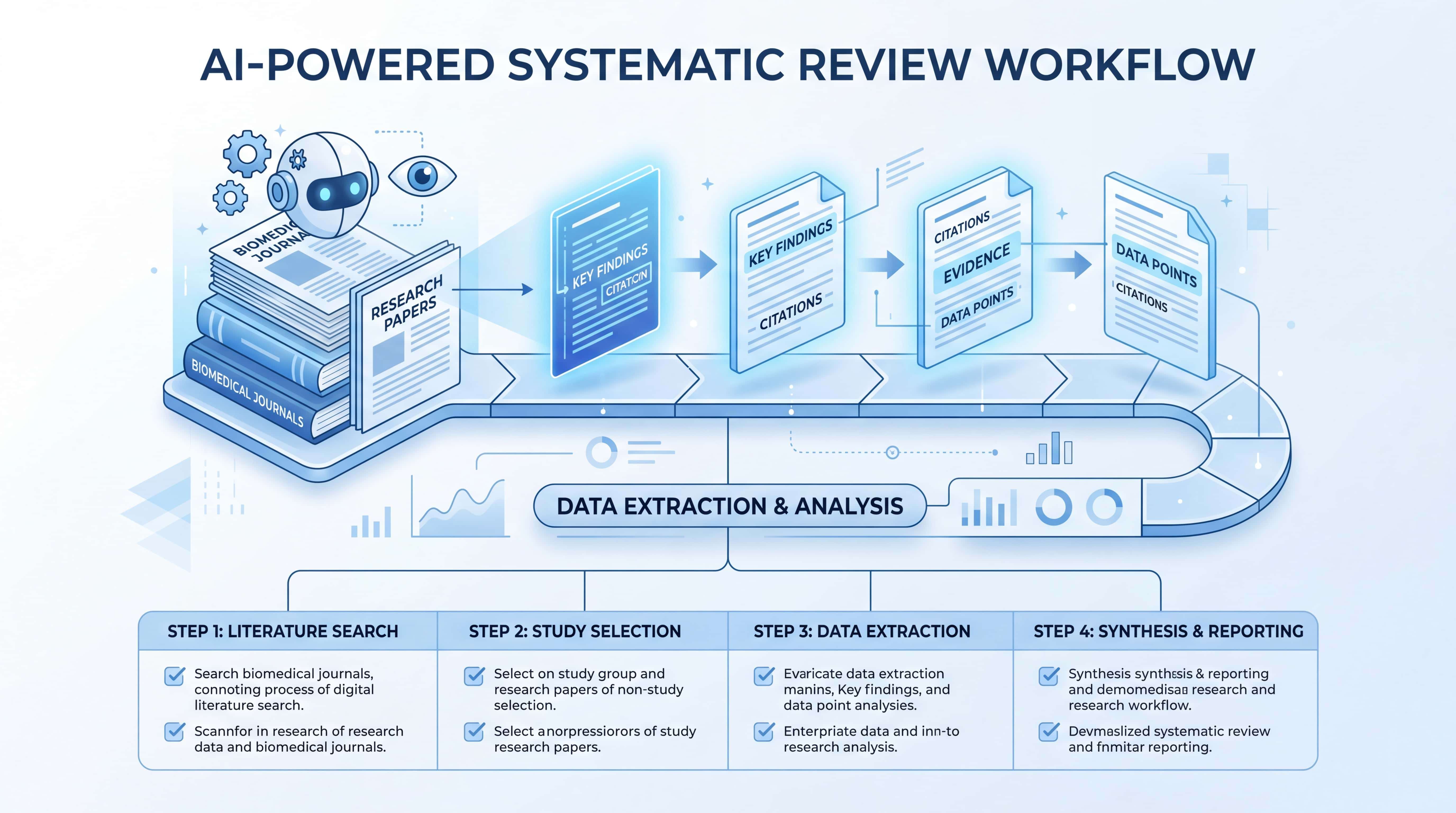
A responsible literature review still follows evidence-based principles. AI should support the process, not bypass it. The best workflow is:
- Define the question clearly.
- Build a transparent search strategy.
- Screen records with documented criteria.
- Extract data into a verified table.
- Compare findings across study types.
- Write the narrative with expert review.
This process is especially important in biomedical research, where weak interpretation can lead to misleading conclusions.
4.2 Check the quality of the underlying studies
AI can summarize evidence, but it cannot judge study quality reliably without human oversight. A strong literature review should still examine:
- Sample size.
- Control design.
- Bias risk.
- Endpoint validity.
- Reproducibility.
- Clinical relevance.
This is where medical training matters. Clinicians and researchers are better equipped to tell whether a result is biologically plausible, statistically sound, and clinically meaningful.
4.3 Keep references accurate
One of the biggest problems in AI-assisted writing is reference integrity. A model may cite a paper that does not exist, misstate an author list, or confuse similar studies. For a literature review, this is unacceptable.
Always verify every citation in the source database or journal website.
This step protects trust, which is central to E-E-A-T and to scientific writing itself.
5. How to Use AI Safely in Biomedical Reviews
5.1 Best practices for researchers
To use AI well in a literature review, keep the workflow disciplined:
- Use AI to expand search ideas.
- Use it to summarize large text blocks.
- Ask it to extract structured fields.
- Ask it to compare studies by outcome or mechanism.
- Verify every output manually.
This balanced approach saves time without lowering quality.
5.2 When AI tools become especially useful
AI is most useful when the topic is broad, the literature is fragmented, or the reviewer needs to synthesize multiple layers of evidence. It is also helpful when preparing:
- Narrative reviews.
- Scoping reviews.
- Evidence maps.
- Grant background sections.
- Discussion sections for biomedical papers.
For teams that want to work faster, tools like scifocus.ai can help organize literature, support drafting, and streamline evidence synthesis. Used correctly, it can reduce repetitive work and help researchers focus on interpretation.
5.3 Why Helix-like AI workflows matter
In practice, the value of a Helix-style AI workflow is simple. It turns a difficult literature review into a repeatable system. The user still makes the scientific decisions. The AI handles the heavy lifting in search, sorting, and first-pass synthesis. That means less wasted time and more time for critical thinking.
6. The Future of Literature Reviews in Biomedicine
6.1 From manual reading to intelligent evidence systems
The future of the literature review is not the disappearance of human expertise. It is the combination of human judgment with intelligent tools. Reviews will become faster, more transparent, and easier to update.
This matters because biomedical knowledge changes quickly. A review written today may need revision in six months. AI-assisted workflows make living reviews more realistic.
6.2 What will remain the researcher’s job
Even with advanced AI, researchers must still:
- Define the question.
- Judge relevance.
- Interpret uncertainty.
- Explain clinical meaning.
- Identify gaps for future work.
These tasks require medical training and scientific reasoning. That is why AI should be viewed as an assistant, not an author.
Conclusion
AI is not replacing the literature review. It is making it more efficient, more structured, and more scalable. In biomedical research, that means faster searching, better extraction, clearer synthesis, and more practical insights. For medical students, clinicians, and researchers, the advantage is real. The best results come from combining AI speed with expert judgment. If you want to streamline your next review, consider using scifocus.ai to support your workflow and reduce repetitive manual work.
Did you like this article? Explore a few more related posts.
Start Your Research Journey With Scifocus Today
Create your free Scifocus account today and take your research to the next level. Experience the difference firsthand—your journey to academic excellence starts here.