
How Is CRISPR Gene Editing Transforming Treatment Strategies for Inherited Diseases?
Introduction
CRISPR gene editing is changing how clinicians and researchers think about inherited disease. Instead of only managing symptoms, it creates the possibility of correcting the underlying mutation. For medical students, physicians, and researchers, this shift is especially important. It affects trial design, therapeutic strategy, and long-term patient care. In this article, we will examine how CRISPR gene editing works, where it is already being tested, and why it may reshape the future of genetic medicine. As a research tool, it also helps scientists study disease mechanisms with unprecedented precision.
1. Why CRISPR Gene Editing Matters in Genetic Medicine
1.1 Moving Beyond Symptom Control
Inherited diseases are caused by changes in DNA. Many current treatments can only reduce symptoms. They do not fix the root cause. That limitation has driven interest in CRISPR gene editing, because it can target a specific DNA sequence and alter it directly.
The scale of the problem is significant. Human disease is linked to thousands of gene variants. Conditions such as hemophilia, phenylketonuria, and cystic fibrosis are among the classic examples discussed in gene therapy research. For these disorders, a one-time correction may offer more durable benefit than lifelong supportive care.
1.2 Why Precision Matters
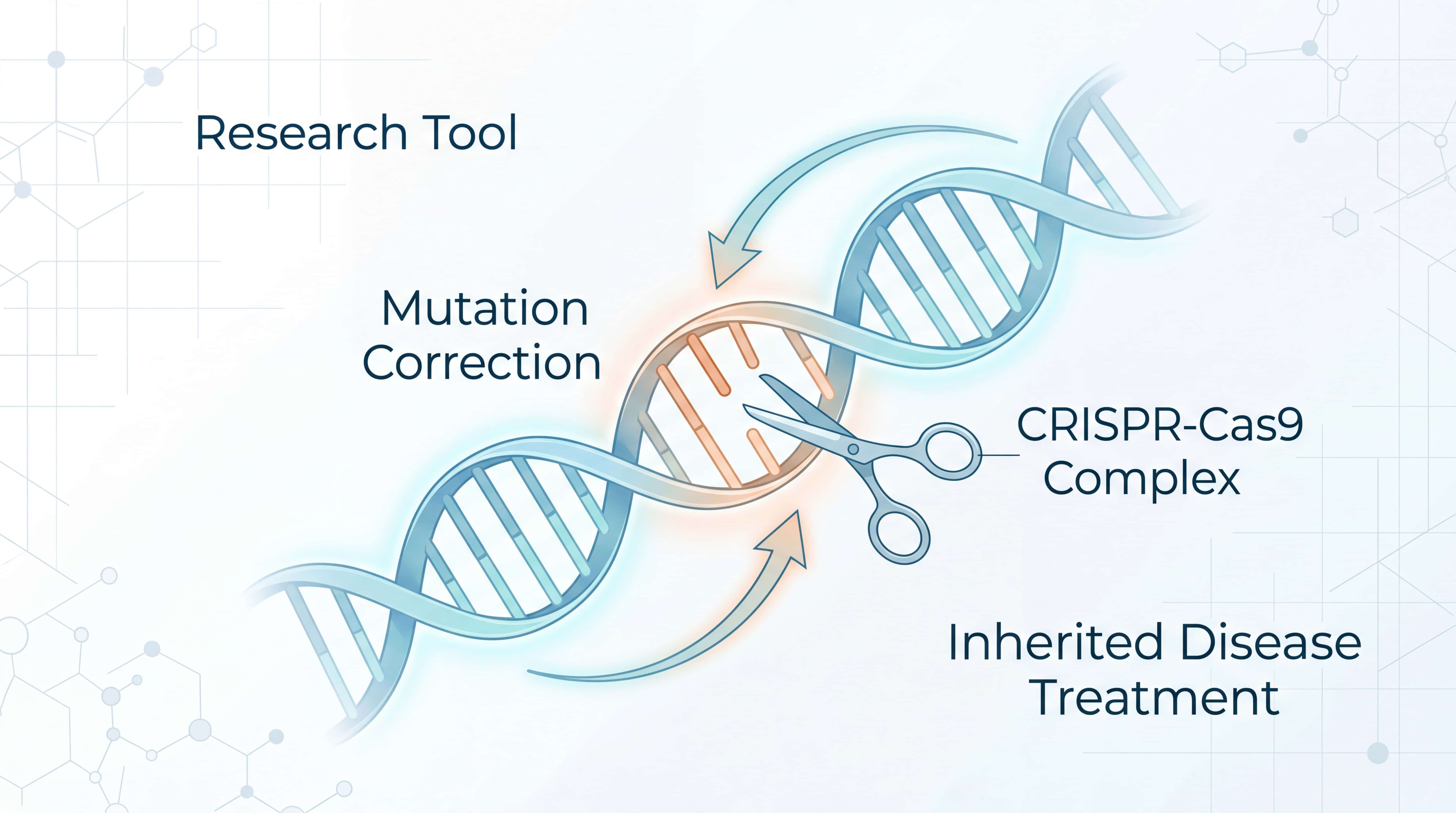
CRISPR-Cas9 uses a guide RNA, or gRNA, to direct the Cas9 protein to a chosen genomic site. The targeted DNA is cut, and the cell repairs the break through non-homologous end joining or homology-directed repair. This is why CRISPR gene editing is viewed as a major step forward. It is precise, modular, and relatively easy to design compared with earlier systems.
Earlier genome editing platforms such as ZFN and TALEN opened the field. CRISPR made it far more accessible. That is also why it quickly became a core research tool in basic science, translational research, and therapeutic development.
2. How CRISPR Works in Practice
2.1 The Core Mechanism
The CRISPR-Cas9 system is derived from bacterial adaptive immunity. In nature, bacteria store fragments of foreign DNA in CRISPR arrays. These sequences help recognize invading genetic material later. In the lab, researchers repurpose this system to target a gene of interest.
The workflow is straightforward:
- Identify the target gene.
- Design the sgRNA.
- Build the Cas9 expression vector.
- Deliver it into cells.
- Allow DNA repair to create knockout, insertion, or correction.
This simplicity is one reason CRISPR gene editing spread so rapidly across laboratories worldwide.
2.2 Repair Pathways and Experimental Outcomes
After Cas9 creates a double-strand break, the cell can repair it in two major ways. NHEJ often introduces small insertions or deletions. That makes it useful for gene knockout. HDR can insert or replace a defined sequence, though it is generally less efficient.
For researchers, this is not just a therapeutic platform. It is also a highly effective research tool for studying gene function, protein interaction, and disease modeling. In living cells, CRISPR combined with single-molecule labeling can help track chromosome structure and dynamics. That makes it valuable well beyond therapy.
3. Where CRISPR Is Already Being Applied
3.1 Disease Research and Early Human Studies
CRISPR-Cas9 has been used in mice, zebrafish, fruit flies, nematodes, Arabidopsis, tobacco, rice, wheat, corn, and bacteria. It has also been applied in human embryonic stem cells and other experimental systems. This wide range of use shows how flexible the platform is.
In 2016, the first human CRISPR trial in China drew global attention. Immune cells were edited to improve their ability to attack tumors. While that study focused on cancer, it marked an important milestone for clinical translation. It showed that CRISPR gene editing had moved beyond theory and into human testing.
3.2 Inherited Disease Targets
Inherited disorders are a major focus because many are driven by a known mutation in a single gene. Examples frequently discussed in the literature include:
- Hemophilia
- Phenylketonuria
- Cystic fibrosis
These diseases are attractive targets because the genetic cause is often clear. That makes them easier to model and, in some cases, more feasible to correct. The key promise of CRISPR gene editing is not only to treat disease, but to redefine what “treatment” means.
4. Scientific and Clinical Challenges
4.1 Safety, Delivery, and Off-Target Risk
Despite strong potential, CRISPR is not ready for universal use. The biggest challenges remain delivery, editing efficiency, and off-target effects. A therapeutic system must reach the right tissue, edit the right cells, and avoid unwanted changes elsewhere in the genome.
These concerns matter especially in human therapy. A cut in the wrong place can create unintended consequences. Researchers therefore need careful validation, appropriate controls, and robust sequencing analysis. For clinicians, this means early-stage CRISPR results should be interpreted with caution.
4.2 Ethical and Regulatory Issues
Inherited disease treatment raises additional ethical questions, especially when germline cells or embryos are involved. Most current clinical work focuses on somatic cells, not heritable editing. That distinction is essential.
Responsible use of CRISPR gene editing depends on transparent oversight, patient safety, and rigorous evidence. For physicians and researchers, the goal is not only innovation, but also trust.
5. The Role of Research Tools in Advancing CRISPR
5.1 Why Better Research Support Is Needed
As CRISPR studies expand, research teams need faster ways to organize literature, compare protocols, and track findings across fields. This is where a strong research tool becomes valuable. It can help researchers manage experiments, identify relevant papers, and reduce time lost in manual searching.
For medical students and clinicians, this matters too. The literature is growing quickly. A structured workflow supports better reading, better evidence review, and better project planning.
5.2 How scifocus.ai Can Help
scifocus.ai can support researchers who work with CRISPR gene editing by streamlining literature discovery and knowledge synthesis. It is especially useful when you need to:
- Find relevant studies faster
- Organize technical references
- Track gene-editing mechanisms and disease targets
- Support evidence-based research planning
For teams studying inherited disease, this kind of research tool can improve efficiency and reduce missed information. If your work depends on accurate, up-to-date scientific reading, scifocus.ai can help you move from scattered search to focused insight.
Conclusion
CRISPR gene editing has already changed the strategy for inherited diseases. It has shifted attention from symptom management to mutation correction. It has also become one of the most powerful platforms in modern biology, both as a therapeutic approach and as a research tool for understanding disease.
The future will depend on safer delivery, stronger validation, and careful ethical oversight. But the direction is clear. CRISPR is reshaping genetic medicine in a way that earlier tools could not. For researchers, physicians, and students who want to keep up with this fast-moving field, using scifocus.ai can make the work more efficient, more organized, and more clinically relevant.

Did you like this article? Explore a few more related posts.
Start Your Research Journey With Scifocus Today
Create your free Scifocus account today and take your research to the next level. Experience the difference firsthand—your journey to academic excellence starts here.