
Introduction
Big data is reshaping personalized medicine by turning fragmented clinical, genomic, and behavioral records into actionable evidence. For medical students, physicians, and researchers, the challenge is no longer a lack of data. It is how to analyze it safely, accurately, and fast enough to guide care. In this essay, we examine how big data supports better diagnosis, treatment selection, monitoring, and evidence generation in precision medicine.
1. Big Data as the Foundation of Personalized Medicine
1.1 Why scale matters in modern care
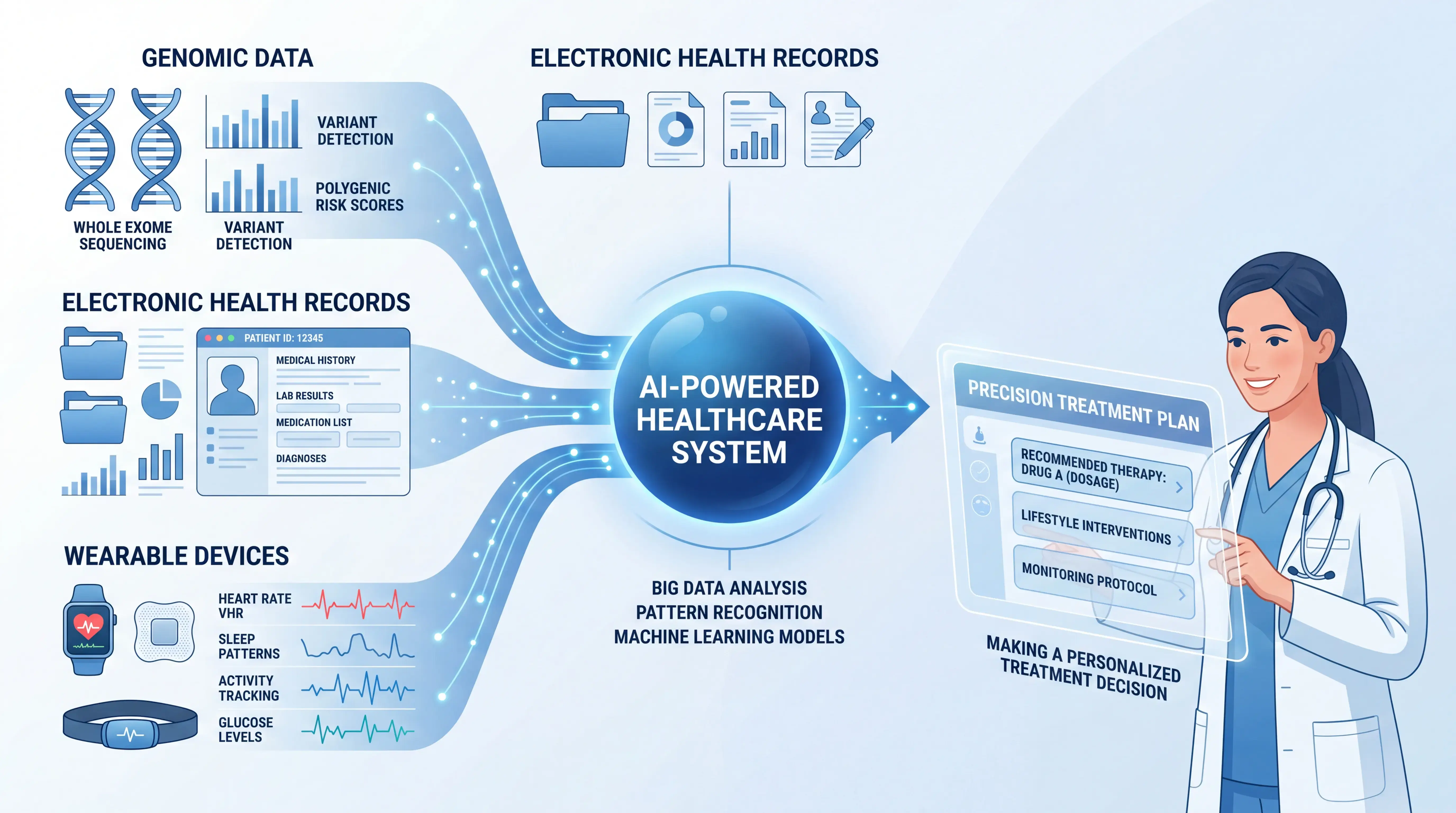
Personalized medicine depends on patterns that are too complex for small datasets. Big data helps integrate large volumes of clinical, imaging, genomic, and real-time sensor information. This matters because many diseases are influenced by multiple genes, environmental exposures, and treatment histories.
A key strength of big data is its ability to reduce random error and improve the precision of clinical inference. Large, longitudinal datasets can support more reliable risk prediction and outcome modeling than isolated case series.
The classic 4V framework explains why biomedical data are different: volume, variety, velocity, and value. In practice, this means data arrive from many sources, in many formats, and often in real time. That is exactly why an essay on personalized medicine must begin with data infrastructure, not just clinical ambition.
1.2 From population averages to individual decisions
Traditional medicine often relies on average treatment effects. Personalized medicine asks a different question: which treatment is best for this patient, now? Big data helps answer that question by linking molecular profiles with clinical trajectories.
In oncology, for example, large molecular databases and electronic health records can help identify driver mutations and treatment response patterns. Cancer research has been an early leader here because tumor heterogeneity is high, and clinical decisions often require fine-grained evidence.
This shift from population-level rules to patient-level prediction is one of the most important changes in modern medicine. It moves the field closer to precision prevention, precision diagnosis, and precision therapy.
2. How Big Data Improves Diagnosis and Risk Prediction
2.1 Integrating multi-source evidence
Big data allows researchers and clinicians to combine evidence from different systems. These may include hospital records, laboratory results, pathology reports, imaging, wearable devices, and genomic sequencing. When these data are standardized and linked, they create a more complete picture of disease.
This is especially useful in complex diseases such as cancer, diabetes, cardiovascular disease, and chronic inflammatory disorders. A single biomarker rarely explains the full clinical picture. Integrated data can reveal hidden interactions and improve stratification.
For example, large cohort studies can track risk factors, disease incidence, and prognosis across time. They also support real-world evidence generation, which is increasingly important when clinical trial populations are too narrow to represent routine practice.
2.2 Biomarkers, prognosis, and decision support
Big data accelerates biomarker discovery. By comparing outcomes across large patient groups, researchers can identify signals associated with diagnosis, progression, recurrence, or treatment response. This is valuable for both clinical care and drug development.
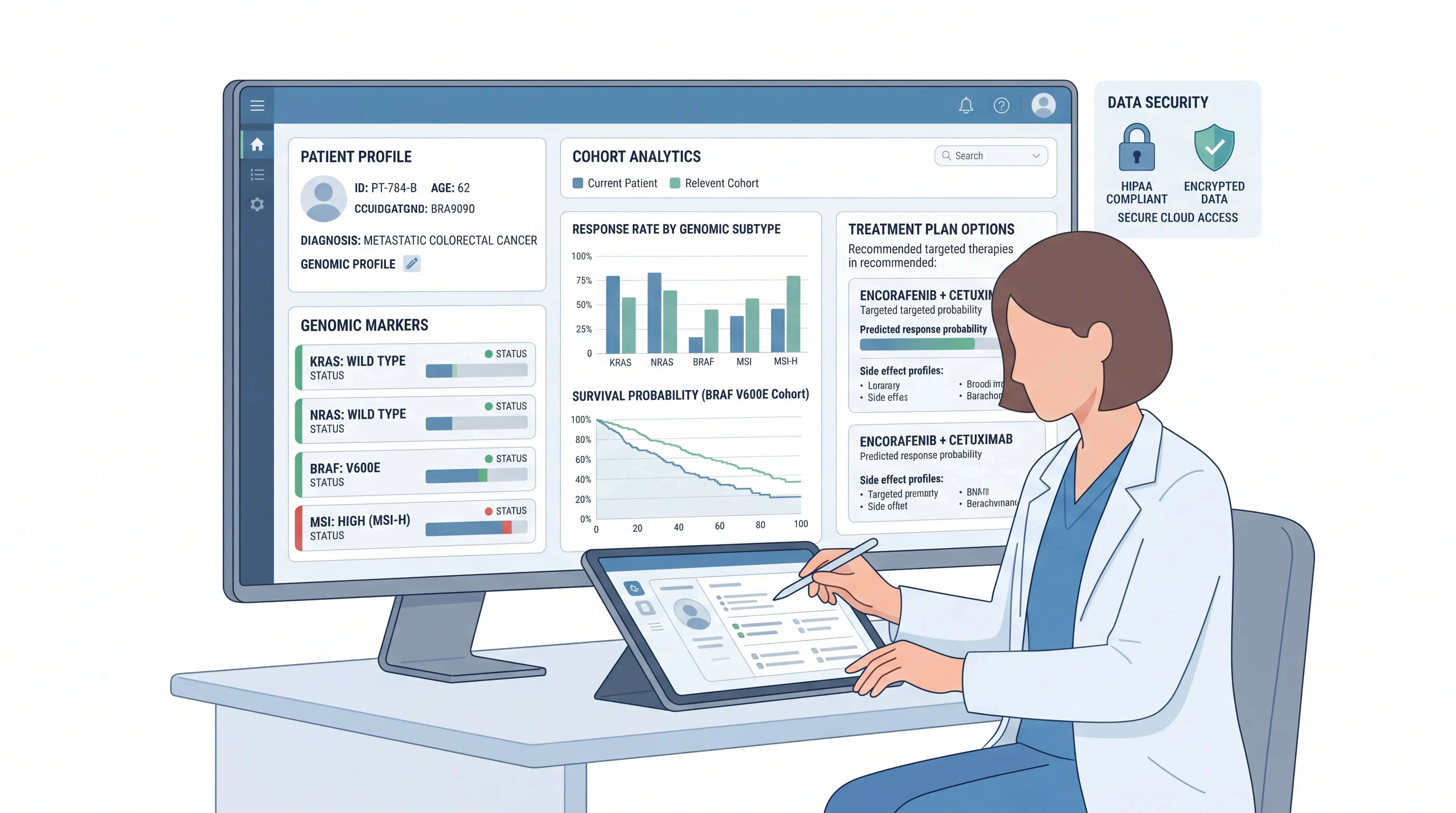
In practice, decision support systems can use these signals to help clinicians select therapies, identify high-risk patients, or suggest follow-up intensity. Some platforms also combine clinical notes and biomarker data to support tumor board discussions and treatment review.
The practical value is clear: big data helps convert scattered observations into clinically usable decision support. That is the core promise behind personalized medicine.
3. Big Data in Treatment Selection and Oncology
3.1 Why cancer became the leading use case
Cancer has been one of the strongest drivers of personalized medicine because it is molecularly diverse and clinically urgent. Large-scale projects such as cancer genomics initiatives have generated massive datasets that help researchers catalog mutations and identify actionable targets.
Clinical data platforms have also emerged to learn from routine care. One important lesson is that clinical trials capture only a small fraction of patients. Real-world datasets can reveal what happens in the much larger group of patients who are never enrolled in trials.
A well-known example is the use of large oncology data platforms to aggregate electronic health records and support treatment benchmarking. These systems can show how similar patients responded to a specific intervention and whether care aligns with established standards.
3.2 Computational systems and practical limits
Cognitive computing and machine learning can help process the scale and complexity of oncology data. Systems such as IBM Watson Health were designed to combine literature, databases, and patient information to support decision-making. In theory, these tools can surface relevant treatment options faster than manual review.
But there are limits. Data quality, transparency, interoperability, and the risk of off-label recommendations remain important concerns. Big data does not replace clinical judgment. It supports it. Physicians still need to evaluate the evidence, the patient context, and the ethical implications.
Cost is another issue. Sequencing, curation, and analytics can be expensive. If workflows are not efficient, adoption will remain uneven. That is why scalable platforms and careful implementation matter as much as algorithms.
4. Evidence Generation, Cohorts, and Virtual Research
4.1 Real-world evidence and population cohorts
Big data is transforming not only care delivery, but also evidence generation. Large cohort studies can integrate surveillance systems, information systems, insurance records, and biospecimen databases. This makes it possible to study multiple diseases, risk factors, and outcomes in a single framework.
Such cohorts are valuable because they are prospective, large-scale, and often multi-disciplinary. They support better understanding of disease burden and can uncover patterns that traditional sampling may miss. In public health, they also help track changes in disease spectra over time.
This is one reason big data is now central to translational research. It bridges basic discovery and bedside application.
4.2 Virtual trials and faster hypothesis testing
Another major shift is the use of real-world and network-based data to support virtual or simulated trials. When well curated, large datasets can help test hypotheses before expensive prospective studies begin. They can also improve trial design by identifying eligible subgroups and expected response patterns.
For rare diseases, where large cohorts are difficult to assemble, multi-omics and imaging-based approaches can strengthen evidence around a target. Researchers can use converging signals from different data layers to support robustness.
This is where an essay on personalized medicine becomes especially relevant to researchers: big data makes faster, more efficient evidence generation possible.
5. Data Security, Ethics, and Clinical Trust
5.1 Privacy is not optional
The more useful the data, the more serious the privacy risk. Biomedical datasets often contain sensitive information, and large-scale integration increases the possibility of leakage or misuse. Data security and legal protection are therefore core requirements, not optional add-ons.
Medical institutions must address de-identification, access control, auditing, and governance. Researchers should also understand local regulations and consent requirements. Without trust, even the best analytics platform will fail in practice.
Personalized medicine can only scale if patients trust that their information is protected. That principle should guide every data workflow.
5.2 Standardization and interoperability
A second challenge is standardization. If data are inconsistent across hospitals, devices, or studies, analysis becomes unreliable. Standardized coding, structured records, and interoperable pipelines are essential for sharing and reuse.
This is also where visualization matters. Clear graphs, dashboards, and summary figures help clinicians and researchers interpret complex patterns quickly. In biomedical work, data are not useful unless people can actually understand them.
6. Practical Next Steps for Clinicians and Researchers
6.1 What to look for in a strong workflow
A good personalized medicine workflow usually includes:
- High-quality, standardized input data.
- Secure storage and compliant access.
- Integrated clinical and molecular analysis.
- Interpretable outputs for decision-making.
- Continuous feedback from outcomes.
Each step reduces noise and increases clinical usefulness. Without this structure, even sophisticated analytics can produce misleading conclusions.
6.2 Where scifocus.ai can help
For teams working on this kind of essay, literature review, or translational project, scifocus.ai can support faster evidence discovery and structured writing. It can help researchers organize sources, refine arguments, and present findings in a clearer academic format.
For busy medical students, doctors, and scientists, tools like scifocus.ai can reduce writing friction and keep the focus on evidence, not formatting. That makes it easier to turn complex ideas about big data into publishable, decision-ready content.
Conclusion
Big data is transforming personalized medicine by enabling better risk prediction, more precise treatment selection, stronger real-world evidence, and faster translational research. It is also exposing the field’s major challenges: privacy, standardization, cost, and workflow integration. For clinicians and researchers, the goal is not simply to collect more data. It is to convert data into safer, smarter, and more individualized care.
If you are preparing an academic essay, research summary, or clinical content on this topic, scifocus.ai can help you work faster and write with greater clarity.
Did you like this article? Explore a few more related posts.
Start Your Research Journey With Scifocus Today
Create your free Scifocus account today and take your research to the next level. Experience the difference firsthand—your journey to academic excellence starts here.