

Historic vs. Historical: How to Use Each Word Correctly
Introduction
If you write an essay for medical school, clinical research, or journal submission, small word choices can affect clarity and credibility. Historic vs. historical is one of those pairs that often causes confusion. Both words relate to the past, but they do not mean the same thing. Using the wrong one can weaken precision in academic writing. This guide explains the difference clearly, with examples you can apply in research papers, case reports, and professional communication.
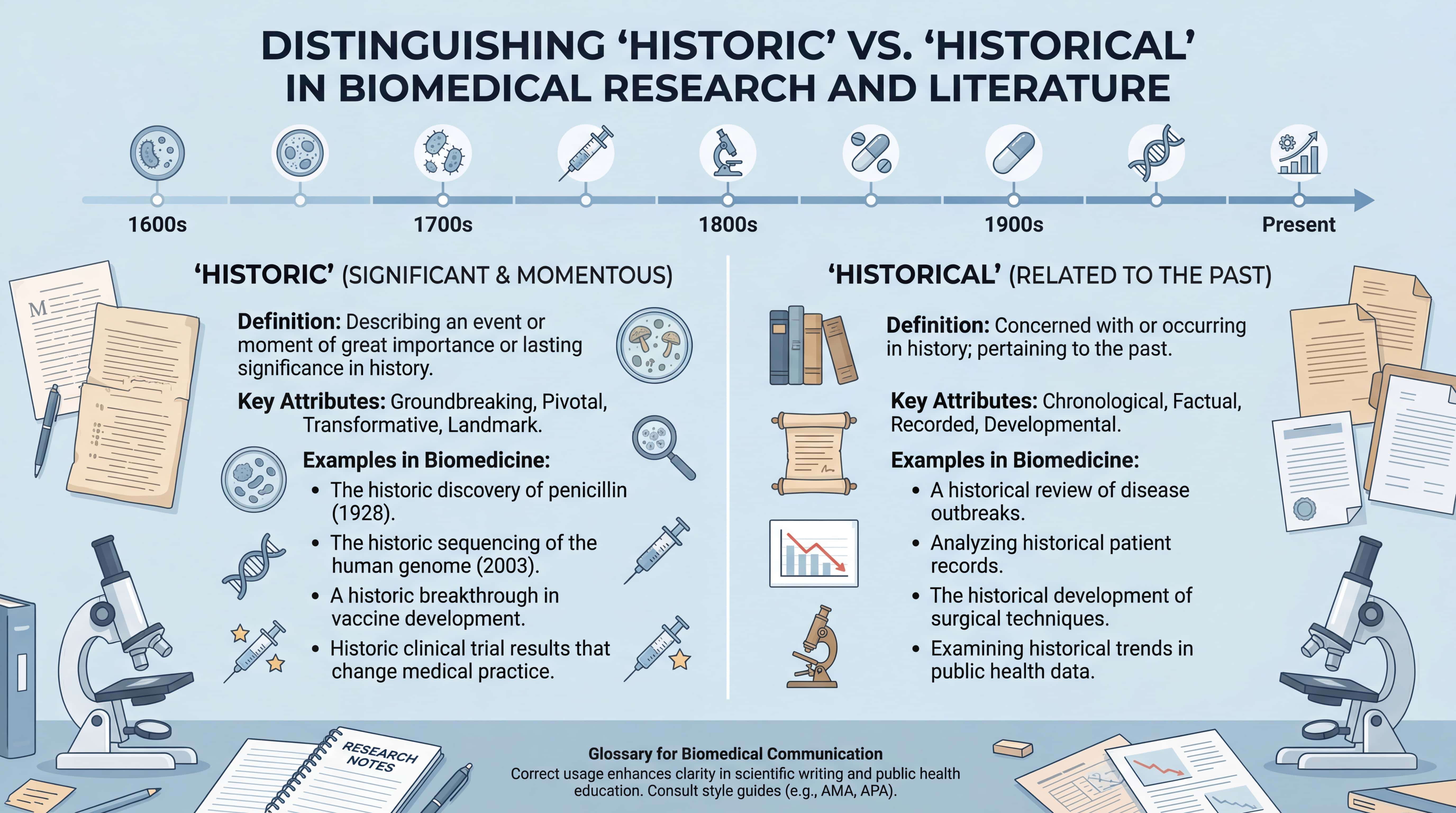
1. The Core Difference Between Historic and Historical
1.1 What “historical” means
Historical refers to anything connected with history, the past, or the study of past events. It is the safer and more common word in formal writing. If you mean something related to a time period, a record, or a past event, “historical” is usually correct.
For example:
- historical data
- historical records
- historical analysis
- historical context
In medicine and research, this word is especially common. A historical cohort study compares outcomes using past records. A historical review summarizes events or evidence from earlier periods. In these cases, the word describes a relationship to the past, not importance.
In most academic settings, “historical” is the default choice.
1.2 What “historic” means
Historic means important, famous, or influential in history. It does not simply mean “old.” It implies significance. A historic discovery changed the field. A historic trial changed practice. A historic guideline marked a turning point.
Examples:
- historic breakthrough
- historic decision
- historic milestone
- historic achievement
In clinical and scientific writing, this word should be used only when the event or result had major impact. If there is no clear significance, “historic” may sound inflated or inaccurate.
1.3 A simple test to choose the right word
Use this rule:
- If you mean “related to history,” use historical.
- If you mean “important in history,” use historic.
This distinction matters because precision builds trust. In an academic essay, vague wording can make your argument seem less rigorous.
2. Why the Distinction Matters in Medical and Scientific Writing
2.1 Precision affects credibility
Medical readers expect exact language. A paper that misuses “historic” and “historical” can look careless. This is especially important for doctors, researchers, and students writing abstracts, introductions, and discussion sections.
For example, these two phrases are not interchangeable:
- historical control group
- historic control group
The first is correct if the group comes from past records. The second is usually wrong unless the control group itself was part of a landmark study.
Accuracy in word choice supports accuracy in science.
2.2 The wrong word can distort meaning
Consider this sentence:
- The study analyzed historic patient data.
If the data are simply from the past, this is likely incorrect. The better version is:
- The study analyzed historical patient data.
Now the meaning is clear. The data are old or archived, but not necessarily important in a landmark sense.
This distinction is also useful in literature reviews and epidemiology. A historical comparison does not mean the comparison was significant in history. It means it used earlier evidence, earlier records, or a past time frame.
2.3 Academic writing depends on controlled language
In research, controlled language reduces ambiguity. That is why scientific style often prefers exact, routine expressions. Writers should not use “historic” just because it sounds stronger. Strength comes from evidence, not decoration.
A strong essay should rely on:
- precise terminology
- clear timeline references
- factual statements
- consistent tense
These elements improve readability and make the argument easier to defend.
3. Common Uses in Essays, Papers, and Reports
3.1 Historical in research writing
Use historical when describing background, records, trends, or earlier studies.
Examples:
- The introduction provides historical context for the disease.
- The analysis used historical data from 2010 to 2020.
- The authors reviewed historical trends in survival rates.
- The study compared current outcomes with historical controls.
These are routine expressions in clinical research. They describe relation to the past, not importance.
3.2 Historic in research writing
Use historic when describing an event that changed a field or marked a major milestone.
Examples:
- The trial was a historic moment in oncology.
- The discovery was a historic breakthrough in vaccine development.
- The guideline represented a historic shift in treatment strategy.
In these cases, the word signals significance. If you cannot justify that significance, do not use it.
3.3 A practical comparison table
| Word | Main meaning | Typical use | Example |
|---|---|---|---|
| historical | related to history or the past | academic writing, records, analysis | historical data |
| historic | important in history | major events, breakthroughs, milestones | historic discovery |
If the sentence describes time, choose historical. If it describes importance, choose historic.
4. How to Avoid Mistakes in Medical Essays and Articles
4.1 Check whether you mean time or importance
Before writing, ask:
- Is this about the past?
- Or is this about something significant in history?
If the answer is about the past, use historical. If it is about importance, use historic.
This quick check prevents most errors in an essay or manuscript draft.
4.2 Read the surrounding sentence
Words do not stand alone. The surrounding context determines meaning. For example:
- historical review
- historic review
The first is standard. The second sounds unusual unless the review itself changed the field.
Similarly:
- historical perspective
- historic perspective
Again, the first is correct in most cases. The second is only right if the perspective itself was groundbreaking.
4.3 Use tools, but verify manually
Grammar tools can help, but they do not always understand nuance. In scientific writing, always verify with context. A tool may flag nothing, yet the wording may still be wrong.
A better workflow is:
- draft the sentence
- identify the intended meaning
- check whether the word refers to past time or historical importance
- revise for precision
Manual review remains essential in professional writing.
5. Examples for Medical Students, Doctors, and Researchers
5.1 Correct examples with “historical”
- The author used historical data to describe disease trends.
- The paper included a historical overview of treatment strategies.
- Historical records showed a gradual decline in mortality.
- The study applied a historical control design.
These sentences are neutral and precise. They fit academic prose.
5.2 Correct examples with “historic”
- The approval of the new therapy was a historic event.
- The paper described a historic advance in surgical technique.
- The case report documented a historic turning point in care delivery.
These examples highlight major importance, not simple chronology.
5.3 Incorrect uses to avoid
- historic data, when you mean old data
- historic analysis, when you mean analysis of the past
- historical breakthrough, when you mean a major milestone
Choose the word that matches the meaning, not the one that sounds more impressive.
6. Final Writing Advice for a Strong Academic Essay
6.1 Prioritize clarity over style
In medical writing, clarity is more valuable than dramatic language. Readers want exact meaning. They want to know whether you are referring to the past or to significance in history.
That is why historical is usually more frequent in academic papers, while historic appears more often in editorials, news, and milestone announcements.
6.2 Use structured support for your writing process
If you write research-based content often, a structured writing workflow can save time. Tools like scifocus.ai can help organize sources, refine phrasing, and support a more efficient draft-to-final process. For students and researchers who need cleaner academic output, that kind of support can reduce revision time and improve consistency.
6.3 Keep one rule in mind
Historical = related to the past.
Historic = important in history.
If you remember only that, you will avoid most errors in formal writing.
Conclusion
The difference between historic vs. historical is small in spelling, but large in meaning. For medical students, doctors, and researchers, using the correct word improves precision, professionalism, and trust. In most academic contexts, historical is the right choice when discussing records, data, or past events. Use historic only when describing something truly important in history. If you want to write faster and more accurately, consider using scifocus.ai to support your research and writing workflow.
Did you like this article? Explore a few more related posts.
Start Your Research Journey With Scifocus Today
Create your free Scifocus account today and take your research to the next level. Experience the difference firsthand—your journey to academic excellence starts here.