

High-Impact Literature Review Writing Techniques Professors Actually Use
Introduction
Writing a literature review is harder than many students expect. The common problems are clear: too many papers, weak structure, scattered arguments, and no strong narrative. For medical students, doctors, and researchers, the challenge is not just reading more. It is turning reading into a review that looks focused, credible, and publishable. In this article, you will learn practical methods for building a stronger literature review, from topic framing to outline design, synthesis, and final polishing.
1. Build the Right Review Before You Start Writing
1.1 Define a narrow, publishable focus
A strong literature review starts with a clear question. Broad topics are hard to control. Narrower topics are easier to organize and easier to defend. For example, instead of “lung cancer,” choose “drug resistance in small-cell lung cancer” or “non-coding RNA in platinum resistance.”
A good literature review is not a list of papers. It is a structured argument around one scientific problem.
If your topic is too broad, your review will become shallow. If it is too narrow, you may not find enough literature. The goal is balance. You need enough studies to show depth, but not so many that the story becomes vague.
1.2 Choose a review angle that adds value
A publishable literature review usually has one of these angles:
- mechanism-based
- time-based
- disease subtype-based
- treatment-based
- comparison-based
For instance, in cancer research, you can organize a literature review around drug transporters, DNA repair, apoptosis, signaling pathways, or non-coding RNAs. This makes the paper easier to read and easier to cite.
If your review does not offer a new angle, it will look repetitive even if the topic is important.
1.3 Decide whether you can include your own data
In some cases, researchers turn a failed experimental project into a literature review and add their own data or observations. This is often more efficient than forcing weak experimental results into a full research paper.
That said, only include your own data if it truly supports the narrative. Do not place unrelated results into the review just to increase length. The point is integration, not decoration.
2. Search Smarter and Build a Strong Evidence Base
2.1 Start from milestone papers
A high-quality literature review should include classic, landmark, and recent papers. Do not rely only on recent articles. Older landmark studies often define the field and show how the topic developed.
Useful sources include:
- PubMed
- Google Scholar
- textbook chapters
- journal review articles
- topic-specific academic websites
- conference lectures and expert talks
For beginners, start with review articles first. They help you understand the field faster. Then move to original studies. If you already have some background, use original papers to deepen your outline and identify gaps.
2.2 Group papers before you write
One common mistake is reading many papers without sorting them. This leads to a messy draft. Instead, group your papers by mechanism, method, or conclusion. Then extract the shared logic.
For example, in drug resistance research, papers may cluster into:
- drug efflux proteins, such as P-gp, MRP, and BCRP
- DNA damage and repair
- apoptosis and survival pathways
- ROS-related autophagy
- PI3K/AKT, NF-κB, STAT3, Notch, or SHH signaling
- lncRNA and miRNA regulation
The real work of a literature review happens during synthesis, not during copying.
2.3 Use reference management tools
EndNote, Mendeley, and Zotero can save time and reduce errors. They help you manage dozens or hundreds of references without losing control of formatting.
They also make it easier to:
- track citation gaps
- avoid duplicate papers
- update references quickly
- switch journal styles efficiently
For medical and scientific writing, reference management is not optional. It is a basic productivity skill.
3. Turn Reading into an Outline
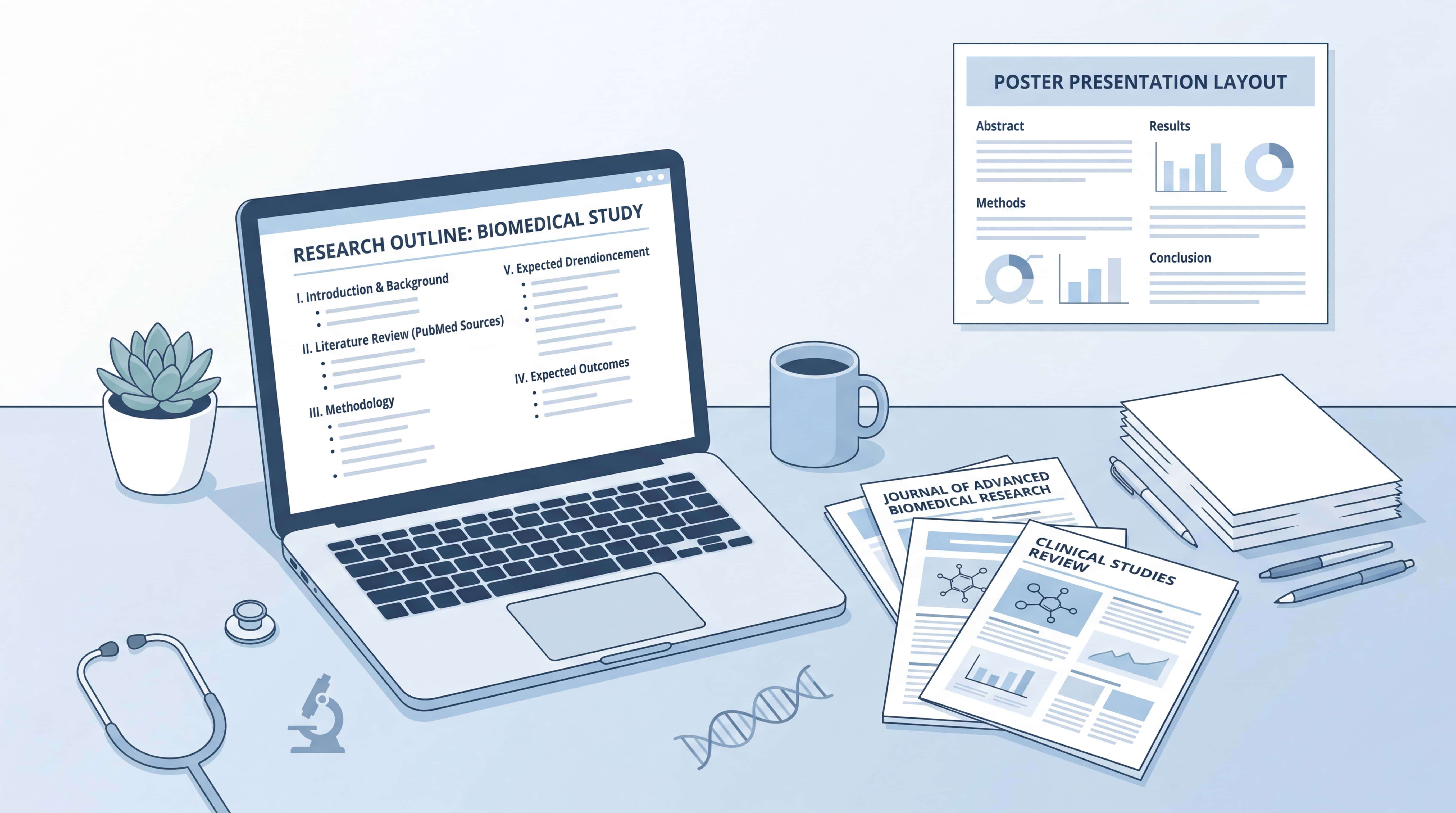
3.1 Write the outline before the draft
Do not wait until you finish all reading. Build a preliminary outline early. Then refine it as new evidence appears. This keeps the project moving.
A practical outline usually includes:
- introduction
- background of the disease or problem
- core mechanisms or categories
- clinical implications
- future directions
- conclusion
In a literature review, the outline is the backbone. If the backbone is weak, the paper collapses.
3.2 Organize by logic, not by author
A common error is writing paragraph after paragraph based on individual studies. That creates a summary, not a review. Each paragraph should focus on one concept.
For example, instead of saying “Study A found this, Study B found that,” write:
- what the shared mechanism is
- where the evidence agrees
- where the evidence differs
- why the difference may exist
Readers want interpretation. They do not want an annotated bibliography.
3.3 Use a clear structural model
You can use one of three common models:
- Inverted triangle: from broad background to a specific issue
- Cause-and-effect: from problem to mechanism to solution
- Chronological: from early work to recent advances
For most medical topics, the inverted triangle works well. Start broad. Then move step by step toward the exact problem your review addresses.
4. Write the Body with Synthesis, Not Repetition
4.1 Compare studies instead of listing them
A strong literature review should compare similarities and differences. This is where your analysis becomes visible.
Ask these questions:
- Do the studies agree?
- If not, why not?
- Are the methods different?
- Are the patient populations different?
- Are the endpoints different?
This approach is especially important in clinical and translational research. Two papers may appear contradictory, but the conflict may come from sample size, assay choice, disease stage, or treatment setting.
4.2 Explain inconsistency clearly
When evidence conflicts, do not ignore it. Address it directly. This increases trust.
For example, one study may show that a pathway promotes resistance, while another suggests the opposite effect in a different context. Your job is to explain the context, not to force artificial harmony.
Scientific credibility improves when you show that you understand both consensus and controversy.
4.3 Use topic sentences and transitions
Every paragraph should begin with a clear topic sentence. Then connect ideas with logical transitions such as:
- similarly
- in addition
- however
- conversely
- therefore
- as a result
This improves flow and makes the paper feel professional. It also helps non-native English writers avoid abrupt jumps.
5. Make the Introduction and Conclusion Work Harder
5.1 The introduction should show the gap
A good introduction does more than define the topic. It explains why the review matters now.
You can open with:
- a major clinical trend
- a controversial finding
- a methodology gap
- a rapidly developing treatment area
- a question that still lacks consensus
Then state what your review will do. Be precise. Readers should know exactly what this paper covers and why those studies were selected.
5.2 The conclusion should do three things
Your conclusion should:
- summarize the main points
- identify unresolved questions
- suggest future directions
For example, in a review of drug resistance, you may conclude that multiple mechanisms act together, clinical translation remains incomplete, and future work should focus on validated biomarkers and combination strategies.
A strong conclusion does not repeat every section. It leaves the reader with one clear scientific takeaway.
5.3 Keep the ending forward-looking
The best final paragraph points toward the next step in the field. That may include biomarker validation, improved experimental models, multi-omics integration, or better patient stratification. This shows strategic thinking, not just summary skill.
6. Improve Publishability with Evidence and Precision
6.1 Match the scope to the target journal
Different journals expect different depths. As a general rule, higher-level journals usually expect broader coverage and stronger citation density. Lower-level journals may accept fewer references, but the logic still has to be solid.
A practical rule is simple: do not under-reference a major review topic. If the field is large, your literature review should reflect that breadth. If the field is narrow, make sure your citation choices are selective and justified.
6.2 Cite landmark papers, not just recent ones
High-impact reviews usually cite both classic and current studies. This shows command of the field and avoids the impression that the review is built only on the latest search results.
A balanced citation strategy helps you show:
- historical development
- current consensus
- unresolved debates
- emerging directions
6.3 Edit for grammar, logic, and completeness
Before submission, check for:
- sentence fragments
- unclear pronouns
- weak transitions
- inconsistent terminology
- spelling and formatting errors
For non-native English authors, this step is critical. Even strong ideas can lose impact if the language is difficult to follow.
7. Use AI Tools to Speed Up the Process Without Losing Quality
7.1 Where AI can help
Tools like scifocus.ai can support literature review writing by helping you:
- organize papers into themes
- generate a working outline
- refine section logic
- summarize repeated evidence
- improve readability and flow
This is especially useful when you have many papers but limited time. It helps you move from raw reading to structured writing faster.
7.2 What AI cannot replace
AI should not replace critical reading. You still need to judge:
- study quality
- clinical relevance
- methodological limits
- conflicting evidence
- originality of the angle
Use AI as an assistant, not as a substitute for scientific judgment.
7.3 A practical workflow
A simple workflow is:
- collect key papers
- group them into themes
- draft the outline
- write one section at a time
- compare supportive and conflicting evidence
- revise for clarity and journal fit
- use AI tools to polish structure and language
This saves time and keeps your literature review disciplined.
Conclusion
A high-impact literature review is built on clear focus, strong grouping, real comparison, and disciplined writing. It should answer a scientific question, not just display reading volume. If you follow a structured outline, synthesize evidence instead of listing studies, and edit for logic and clarity, your paper will be much stronger. For researchers who want a faster and more organized workflow, scifocus.ai can help turn scattered notes into a cleaner, more publishable literature review.
Did you like this article? Explore a few more related posts.
Start Your Research Journey With Scifocus Today
Create your free Scifocus account today and take your research to the next level. Experience the difference firsthand—your journey to academic excellence starts here.