

Emigrate vs. Immigrate
Introduction
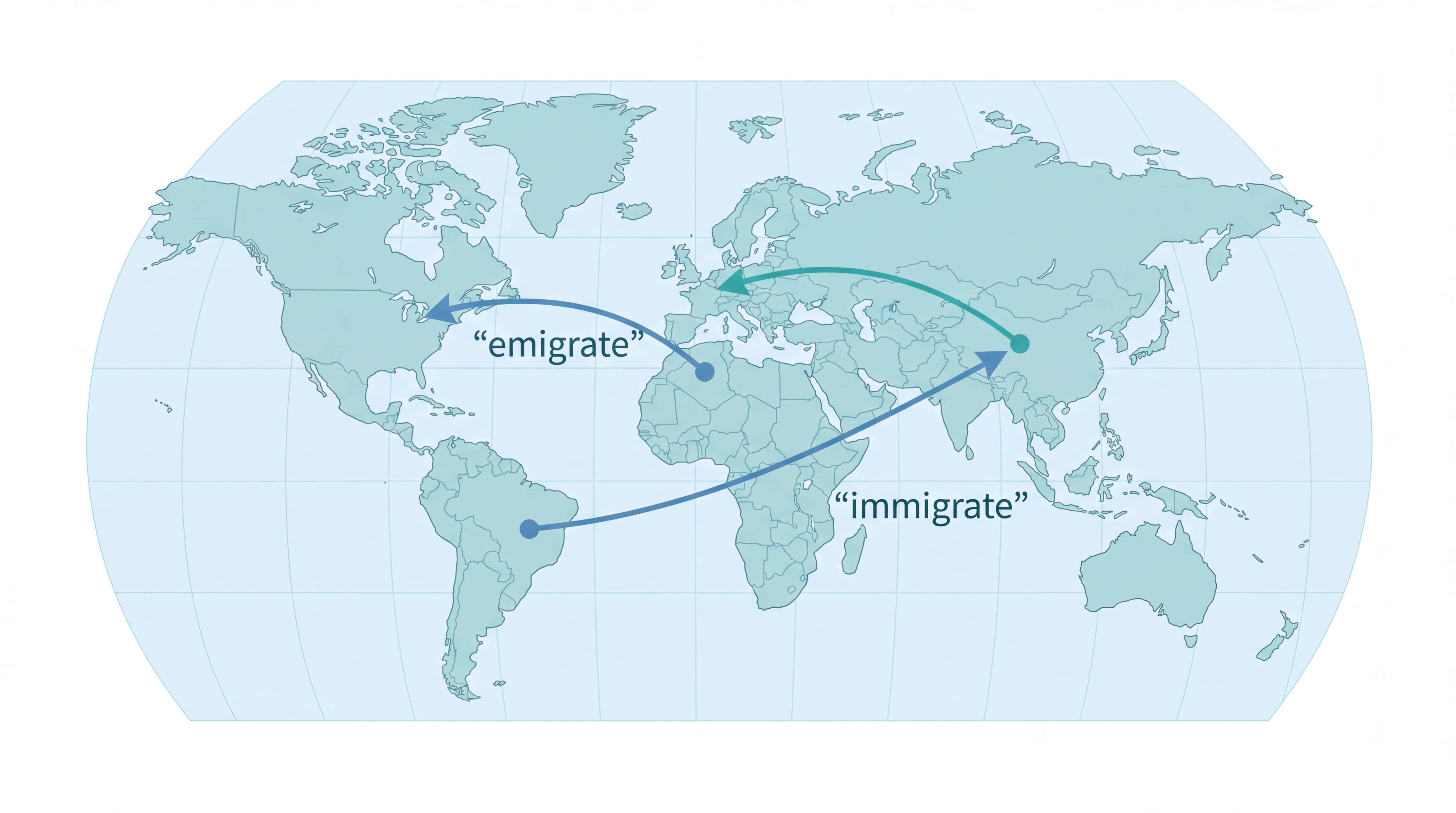
In academic writing, even a small language error can weaken credibility. That is why understanding essay usage around words like emigrate and immigrate matters. These verbs are often confused, yet they refer to opposite directions of movement. For medical students, doctors, and researchers writing about global health, migration, or patient mobility, precision is not optional. Correct word choice improves clarity, academic tone, and trust.
1. What “Emigrate” and “Immigrate” Mean
1.1 The core difference
Emigrate means to leave a country or region to live elsewhere.
Immigrate means to enter a country or region to live there.
The distinction is directional. The same person can be described with both terms, depending on the point of view. For example, a physician may emigrate from India and immigrate to Canada.
1.2 A simple memory rule
A useful rule is this:
- Emigrate = exit
- Immigrate = enter
This is one of the fastest ways to avoid confusion in an essay. The prefix helps. “E” suggests “out of.” “Im” suggests “into.” For scientific and clinical writing, this small habit reduces avoidable language errors.
2. Why the Difference Matters in Academic Writing
2.1 Precision supports credibility
In medical and research writing, accuracy matters at every level. If you misuse emigrate and immigrate, readers may question the care taken in the rest of the essay. This is especially relevant in topics such as:
- workforce migration
- health disparities
- refugee health
- international training pathways
- population movement and public health
A single incorrect term can change the meaning of a sentence. In policy writing, that can lead to confusion.
2.2 The terms are not interchangeable
Many writers treat the words as synonyms, but they are not. They describe the same event from different angles.
For example:
- “The surgeon emigrated from Egypt.”
- “The surgeon immigrated to Germany.”
Both are correct. But they are not identical. The first emphasizes departure. The second emphasizes arrival. In an essay, using the right word shows control of meaning, not just vocabulary.
3. How to Use the Words Correctly in an Essay
3.1 Choose the perspective first
Before writing, ask one question: Are you focusing on departure or arrival?
If the person is leaving a place, use emigrate.
If the person is entering a place, use immigrate.
This is especially important in research summaries. For example, in a paper about physician mobility, you may write about doctors who emigrate from lower-income countries and immigrate to high-income ones. The sentence should match the direction of movement.
3.2 Use clear sentence patterns
Here are correct academic-style examples:
- She emigrated from Brazil in 2019 to pursue residency training.
- He immigrated to the United States after completing his fellowship.
- Many nurses emigrate from countries with workforce shortages.
- Several specialists immigrate to urban centers for better opportunities.
These sentences are short, direct, and suitable for an essay. They also avoid ambiguity.
3.3 Avoid common mistakes
Common errors include:
- using immigrate from instead of emigrate from
- using emigrate to instead of immigrate to
- replacing both words with the generic term “move” when specificity matters
In scholarly writing, generic wording can hide important detail. If migration is central to the topic, use the exact term.
4. Emigrate vs. Immigrate in Medical and Research Contexts
4.1 In global health literature
Migration is a major topic in public health, health systems, and workforce planning. The language used in an essay should reflect the direction of movement accurately.
For example, researchers may analyze how physicians emigrate from countries with limited training capacity. They may also study how they immigrate to regions with higher salaries or better working conditions. That distinction matters because the policy implications are different.
4.2 In patient and family narratives
Migration also appears in case reports, social history, and qualitative studies. A family may immigrate after displacement or political instability. In another context, a specialist may emigrate after receiving a job offer abroad.
When describing these stories, precision shows respect for the subject and strengthens the scientific record. Clear language is part of ethical writing.
4.3 In exam and essay answers
For medical students, this pair often appears in exams, essays, and interview writing tasks. A concise answer is often best:
- Emigrate means to leave one country.
- Immigrate means to enter another country.
If asked to write an essay, include one example for each term. That demonstrates understanding and improves readability.
5. A Practical Framework for Remembering the Difference
5.1 Use the country as your anchor
Place the country in the sentence and test the direction.
- If someone leaves Country A, they emigrate from Country A.
- If someone arrives in Country B, they immigrate to Country B.
This framework works well in both everyday writing and academic essays.
5.2 Pair the verb with the correct preposition
The most reliable combinations are:
- emigrate from
- immigrate to
These patterns are stable and easy to memorize. They also reduce grammatical errors in formal writing.
5.3 Build accuracy into your draft process
If you write essays regularly, use a simple editing checklist:
- Identify the direction of movement.
- Check the verb.
- Verify the preposition.
- Read the sentence aloud for clarity.
- Ensure the meaning remains consistent across the paragraph.
This process is especially useful in time-limited academic work.
6. Common Confusions Beyond the Pair
6.1 Emigrant, immigrant, and migrant
These nouns are also frequently mixed up.
- Emigrant: a person who leaves a country
- Immigrant: a person who enters a country
- Migrant: a broader term for someone who moves from one place to another
In an essay, the choice depends on your scope. If direction matters, use emigrant or immigrant. If you are describing movement more generally, migrant may be appropriate.
6.2 Migration is broader than relocation
In research and clinical writing, migration can include labor movement, forced displacement, asylum, and family reunification. Not every case is a simple move. That is why the exact term matters.
A precise essay does not just report facts. It organizes them correctly.
7. Writing Better Essays with the Right Terminology
7.1 Keep your writing concise
Academic readers prefer clarity over complexity. Short sentences are often stronger than long ones. For example:
- Weak: “The doctor emigrate to another country after many years of difficult work.”
- Strong: “The doctor immigrated to Australia after years of difficult work.”
The second sentence is correct, direct, and easier to read.
7.2 Use tools that support accuracy
If you write essays often, especially for medicine or research, language support can save time. Tools like scifocus.ai can help you draft, refine, and organize academic content more efficiently. That matters when you need clear terminology, consistent tone, and polished structure.
For busy medical students and researchers, this kind of support can reduce editing time and improve the final essay. It is especially useful when working on literature reviews, case discussions, or global health topics where word choice affects interpretation.
7.3 Let the tool support the thinking, not replace it
Good writing tools should improve your process, not replace your judgment. Use them to check structure, refine language, and strengthen readability. Then review the final draft carefully. The goal is better academic writing, not automatic writing.
Conclusion
Emigrate and immigrate are simple words, but they carry precise meanings. One refers to leaving. The other refers to entering. In an essay, especially in medicine, public health, and research, that distinction is essential. It supports clarity, credibility, and professional tone. If you want to write with more confidence and less editing friction, use tools that help you stay accurate and efficient. scifocus.ai can support your academic workflow, improve your draft quality, and make complex writing easier to manage.

Did you like this article? Explore a few more related posts.
Start Your Research Journey With Scifocus Today
Create your free Scifocus account today and take your research to the next level. Experience the difference firsthand—your journey to academic excellence starts here.