

Elicit vs. Illicit
Introduction
Writing an essay for medical school, clinical training, or research publication demands precision. One wrong word can weaken your credibility. “Elicit” and “illicit” are often confused, but they mean completely different things. If you use them incorrectly in an essay, the error can stand out immediately to professors, reviewers, or editors. This article explains the difference clearly, shows how to use each word correctly, and gives practical examples for academic writing.
1. Understanding the Core Difference
1.1 Elicit Means to Bring Out a Response
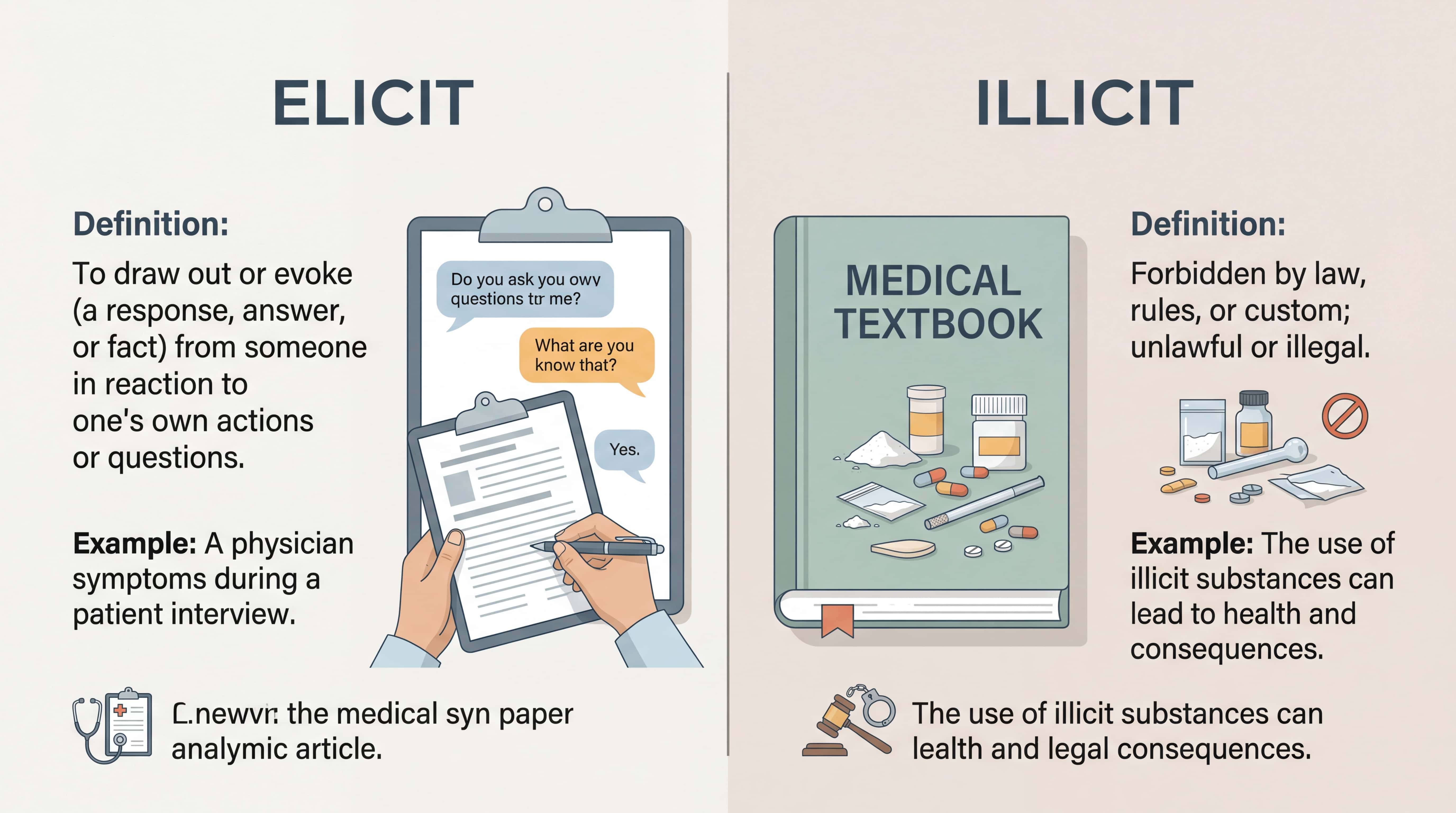
Elicit is a verb. It means to draw out, obtain, or evoke a response, reaction, or information. In medical and research settings, this word is highly useful because it appears often in interviews, examinations, and study design.
For example, a clinician may elicit a pain response during a physical exam. A researcher may elicit feedback through a structured survey. In an essay, this word is appropriate when describing methods, observations, or communication outcomes.
1.2 Illicit Means Illegal or Forbidden
Illicit is an adjective. It describes something that is forbidden by law, rules, or accepted standards. It is commonly used for illegal drugs, illicit trade, or illicit behavior.
In academic writing, illicit is not interchangeable with elicit. The two words differ in both function and meaning. If you write “illicit a response,” the sentence is incorrect. Only elicit can be used as a verb.
1.3 Why the Confusion Happens
The words look similar and sound close enough to cause mistakes. However, their grammar and usage are distinct. This confusion is especially common in fast writing, note-taking, and draft essays.
A useful memory trick is simple:
- Elicit = Verb = extract or draw out
- Illicit = Adjective = illegal or unauthorized
2. How to Use Elicit in an Academic Essay
2.1 Elicit in Clinical and Medical Contexts
In medicine, elicit is often used to describe the act of obtaining a symptom, history, or exam finding. This makes it valuable in a medical essay because it adds precision and professionalism.
Examples:
- The physician tried to elicit a detailed pain history.
- The examiner could not elicit a reflex response.
- The interview questions were designed to elicit honest patient feedback.
These sentences are clear, direct, and grammatically correct. They show action and purpose.
2.2 Elicit in Research Writing
In research, elicit is frequently used when discussing data collection or participant response. It works well in methods sections, discussion sections, and analytical essays.
Examples:
- The survey was designed to elicit patient preferences.
- Focus group prompts helped elicit more detailed responses.
- The questionnaire did not elicit enough information for statistical analysis.
In an essay, using elicit correctly improves accuracy and signals subject-matter competence.
2.3 Common Sentence Patterns
You can often place elicit before words such as:
- response
- reaction
- information
- details
- symptoms
- feedback
Example structures:
- elicit a response
- elicit information
- elicit symptoms
- elicit feedback
These patterns are especially useful when writing concise academic prose.
3. How to Use Illicit in an Academic Essay
3.1 Illicit in Legal and Ethical Contexts
Illicit describes something unauthorized, unlawful, or not permitted. In medical and research contexts, it is often used in discussions of substances, behavior, or systems that violate regulations.
Examples:
- The patient reported illicit drug use.
- Illicit trade in pharmaceuticals can threaten public health.
- The study examined the risks of illicit access to prescription medications.
These examples are correct because illicit modifies a noun.
3.2 Illicit in Public Health and Research
Public health literature often uses illicit when addressing drug misuse, black-market activity, or policy violations. In an essay, this word is useful when discussing risk factors or social determinants.
Examples:
- Illicit substances are associated with increased hospital admissions.
- The paper reviewed patterns of illicit opioid use.
- Illicit distribution channels may undermine treatment access.
Illicit should never be used as a verb. It always describes a noun.
3.3 Common Noun Pairings
Frequent combinations include:
- illicit drugs
- illicit behavior
- illicit trade
- illicit access
- illicit activity
These collocations help keep your essay formal and accurate.
4. Common Mistakes and How to Avoid Them
4.1 Grammar Errors to Watch For
A common error is using the wrong part of speech. For example:
- Incorrect: The survey aimed to illicit responses.
- Correct: The survey aimed to elicit responses.
Another error is choosing the right word but wrong context:
- Incorrect: The patient had an elicit drug history.
- Correct: The patient had an illicit drug history.
A single letter changes the meaning entirely. That is why proofreading matters.
4.2 Quick Test to Choose the Right Word
Ask two questions:
- Do I mean “draw out” or “obtain”? Use elicit.
- Do I mean “illegal” or “forbidden”? Use illicit.
This simple test works in most essays, reports, and research drafts.
4.3 Proofreading Strategy for Writers
If you write academic or medical content, review every sentence for grammar and precision. A fast proofreading system can reduce errors.
Use this three-step check:
- Identify the noun or verb role.
- Confirm the intended meaning.
- Read the sentence aloud for context.
In a high-stakes essay, small language errors can affect trust.
5. Elicit vs. Illicit in Real Academic Examples
5.1 Example Sentences for Medical Students
- The examiner attempted to elicit a knee-jerk reflex.
- The interview was designed to elicit symptom history.
- Illicit substance use should be documented carefully in the chart.
These examples show how both words can appear in the same broader topic while serving different functions.
5.2 Example Sentences for Researchers
- The survey questions were written to elicit measurable responses.
- The authors discussed the impact of illicit drug markets on health systems.
- The interview protocol helped elicit qualitative data from participants.
In each sentence, the word choice matches the grammar and the meaning.
5.3 Why Precision Matters in Scholarly Writing
Academic readers expect exact language. In medicine and research, precision affects clarity, interpretation, and professionalism. Using elicit and illicit correctly supports the credibility of your essay.
It also reduces the chance of confusion in peer review, grading, or publication editing.
6. A Practical Writing Tool for Better Essays
6.1 When You Need Faster, More Accurate Drafts
Medical students, physicians, and researchers often write under pressure. Time limits can lead to avoidable word-choice mistakes. That is where a structured writing workflow helps.
Before you submit an essay, check:
- word meaning
- sentence grammar
- context accuracy
- consistency of terminology
6.2 How scifocus.ai Can Help
If you want to reduce errors and improve clarity, scifocus.ai can support your academic workflow. It can help you refine drafts, improve structure, and strengthen language precision before submission.
For users writing a medical essay, this kind of support is valuable because it saves time and improves polish. It is especially useful when you need to:
- review terminology
- tighten phrasing
- detect awkward wording
- prepare a cleaner final draft
A well-checked essay reads more professionally and communicates more effectively.
Conclusion
Elicit and illicit are easy to confuse, but they are not interchangeable. Elicit is a verb meaning to draw out information or a response. Illicit is an adjective meaning illegal or forbidden. In medical and research writing, using the correct word improves accuracy, credibility, and reader trust.
If you write essays for medicine, science, or clinical research, make word choice part of your quality control. And if you want support with clearer, more polished academic writing, consider using scifocus.ai to streamline your drafting and review process.
Did you like this article? Explore a few more related posts.
Start Your Research Journey With Scifocus Today
Create your free Scifocus account today and take your research to the next level. Experience the difference firsthand—your journey to academic excellence starts here.