

Dose vs. Dosage and Other Medical Word Pairs
Introduction
In medical writing, one small word can change the meaning of a full essay. That matters in papers, protocols, and clinical communication. Dose and dosage are often mixed up, and so are many other medical word pairs. For medical students, doctors, and researchers, these errors can weaken clarity and credibility. This article explains the most common distinctions, with practical examples and research-based context.
1. Dose vs. Dosage: The Core Difference
1.1 What “dose” means
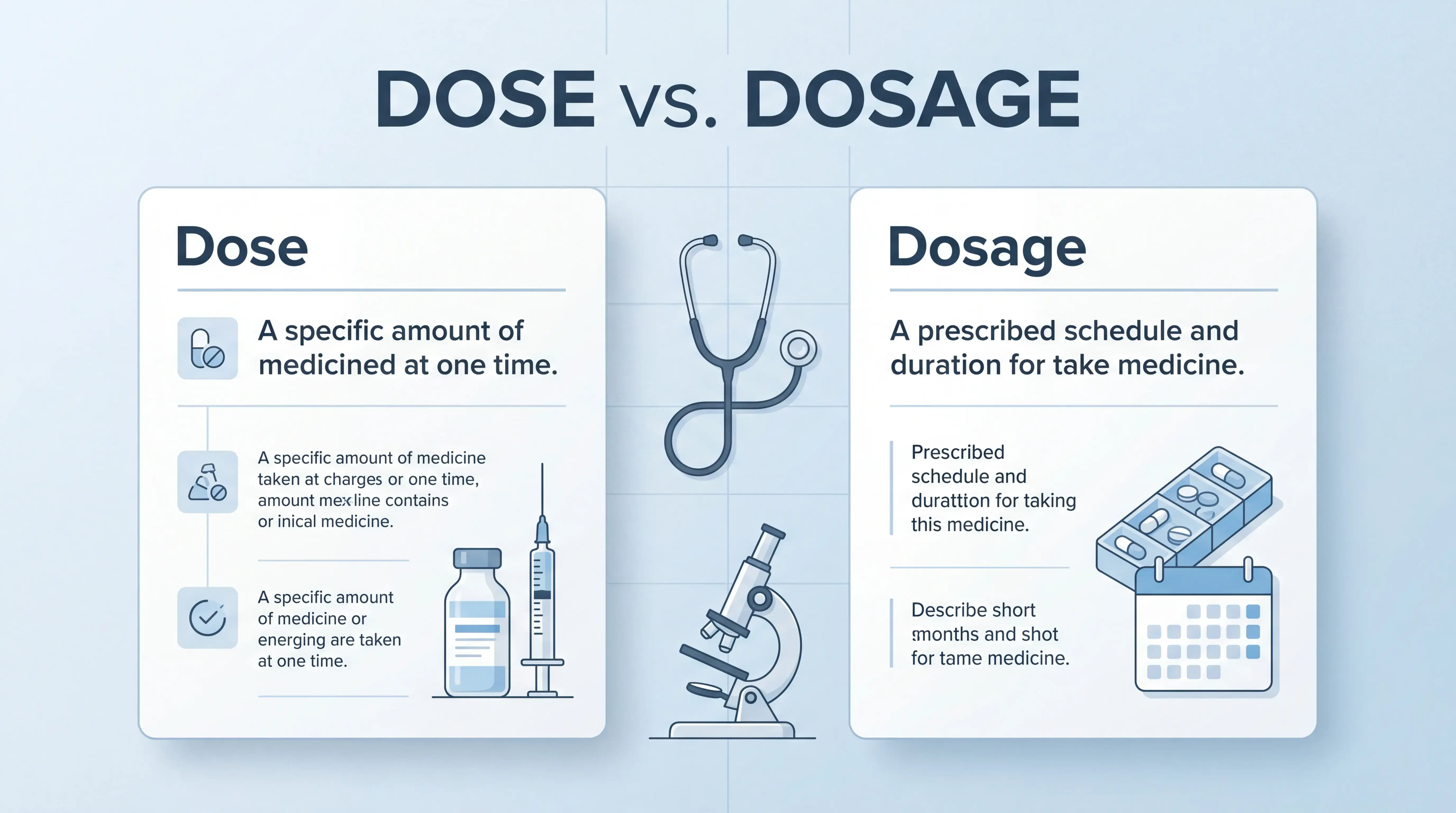
A dose is the amount of a medicine given at one time. It is usually a single quantity. For example, 500 mg of amoxicillin taken once is a dose. In pharmacology, this word is precise. It refers to the actual quantity administered.
Dose answers the question: how much was given right now?
This matters in experiments and in clinical care. If the dose is too low, it may not produce a measurable effect. If it is too high, toxicity may appear. In animal studies, low, medium, and high dose groups are often used to study efficacy and toxicity together.
1.2 What “dosage” means
Dosage is broader. It refers to the prescribed regimen. It can include the dose, frequency, route, and duration. For example, “500 mg twice daily for 7 days” is a dosage plan.
Dose is the amount. Dosage is the full administration plan.
This distinction is especially important in writing. In a lab report, saying “the dosage was 50 mg” may be incomplete if you mean the amount alone. A reviewer may ask for route, schedule, or treatment period.
1.3 Why the difference matters in medical writing
Misusing these terms can create ambiguity. That is risky in clinical documents, research papers, and regulatory text. When precision matters, use:
- Dose for a single administered quantity.
- Dosage for the complete dosing regimen.
- Dosing for the process of giving medicine.
For an academic essay, this level of accuracy signals professional competence.
2. Other Common Medical Word Pairs You Should Not Confuse
2.1 Symptom vs. sign
A symptom is what the patient feels and reports. A sign is what a clinician observes or measures.
For example:
- Pain is a symptom.
- Fever documented by thermometer is a sign.
- Rash seen on examination is a sign.
Symptoms are subjective. Signs are objective.
This distinction is basic, but it is often blurred in student writing. In case reports, separating them improves readability and diagnostic logic.
2.2 Diagnosis vs. prognosis
A diagnosis identifies the condition. A prognosis predicts the likely outcome.
- Diagnosis: pneumonia.
- Prognosis: expected recovery within 1 to 2 weeks, depending on severity and comorbidity.
These terms are not interchangeable. A strong medical essay should use diagnosis to explain what the disease is, and prognosis to explain what may happen next.
2.3 Efficacy vs. effectiveness
Efficacy describes how well an intervention works under ideal, controlled conditions. Effectiveness describes how well it works in real-world practice.
This distinction is important in research design. A drug may show high efficacy in a trial but lower effectiveness in daily clinical use because of adherence, access, or patient variation.
Use efficacy for controlled studies. Use effectiveness for routine practice.
2.4 Adverse effect vs. side effect
An adverse effect is any harmful and unintended outcome related to treatment. A side effect is a secondary effect, which may or may not be harmful.
In formal medical writing, “adverse effect” is usually safer and more precise. It is especially useful in toxicology and pharmacovigilance.
2.5 Acute vs. chronic
Acute means sudden onset or short duration. Chronic means long-lasting or persistent.
Examples:
- Acute toxicity after a single exposure.
- Chronic inflammation over months or years.
These words are not only temporal markers. They also shape study design, endpoint selection, and follow-up length.
3. How Dose Is Selected in Research and Preclinical Studies
3.1 Dose selection should not be arbitrary
In animal experiments, dose selection must be based on evidence. A good starting point includes acute toxicity data, pharmacodynamic findings, pharmacokinetic data, foreign literature on similar compounds, and the recommended clinical trial dose.
The final dose should be confirmed through a pilot study.
That step reduces avoidable error. It also helps identify a range that is scientifically useful and ethically defensible.
3.2 Why low, medium, and high doses are used
A low dose should not be too low to have no effect. If it produces no measurable response, it cannot help the study. In practice, the low dose is often used to find a safe range and should usually be above the overall effective dose in animals, while still avoiding toxicity.
The medium dose should produce slight to moderate toxic reactions. This helps researchers understand the dose-response relationship.
The high dose is used to identify toxic target organs, toxicity signs, and potential rescue measures. It also supports monitoring plans for clinical adverse reactions.
Without a structured dose range, toxicology and efficacy data are incomplete.
3.3 Route of administration must match clinical use
As a rule, the route in animal studies should be consistent with the clinical route. If the drug is given orally in patients, gavage can be used in animals. However, repeated long-term gavage may injure the esophageal mucosa.
In some cases, the drug can be mixed into feed or drinking water. This is common, but several conditions must be met:
- The drug must remain stable in feed or water.
- Distribution must be uniform.
- Intake must be measurable with accuracy.
- The amount mixed into feed should generally not exceed 10 percent, to protect nutrition.
A valid dose is not only about quantity. It is also about route, stability, and exposure accuracy.
4. Writing Medical Terms Correctly in an Academic Essay
4.1 Use precision, not habit
Many medical terms sound similar, but they do not mean the same thing. In academic writing, habit-based language can weaken an argument. Review every sentence for exact meaning.
Ask these questions:
- Am I describing a single amount or a full regimen?
- Is the information subjective or objective?
- Am I reporting controlled efficacy or real-world effectiveness?
- Is this a diagnosis, a symptom, or a sign?
4.2 Choose words that support evidence
Medical writing should be readable and verifiable. Short sentences help. Clear terms help more.
Examples:
- Better: “The dose was 50 mg once daily.”
- Better: “The dosage was 50 mg once daily for 14 days.”
- Better: “The patient reported nausea.”
- Better: “The clinician observed tachycardia.”
Precise wording improves trust, especially in manuscripts, abstracts, and clinical documentation.
4.3 A simple editorial checklist
Before submitting a paper or preparing an essay, check the following:
- Dose vs. dosage is used correctly.
- Signs and symptoms are separated.
- Diagnosis and prognosis are not mixed.
- Efficacy and effectiveness are not confused.
- Adverse effects are described clearly.
- Route, frequency, and duration are stated when needed.
This small review can prevent major revisions later.
5. How SciFocus.ai Can Help You Write Better Medical Content
5.1 Faster drafts, cleaner terminology
Medical writing often fails at the detail level. A sentence is grammatically correct, but the terminology is off. Tools like SciFocus.ai can help streamline drafting, improve structure, and support clearer academic writing.
For researchers and clinicians, that means less time correcting terminology and more time refining content.
5.2 Better consistency across papers and reports
If you write multiple manuscripts, consistency matters. SciFocus.ai can support smoother workflows for outlines, revisions, and terminology checks. That is especially useful when you are preparing journal submissions, conference materials, or a formal essay on pharmacology or clinical practice.
A reliable writing workflow reduces avoidable language errors and strengthens your professional voice.
5.3 A practical next step
If your work involves medical communication, use a tool that helps you write with precision. SciFocus.ai can support clearer drafts, faster editing, and more consistent academic style. That is valuable when every word carries scientific weight.
Conclusion
In medicine, word choice is not cosmetic. It shapes meaning, credibility, and scientific accuracy. Dose and dosage are not the same. Neither are symptom and sign, diagnosis and prognosis, or efficacy and effectiveness. For students, physicians, and researchers, mastering these distinctions improves both writing and thinking. If you want cleaner, more precise medical content, consider using SciFocus.ai to support your next draft, paper, or clinical essay.

Did you like this article? Explore a few more related posts.
Start Your Research Journey With Scifocus Today
Create your free Scifocus account today and take your research to the next level. Experience the difference firsthand—your journey to academic excellence starts here.