

What Is Direct vs Indirect Quotation
Introduction
In medical essays, a weak quotation strategy can quickly reduce clarity, credibility, and originality. If you write for journals, coursework, or research reports, you need to know exactly when to use direct vs indirect quotation. The difference affects accuracy, plagiarism risk, and how professionally your essay reads. In academic medicine, that matters. A strong essay does not just repeat sources. It uses them with precision.
1. What Direct vs Indirect Quotation Means
1.1 Direct Quotation
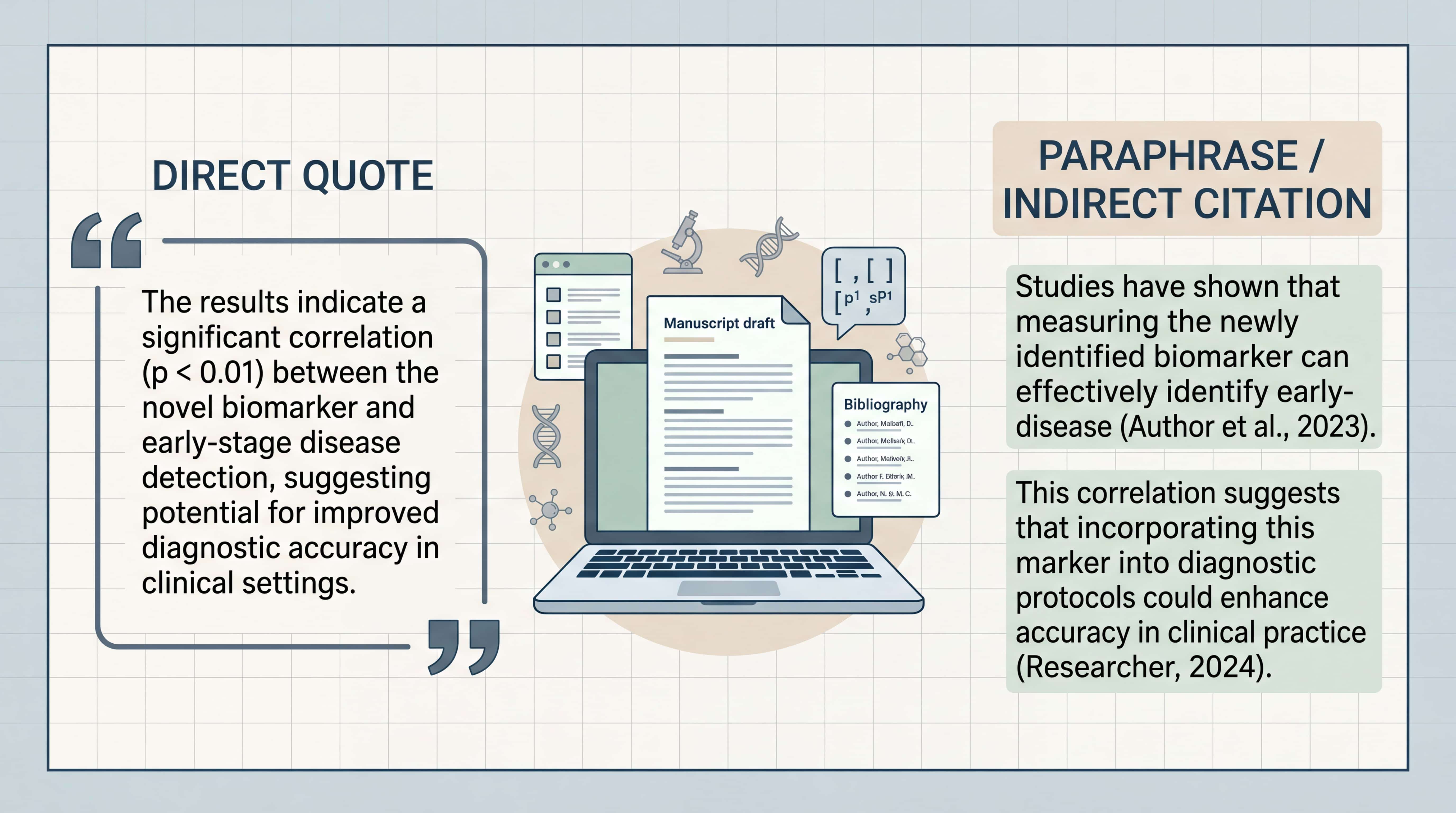
A direct quotation reproduces the original wording exactly. It uses quotation marks and keeps the source’s sentence structure, vocabulary, and meaning unchanged. In an essay, this form is useful when the original language is precise, memorable, or difficult to paraphrase without losing meaning.
In medical and scientific writing, direct quotation should be used sparingly. Most journals and academic instructors expect you to explain ideas in your own words. Still, direct quotation can be useful when citing a formal definition, a guideline statement, or a phrase whose wording is legally or clinically important.
A direct quotation must be exact. Even small changes can distort the source or create citation problems.
1.2 Indirect Quotation
Indirect quotation, also called paraphrasing, restates the original idea in new words and sentence structure. The meaning stays the same, but the wording changes. This is the dominant style in scientific essay writing because it shows understanding rather than copying.
For med students, doctors, and researchers, indirect quotation is usually the better choice. It helps you integrate evidence into your argument, avoid overusing long quoted passages, and reduce plagiarism risk. It also reads more naturally in a formal essay.
1.3 Why the Difference Matters
The distinction is not only stylistic. It affects three practical areas:
- Academic integrity.
- Readability.
- Citation accuracy.
In research writing, text-matching software often flags copied wording. Some journals tolerate limited overlap, especially in methods sections, but repeated exact phrasing can still cause problems. A well-written essay should therefore rely on accurate paraphrase and disciplined citation.
2. When to Use Direct Quotation in an Essay
2.1 Use It for Exact Wording
Use direct quotation when the exact language is important. This includes policy statements, diagnostic definitions, ethical standards, and official recommendations. In clinical writing, a precise phrase may carry meaning that paraphrase could weaken.
For example, if a guideline defines a term in a specific way, quoting it directly may be more appropriate than changing the wording. This is especially true when the source wording is short and authoritative.
2.2 Use It for Highly Cited or Memorable Statements
Direct quotation can also be useful when the original sentence is especially concise or influential. A well-known statement may add authority to your essay if presented accurately and with proper attribution. But this should remain selective.
Overusing direct quotation can make an essay feel passive and fragmented. If most of your paragraphs are built from quoted text, your own analysis becomes less visible.
2.3 Use It When Meaning Could Be Lost
Some scientific statements are difficult to paraphrase without changing the nuance. In those cases, direct quotation protects the source’s intent. This is common when the wording is narrow, technical, or legally sensitive.
However, even then, keep the quotation brief. Academic writing values synthesis. The reader should still see your interpretation, not only the source text.
3. When to Use Indirect Quotation in an Essay
3.1 Use It for Most Academic Arguments
Indirect quotation is the default choice in an essay. It allows you to summarize findings, compare studies, and connect evidence to your thesis. In medicine, this is especially important because research rarely stands alone. One study supports another. One finding refines a previous one.
Paraphrasing shows that you understand the source. It also helps you control tone and structure so your essay remains coherent and professional.
3.2 Use It to Build a Strong Literature Base
A strong academic essay should cite background studies, recent progress, and key original research. It should not rely only on review articles. In fact, editors and reviewers often judge a paper by the quality and diversity of its references. If your citations show only summaries, your argument may look shallow.
Indirect quotation lets you bring in the most relevant evidence without flooding the page with direct quotes. That is especially useful for medical students and researchers who need to synthesize multiple studies quickly and accurately.
3.3 Use It to Reduce Similarity Risk
Text similarity is a real concern in publishing. Many journals screen submissions before review. Methods sections are often the most vulnerable because writers may unintentionally copy standard phrasing. That is why paraphrasing must be done carefully.
A practical rule is simple. Do not preserve the source sentence structure too closely. Change the grammar, the sequence, and the word choice. If you only replace a few words, the result may still look copied.
4. How to Paraphrase Safely and Professionally
4.1 Change Structure, Not Only Words
Effective indirect quotation is not word substitution. It requires structural change. You can:
- Switch active voice to passive voice.
- Reorder ideas.
- Break one long sentence into two short ones.
- Combine two short sentences into one.
- Replace general wording with more precise academic terms.
This method is especially useful in medical essays, where complex information must remain readable and exact.
4.2 Keep the Meaning and Citation
A paraphrase must preserve the source’s meaning. If you change the conclusion, you are no longer paraphrasing. You are misrepresenting the research. That is a serious academic error.
Also, paraphrasing does not remove the need for citation. Even when every word is rewritten, the idea still belongs to the original author. A proper essay always gives credit.
4.3 Check for Unintentional Overlap
Many journals and universities consider long identical sequences a risk, especially when five or more consecutive words match the source text. That does not mean every matching phrase is plagiarism. Standard terminology is sometimes unavoidable. But if your sentence resembles the source too closely, revise it.
A practical workflow helps:
- Read the source carefully.
- Close the source.
- Rewrite from memory.
- Compare for meaning.
- Add the citation.
- Review with similarity software if needed.
This method reduces accidental copying and improves sentence independence.
5. Common Mistakes in Direct vs Indirect Quotation
5.1 Copying Too Much
The most common mistake is copying a source sentence and changing only one or two words. That is not safe paraphrasing. It is close textual overlap. In a medical essay, this can undermine trust.
5.2 Quoting Without Purpose
Another mistake is using direct quotation when the same point could be stated more clearly in your own words. If the quote does not add precision, authority, or a unique voice, it probably does not belong.
5.3 Mixing Tenses or Logic
In scientific writing, tense matters. General facts are often written in the present tense. Past experiments and discoveries are usually written in the past tense. If you quote or paraphrase carelessly, your essay can become inconsistent.
For example:
- Use present tense for established knowledge.
- Use past tense for a specific completed study.
- Use present perfect for research that continues to the present.
That consistency makes your essay sound more rigorous.
5.4 Forgetting the Audience
Medical readers value clarity, evidence, and accuracy. They do not need decorative language. They need clear interpretation of data. Whether you use direct or indirect quotation, the goal is the same. Support the argument without distracting from it.
6. Best Practice for Medical Students, Doctors, and Researchers
6.1 Build an Evidence-First Writing Habit
Start with the claim you want to make. Then choose the source that best supports it. After that, decide whether the source needs a direct quotation or an indirect quotation.
In most cases, indirect quotation will be enough. Reserve direct quotation for definitions, policies, or exact wording that must remain unchanged.
6.2 Use Reference Management Tools
Reference tools help keep citations consistent and reduce formatting errors. They also make it easier to match in-text citations with the reference list. That is important in any serious essay because mismatched references weaken credibility.
6.3 Let AI Support the Writing Process
Tools such as scifocus.ai can help streamline outlining, paraphrasing support, and reference organization. For busy medical students and researchers, that means less time spent on repetitive drafting and more time focused on evidence, logic, and revision. Used properly, AI can improve workflow without replacing academic judgment.
Conclusion
Direct quotation and indirect quotation serve different purposes. Direct quotation preserves exact wording and should be used selectively. Indirect quotation is the main tool for scientific essay writing because it shows understanding, improves readability, and supports original analysis. For medical students, doctors, and researchers, the best approach is usually to paraphrase carefully, cite accurately, and quote directly only when precision matters.
If you want to produce a stronger essay with less friction, organize your sources, paraphrase with structure in mind, and review your draft before submission. For a faster and more disciplined workflow, consider scifocus.ai as a writing assistant for planning, drafting, and reference management.

Did you like this article? Explore a few more related posts.
Start Your Research Journey With Scifocus Today
Create your free Scifocus account today and take your research to the next level. Experience the difference firsthand—your journey to academic excellence starts here.