

Cross-Sectional vs Longitudinal Studies in Medical Research
Introduction
Choosing the right study design is one of the hardest steps in a medical essay. Many students and clinicians know the terms, but still mix up what each design can prove. Cross-sectional vs longitudinal studies in medical research is a key comparison because it affects how you measure disease, interpret risk, and avoid false conclusions. This article breaks down the difference in a practical way. It is written for medical students, doctors, and researchers who need clear, usable guidance.
1. What Cross-Sectional Studies Measure
1.1 A Snapshot of a Population
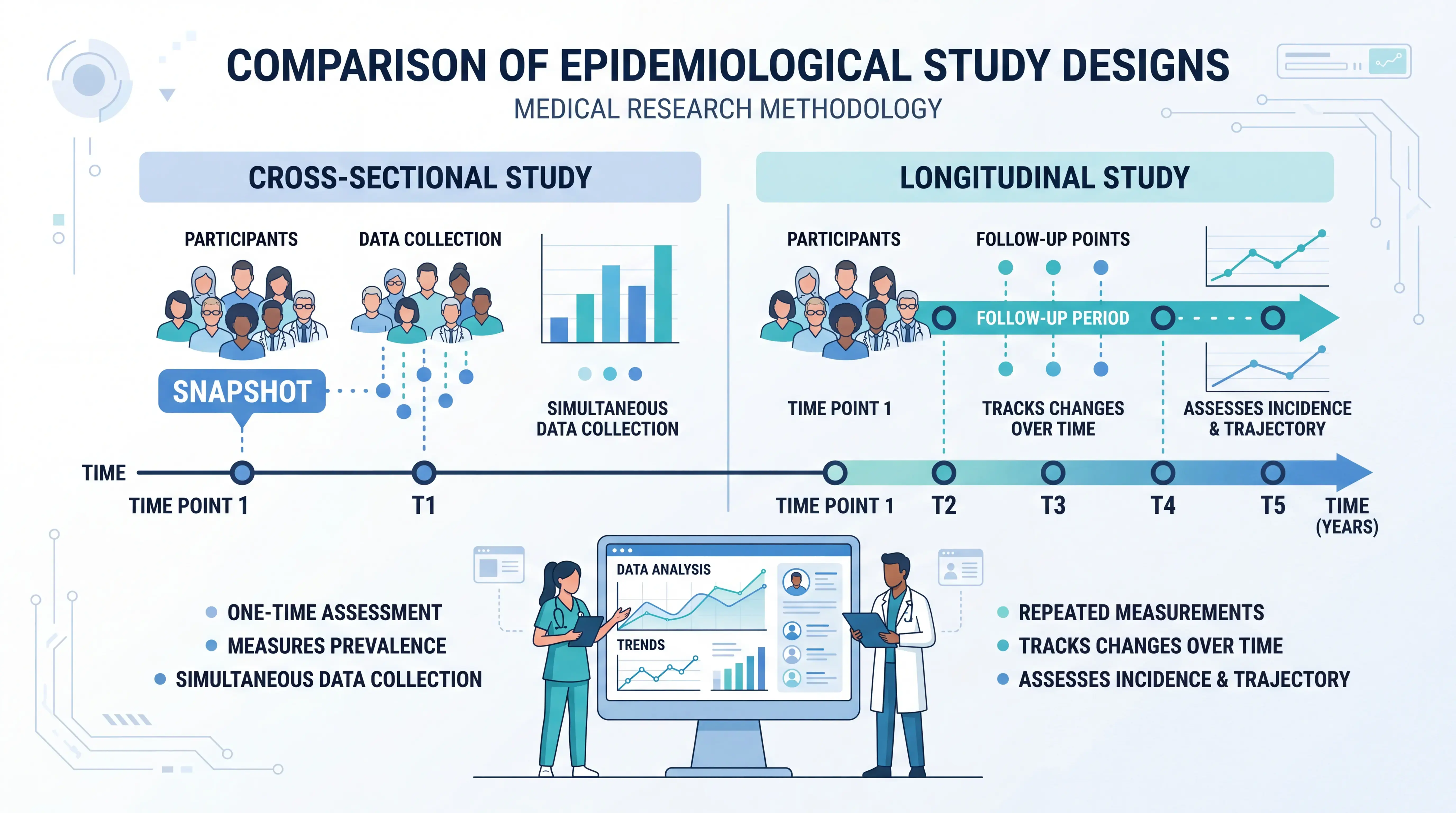
A cross-sectional study collects data at one specific time point. It looks at a defined population, such as patients with diabetes, adults in one city, or a national sample. The goal is to describe how disease or health status is distributed.
In simple terms, a cross-sectional study is like taking a single photo of a population. You see who has the disease, who does not, and what related characteristics are present at that moment.
This design is often used for prevalence studies. For example, a national nutrition survey can estimate obesity rates, hypertension prevalence, or regional differences in health status. It can also support screening and public health monitoring.
1.2 Why It Matters in Medical Research
Cross-sectional studies are useful when you need fast, practical information. They can answer questions such as:
- How common is a disease?
- Does prevalence differ by age, sex, or region?
- Are there clues that may suggest a risk factor?
These studies are especially helpful when large-scale data are available. A population census is essentially a full cross-sectional study. A national health survey is a sampled cross-sectional study.
However, cross-sectional vs longitudinal studies in medical research differs in one critical point: a cross-sectional study does not establish time order. You may find an association, but you cannot confirm whether the exposure came before the outcome.
2. What Longitudinal Studies Measure
2.1 Repeated Observation Over Time
Longitudinal studies follow the same individuals over time. They are designed to observe change, development, or outcome events across months or years. This can be prospective, retrospective, or mixed, depending on how the data are collected.
A longitudinal study is not just a snapshot. It is a sequence of observations. That time element is what makes it powerful for studying progression, prognosis, and causality.
A common medical example is a cohort study. If researchers group smokers and non-smokers, then follow them for years to compare lung cancer incidence, that is a longitudinal approach. The logic is from exposure to outcome.
2.2 When Longitudinal Design Is the Better Fit
Longitudinal studies are best when the clinical question involves:
- Disease incidence
- Risk prediction
- Prognosis
- Treatment effects over time
- Long-term safety or adverse events
For example, if you want to know whether asbestos exposure increases the risk of pleural mesothelioma, a longitudinal cohort design is far more informative than a one-time survey. It shows whether exposure came first and whether disease appears later.
In cross-sectional vs longitudinal studies in medical research, the longitudinal design is stronger for temporal sequence. That makes it more suitable for causal hypotheses, although confounding can still remain.
3. Cross-Sectional vs Longitudinal Studies in Medical Research: Core Differences
3.1 Time and Direction
The most important difference is time.
- Cross-sectional studies examine one time point.
- Longitudinal studies examine multiple time points.
Cross-sectional research asks, “What is happening now?”
Longitudinal research asks, “What changes over time, and what happens next?”
This difference affects the type of evidence you can claim. Cross-sectional findings describe distribution and association. Longitudinal findings can show sequence, change, and sometimes stronger causal inference.
3.2 What Each Design Can and Cannot Prove
Cross-sectional studies are good for prevalence and hypothesis generation. They can show that two variables occur together, but not which one came first.
Longitudinal studies can show that exposure precedes outcome. That is a major advantage in medical research. Still, they are not automatically causal proof. Bias, confounding, and loss to follow-up can still distort results.
A strong medical essay should always distinguish association from causation. This is where many research reports become weak. The design must match the claim.
3.3 A Practical Example
Imagine a clinic wants to study smoking and chronic bronchitis in older adults.
- A cross-sectional study would measure smoking status and bronchitis status at the same visit.
- A longitudinal cohort study would start with adults without bronchitis, classify them by smoking exposure, then follow them for future disease.
The first design tells you prevalence and association. The second tells you incidence and risk over time.
4. How to Choose the Right Design
4.1 Choose Cross-Sectional When You Need Prevalence
Use a cross-sectional study when your goal is to describe a population at one point in time. It is a strong choice for:
- Prevalence surveys
- Health needs assessments
- Screening programs
- Descriptive epidemiology
It is often faster and cheaper than a longitudinal study. It also needs less follow-up, which makes it practical for busy clinical teams.
4.2 Choose Longitudinal When You Need Change or Risk
Use a longitudinal study when the clinical question depends on time. That includes:
- Risk factor analysis
- Prognosis research
- Treatment outcome studies
- Chronic disease progression
- Safety monitoring
If your question is about “before” and “after,” or “exposure” and “later outcome,” longitudinal design is usually the better fit.
4.3 Consider Feasibility and Bias
Study design is not only about theory. It is also about feasibility.
A cross-sectional study may be easier to complete in a hospital or clinic. A longitudinal study usually requires:
- Clear inclusion criteria
- Reliable baseline data
- Follow-up planning
- Statistical handling of missing data
- More time and resources
The right design is the one that answers the research question without overclaiming. That is a core principle in high-quality clinical research.
5. Common Pitfalls in Medical Research
5.1 Mistaking Association for Causation
This is the most common error in a cross-sectional study. If you find that smoking is more common in patients with disease, you cannot assume smoking caused the disease unless the temporal order is known.
5.2 Ignoring Selection Bias
A study from one hospital may not represent the broader population. A small sample can produce misleading prevalence estimates. This is why representativeness matters, especially in cross-sectional surveys.
5.3 Poor Follow-Up in Longitudinal Studies
Longitudinal research can lose value if follow-up is incomplete. Dropouts can bias results, especially when loss is related to disease severity, treatment response, or exposure status.
5.4 Weak Variable Definitions
Both designs need clear operational definitions. Exposure, outcome, and covariates must be defined in advance. If “smoking” includes occasional exposure in one group and heavy use in another, the comparison becomes unreliable.
6. How to Write About These Designs in an Essay
6.1 Use the Right Language
If you are writing an academic essay, be precise. Use terms such as:
- prevalence
- incidence
- follow-up
- temporal sequence
- association
- confounding
Avoid vague statements like “proved the cause” unless the study design truly supports that level of inference.
6.2 Structure Your Argument
A strong research essay should:
- Define both designs clearly.
- Compare their time structure.
- Explain what each can measure.
- State strengths and limitations.
- Match the design to the clinical question.
Clear structure improves both scientific credibility and readability.
6.3 Use Medical Context, Not Theory Alone
Readers trust writing that is grounded in clinical reality. For example:
- Cross-sectional studies are common in prevalence surveys and screening.
- Longitudinal studies are common in cohort research, prognosis, and treatment follow-up.
That context helps the reader understand why the design matters in practice.
7. A Smarter Workflow for Medical Researchers
7.1 Start With the Question
Before writing, define the exact research question. Ask:
- Do I need prevalence or incidence?
- Do I need one time point or follow-up?
- Do I want to describe a population or test a hypothesis?
The answer will usually point to either a cross-sectional or longitudinal design.
7.2 Match the Design to the Evidence Level
If the goal is descriptive epidemiology, a cross-sectional study may be enough. If the goal is disease progression, prognosis, or risk estimation, a longitudinal study is usually superior.
7.3 Use Tools That Save Time
This is where scifocus.ai can help. It can support researchers who need faster literature review, clearer structuring, and more efficient academic writing. For medical students and clinicians working on an essay, a tool like this can help organize evidence, refine arguments, and keep the writing aligned with the study design.
Conclusion
Cross-sectional vs longitudinal studies in medical research is not just a vocabulary issue. It is a design choice that shapes the quality of your evidence. Cross-sectional studies are best for prevalence and snapshots. Longitudinal studies are best for change, incidence, and temporal relationships. If you choose the wrong design, your conclusions may be weak or misleading.
For medical students, doctors, and researchers, the key is simple. Start with the question, then match it to the design. If you want help turning that research question into a polished academic draft, consider using scifocus.ai to support your next medical essay.
Did you like this article? Explore a few more related posts.
Start Your Research Journey With Scifocus Today
Create your free Scifocus account today and take your research to the next level. Experience the difference firsthand—your journey to academic excellence starts here.