

Complement vs Compliment
Introduction
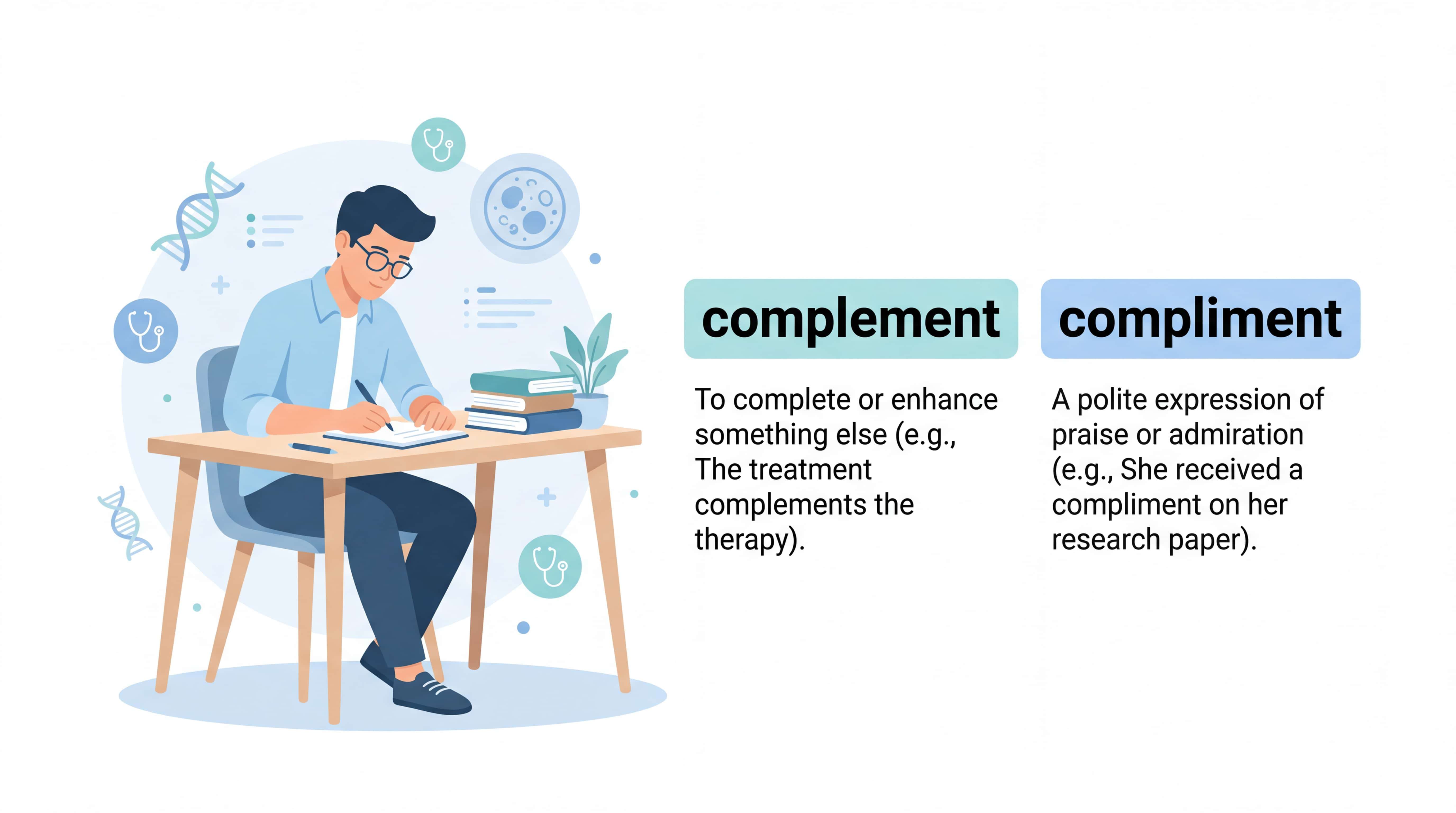
If you write an essay, a research paper, or a clinical report, word choice matters. Complement vs compliment is a common confusion, and it can affect both clarity and professionalism. For medical students, doctors, and researchers, using the right word is not a minor detail. It reflects precision, credibility, and strong academic writing. This essay explains the difference clearly and gives practical rules you can use immediately.
1. Understanding Complement vs Compliment
1.1 The core meaning of each word
Complement means to complete, match well, or enhance something. It is often used when one thing adds value to another. In academic writing, it appears in phrases such as “the data complement the findings” or “the therapy complements standard care.”
Compliment means praise or an expression of approval. It is used when someone says something positive about a person, result, or effort. For example, “The reviewer gave a compliment on the clarity of the essay.”
1.2 Why this distinction matters in professional writing
These words sound identical, but they are not interchangeable. In a medical essay, confusing them can change the meaning of a sentence. If you write “The study complimented the previous trial,” the sentence is incorrect unless you mean praise. In most academic contexts, complement vs compliment is a test of accuracy, not style.
A clear distinction also improves trust. Readers in medicine and science expect exact language. A single wrong word can weaken an otherwise strong essay.
2. How to Use Complement Correctly
2.1 Grammar and common sentence patterns
As a verb, complement usually takes a direct object. It often answers the question, “What completes or enhances what?”
Examples:
- The new imaging method complements traditional diagnosis.
- The patient’s history complements the laboratory findings.
- The two drugs complement each other in combination therapy.
As a noun, complement means something that completes a whole.
- Vitamin C is a useful complement to the treatment plan.
- The second dataset serves as a complement to the first.
2.2 Academic and medical examples
In scientific writing, complement is common because researchers often describe one method, result, or intervention as supporting another. This is especially useful in comparative essays, literature reviews, and discussion sections.
Consider these accurate uses:
- “The biomarker panel complements clinical assessment.”
- “The new evidence complements prior research.”
- “The intervention complements current guidelines.”
These sentences are precise because they describe enhancement, not praise. That is why complement vs compliment is so important in an essay for academic or clinical audiences.
2.3 A quick memory rule
Use this simple test:
- If the word means “complete” or “go well with,” use complement.
- If the word means “praise,” use compliment.
A useful clue is the letter pattern. Complement contains “e,” like “enhance.” Compliment contains “i,” like “admire.” This is not a grammar rule, but it helps reduce mistakes when drafting an essay quickly.
3. How to Use Compliment Correctly
3.1 Meaning in formal and informal contexts
Compliment is mainly about praise. In professional settings, it can describe positive feedback from a supervisor, reviewer, or colleague.
Examples:
- The attending physician paid the resident a compliment on the case presentation.
- The editor’s compliment encouraged the author to revise the essay carefully.
- The reviewer’s compliment was brief but meaningful.
In medicine, compliments are usually about communication, teaching, or presentation quality. They are less common in technical results.
3.2 Avoiding misuse in academic essays
A frequent error is using compliment when the writer means that two things work well together. That is incorrect. In an essay, the sentence “The protocol complimented the guidelines” is wrong unless the protocol is literally praising the guidelines.
To avoid this, ask yourself:
- Is the sentence about praise?
- Or is it about completion, support, or compatibility?
If it is about compatibility, complement is correct. This small habit can improve the accuracy of your essay and reduce editing time later.
4. Complement vs Compliment in Medical and Research Writing
4.1 Why precision is essential in your essay
Medical writing must be unambiguous. Readers depend on exact wording to interpret evidence, compare interventions, and evaluate outcomes. In that setting, complement vs compliment is more than a vocabulary issue. It affects meaning.
For example:
- “The new assay complements the existing workflow” means it improves or fits with it.
- “The new assay is a compliment to the workflow” is wrong in this context.
That difference matters in manuscripts, abstracts, case reports, and review essays. Clear language helps preserve scientific integrity.
4.2 Practical editing checklist
When revising an essay, use this checklist:
- Replace “compliment” with “praise” and see if the sentence still makes sense.
- If not, the correct word is probably “complement.”
- Read the sentence aloud.
- Check whether the word refers to enhancement or approval.
- Review the surrounding context, especially in technical writing.
This simple process can prevent avoidable errors. It is especially useful for non-native English speakers and busy clinicians writing under time constraints.
4.3 Examples you can reuse
Here are polished examples suitable for an academic essay:
- The imaging results complement the physical examination.
- Her comments were a sincere compliment to the team’s work.
- The patient education leaflet complements verbal counseling.
- The reviewer offered a compliment on the structure of the essay.
These examples show the difference in real use. Complement vs compliment becomes much easier once you see how each word functions in context.
5. Common Mistakes and How to Fix Them
5.1 Word choice errors in essays
Many writers choose the wrong word because both terms sound the same. This is a classic homophone problem. In a fast-paced academic environment, the mistake often slips through first drafts.
Typical errors include:
- Using “compliment” for “complementary treatment.”
- Writing “The findings compliment the literature.”
- Mixing noun and verb forms without checking meaning.
The solution is not memorization alone. It is contextual reading. In a strong essay, every sentence should be checked for meaning, not just spelling.
5.2 Final proofreading strategy
Before submitting an essay, scan for these items:
- Homophones.
- Verb-object pairings.
- Noun forms that may sound right but mean the wrong thing.
- Sentences with vague or overloaded language.
If your draft contains many terms related to research, medicine, or analysis, precise editing becomes even more important. Complement vs compliment is one of the easiest errors to fix, but only if you notice it before submission.
Conclusion
Complement vs compliment is a small language distinction with a large impact on professional writing. Use complement for completion, compatibility, or enhancement. Use compliment for praise. In medical essays and research documents, that distinction supports clarity, authority, and reader trust.
If you want to improve writing efficiency and reduce editing errors, tools like scifocus.ai can help streamline drafting, refine academic language, and support more accurate essays. For medical students, doctors, and researchers, that means faster writing and cleaner results.

Did you like this article? Explore a few more related posts.
Start Your Research Journey With Scifocus Today
Create your free Scifocus account today and take your research to the next level. Experience the difference firsthand—your journey to academic excellence starts here.