

Common Mistakes in Literature Review
Introduction
A strong essay starts with a literature review that does more than list papers. It must compare evidence, identify gaps, and show why the topic matters. Yet many medical students, doctors, and researchers lose marks because the review becomes too broad, too vague, or too descriptive.
1. Why Literature Reviews Fail
1.1 Treating the literature review as a summary
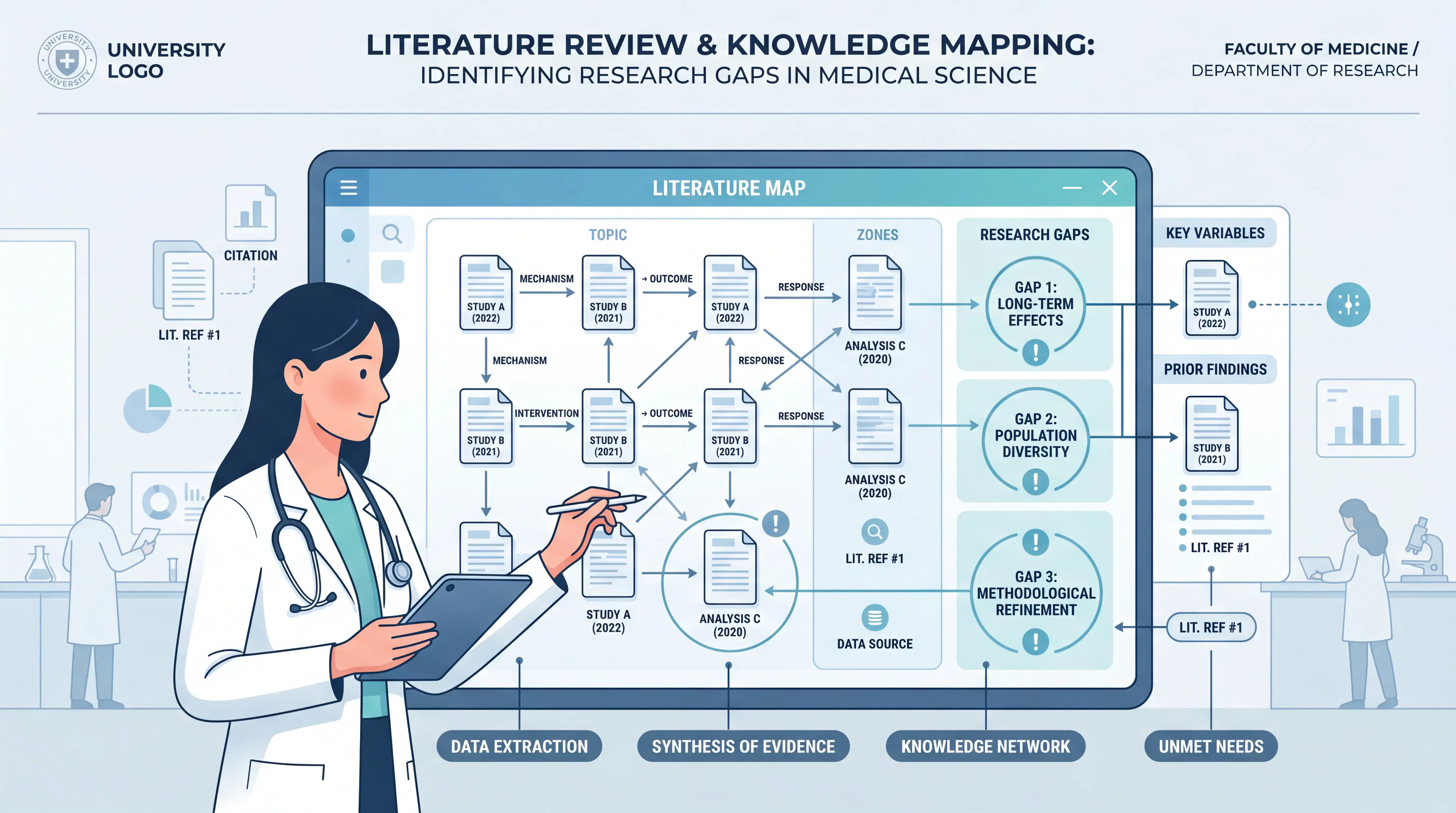
One of the most common mistakes in a literature review is turning it into a simple reading list. This weakens any essay because it shows what is known, but not what it means. A review should synthesize studies, not just repeat them.
For example, saying that “Study A found X, Study B found Y, and Study C found Z” is not enough. A better approach is to explain why the findings differ, whether the methods vary, and what the disagreement means for your research question.
A literature review must answer two questions: what do we know, and what is still uncertain? That is the core function of review writing in scientific work.
1.2 Missing the research gap
Another frequent problem is failing to identify the gap in existing research. The knowledge base notes that many authors struggle to pinpoint shortcomings in prior studies. As a result, reviewers often see weak statements such as “more research is needed,” which adds little value.
A strong gap statement should be specific. It may concern a population, method, outcome, or context. For instance, if most studies examine one disease stage, but your topic focuses on a later stage, that difference should be stated clearly.
1.3 Using vague or unsupported claims
A literature review loses authority when it uses general phrases without evidence. Words like “many studies,” “several researchers,” or “it is well known” do not convince readers unless they are backed by citations.
In an academic essay, precision matters. Use exact claims, exact contexts, and exact limitations. This makes the review more trustworthy and easier for supervisors or reviewers to follow.
2. Common Structural Mistakes
2.1 Poor organization of themes
A review often fails because it follows the order of the papers, not the logic of the topic. This creates a list-like structure that is hard to read. A better literature review groups studies by theme, method, population, or outcome.
This approach helps readers see the pattern across studies. It also makes it easier to build an argument. In medical and scientific writing, structure is not a cosmetic detail. It is part of the evidence itself.
A practical method is to outline your section before drafting:
- Define the central question.
- Group studies into 3 to 5 themes.
- Compare findings within each theme.
- End each theme with a limitation or gap.
2.2 Overusing outdated sources
Older sources can be useful, but relying on them too heavily is a mistake. A literature review should reflect current progress, trends, and methods. The knowledge base emphasizes that reviews should capture new developments and new directions in the field.
If your review only cites older papers, readers may assume the topic has not been updated. In fast-moving fields like medicine, this is a serious weakness. Use older studies to build the foundation, but pair them with recent evidence.
2.3 Not matching scope to the research question
Some reviews are too broad. Others are too narrow. Both create problems. If the scope is too broad, the review becomes shallow. If it is too narrow, it may miss the context needed to justify the study.
The scope should match the research question exactly. A focused review is usually stronger than an expansive one. It allows you to compare evidence in depth and avoid unnecessary material.
3. Analytical Mistakes That Weaken the Essay
3.1 Confusing critique with criticism
A literature review is not supposed to attack previous authors. It should evaluate the evidence fairly. The goal is to explain strengths, weaknesses, and applicability.
In scientific writing, critique means asking practical questions:
- Was the sample appropriate?
- Was the method valid for the question?
- Do the findings apply to your context?
- Are there conflicting results from other studies?
This balanced approach shows maturity. It also increases the credibility of the essay.
3.2 Ignoring methodological differences
Many conflicts in the literature come from method differences, not just topic differences. If one study uses a retrospective design and another uses a prospective one, their conclusions may not be directly comparable.
A good review should note these differences. The knowledge base provides useful sentence patterns for this type of critique, especially when discussing the strengths and limits of a method. This is important in medical research, where study design strongly influences interpretation.
If methods differ, conclusions may differ too. A strong review explains that relationship clearly.
3.3 Failing to connect evidence to your study
A review should lead directly to your own research question. If the final paragraph does not show why your study is needed, the section feels disconnected.
This is where many writers lose the argument. They describe the literature well, but do not explain how it supports their hypothesis, objective, or clinical question. Your review should move from evidence to justification in a clear line.
4. Writing Mistakes in Academic Style
4.1 Using too much passive or indirect language
Excessively cautious language can make a review sound weak. You do not need to hide every claim behind long phrases. Use direct, precise sentences when the evidence supports them.
For example, instead of writing “It may be suggested that there is a possible association,” write “The evidence suggests an association.” Clear writing improves readability and authority.
4.2 Repeating the same point in different words
Repetition is another common issue. It wastes space and makes the review feel unfocused. Every paragraph should add something new: a comparison, a limitation, a contradiction, or a gap.
This is especially important when you have a strict word limit. A concise literature review is often stronger than a long one. In an academic essay, every sentence should carry a purpose.
4.3 Weak transitions between paragraphs
A literature review should read as one argument, not separate notes. Weak transitions break that flow. Use transition phrases that show comparison, contrast, or consequence.
Examples include:
- However
- In contrast
- Similarly
- As a result
- Therefore
These simple connectors help the reader follow the logic of the review without confusion.
5. A Practical Way to Avoid These Mistakes
5.1 Use a review framework before drafting
Before writing, build a simple framework. This reduces the risk of repetition and weak structure. For medical students and researchers, a 4-step process works well:
- Collect recent and relevant studies.
- Group them by theme or method.
- Identify agreement, disagreement, and gaps.
- Write a concluding paragraph that justifies your study.
This method keeps the review analytical and focused. It also makes revision faster.
5.2 Write with evidence, not opinion
A review should not rely on personal impressions. Every key claim should be traceable to a source. This is one of the clearest signs of academic quality.
When possible, include details such as:
- sample type
- study design
- population
- major outcome
- limitation
These details improve precision and help readers trust your evaluation.
5.3 Use AI support carefully
Tools can help organize studies, summarize patterns, and save time. But the final review still needs human judgment. You must decide what matters, what conflicts, and what gap is most important.
This is where scifocus.ai can help. It can support faster literature organization and cleaner drafting, so you spend more time on analysis and less time on manual sorting. For busy clinicians, medical students, and researchers, that can make the difference between a rough draft and a publishable essay.
Conclusion
The most common mistakes in literature review writing are easy to spot once you know what to look for. Weak summaries, vague gaps, poor structure, shallow critique, and disconnected arguments all reduce academic quality. A strong review is focused, analytical, and evidence-based. It should show what is known, what is disputed, and why the new study is necessary. If you want to write faster and more clearly, use scifocus.ai to streamline your literature work and strengthen your next academic essay.
Did you like this article? Explore a few more related posts.
Start Your Research Journey With Scifocus Today
Create your free Scifocus account today and take your research to the next level. Experience the difference firsthand—your journey to academic excellence starts here.