

Common Grammar Mistakes in Medical Journals
Introduction
Medical writing demands precision. Yet even a strong essay can lose credibility when small grammar errors slip into a manuscript. For medical students, doctors, and researchers, these mistakes can affect clarity, peer review, and publication quality. The most common problems are often simple: wrong prepositions, weak title construction, and unclear author or affiliation wording. If you want your medical journal writing to read as professional and trustworthy, grammar must be controlled at the sentence level.
1. Why Grammar Matters in Medical Journal Writing
1.1 Grammar Shapes Scientific Credibility
In medical journals, grammar is not only about style. It affects how reviewers interpret your meaning. A sentence with the wrong preposition or tense can make a method sound vague or even incorrect.
This matters because journal readers scan fast. The title, abstract, and key methods are often the only parts many readers see. If those sections contain grammar errors, your work may appear less rigorous than it really is.
1.2 Grammar Errors Can Change Meaning
In medical research, small wording differences can alter the interpretation of a result. For example, using the wrong preposition may suggest an abstract method when you meant a concrete tool.
A sentence like “tumor volumes were measured by a vernier caliper” is less precise than “tumor volumes were measured with a vernier caliper.” The second version correctly matches a physical instrument to the preposition with. That is the level of detail expected in a polished essay for scientific publication.
2. Common Preposition Mistakes in Medical Writing
2.1 “By” vs. “With”
One of the most common grammar mistakes in medical journals is preposition misuse. In scientific English, by usually refers to an abstract method or process, while with usually refers to a concrete tool or instrument.
For example:
- Correct: tumor volumes were measured with a vernier caliper.
- Less precise: tumor volumes were measured by a vernier caliper.
Here, the caliper is a physical instrument, so with is the natural choice. This is a small change, but it improves accuracy and readability.
2.2 How to Check Prepositions Quickly
When editing a manuscript, ask one simple question: is the phrase describing a method or a tool?
Use this quick rule:
- By for method, process, or mechanism.
- With for instrument, device, or material.
- In for location or setting.
- For for purpose or function.
This rule will not solve every case, but it helps avoid a large number of avoidable errors in a medical essay.
3. Title Construction Problems in Medical Journals
3.1 Titles Must Be Short and Specific
A title is the most read part of a paper. It should show the main point without unnecessary words. In medical journals, weak titles often begin with phrases like “Study of” or “Investigation of.” These add length but not meaning.
A stronger title is direct. It identifies the topic, the method, or the key finding. Good titles are concise, specific, and easy to understand at first glance.
3.2 Avoid Empty Phrases and Overly Broad Titles
One common mistake is using broad or weak wording. For example, a title like “Study of the Role of Inhibitor of Apoptosis Protein in Radiation Resistance of Non-Small Cell Lung Cancer” is too long and contains filler language.
A better title should remove unnecessary words and focus on the scientific point. In medical publishing, readers want the subject and the result quickly. A title should not sound like a general school essay. It should sound like a research statement.
3.3 Avoid Unclear Abbreviations
Another title problem is overusing abbreviations. Abbreviations can save space, but they can also reduce clarity. If the audience cannot immediately understand the term, the title becomes weaker.
For example, using NSCLC may be familiar to oncology specialists, but not every reader will know it instantly. A title should support discoverability. If clarity suffers, the paper may lose visibility, even if the research is strong.
4. Repetition and Redundancy in Scientific Language
4.1 Do Not Repeat the Same Meaning Twice
Medical journal writing often includes semantic repetition. This happens when two words express nearly the same idea. A common example is using both “differentially expressed” and “upregulated” in the same title or sentence when only one is needed.
If a gene is described as differentially expressed, that already indicates expression change. Adding upregulated can be redundant unless you are specifically narrowing the direction of change. Precision means saying more with fewer words, not repeating the same idea.
4.2 Remove Unnecessary Articles and Filler Words
Another frequent issue is overusing articles and weak connectors. In journal titles and formal scientific sentences, words like the, a, and of should be used only when they improve clarity.
This does not mean removing them everywhere. It means editing carefully. A cleaner sentence often reads more professionally and is easier to index in databases. That is one reason a well-edited essay can outperform a cluttered one, even if both report the same data.
5. Common Grammar Errors in Subject-Verb Agreement and Pronouns
5.1 Third-Person Singular Agreement
Subject-verb agreement is a basic but frequent problem. In scientific writing, singular subjects require singular verbs, and plural subjects require plural verbs.
For example, if the subject is Metformin, the verb should match in the singular form: targets, not target. These errors may look minor, but they weaken the sentence immediately. Reviewers notice them quickly.
5.2 Singular and Plural Confusion
Medical journal writers also make mistakes with countable nouns and plural forms. This is common when the sentence is technically correct in meaning but grammatically inconsistent.
A careful editor should check every noun phrase. If a plural object is described with a singular pronoun, the sentence becomes unstable. In scientific English, consistency is part of credibility.
5.3 Pronoun Reference Errors
Pronoun reference is another major problem in medical journals. The pronoun must clearly match the noun it refers to. If the noun is plural, the pronoun should also be plural.
For example, if “microbubbles” is the antecedent, the correct pronoun is their, not its. The rule is simple, but the error is common in long titles and dense method sections. This is one reason manuscript editing is often more demanding than drafting the first version of an essay.
6. Author Order, Affiliation Order, and Journal Convention
6.1 Authorship Must Reflect Contribution
In medical publishing, authorship is not just a name list. It reflects responsibility and contribution. Many SCI journals require authorship details and contribution statements.
The first author usually performs most of the experimental work and writes much of the paper. The corresponding author usually leads the project, secures funding, and oversees submission. Because authorship carries both credit and responsibility, it must be handled carefully.
6.2 Affiliation Order Can Be Sensitive
In collaborative projects, affiliation order may become a source of confusion or conflict. Some institutions care deeply about being listed first. But in general, affiliation order is less rigid than author order.
A practical approach is to place the primary full-time institution first and secondary institutions later, unless the journal or project agreement says otherwise. The key is consistency and transparent responsibility. That reduces disputes and helps the paper move through submission smoothly.
6.3 Use Accepted English Institution Names
Institution names should follow the standard English versions used by the academic community. Do not invent a new translation if an internationally recognized form already exists. Consistency matters for indexing, citation, and searchability.
This is especially important for long-established universities and hospitals. A stable institutional name supports discoverability and prevents confusion across databases.
7. A Practical Editing Workflow for Medical Manuscripts
7.1 Edit in Layers
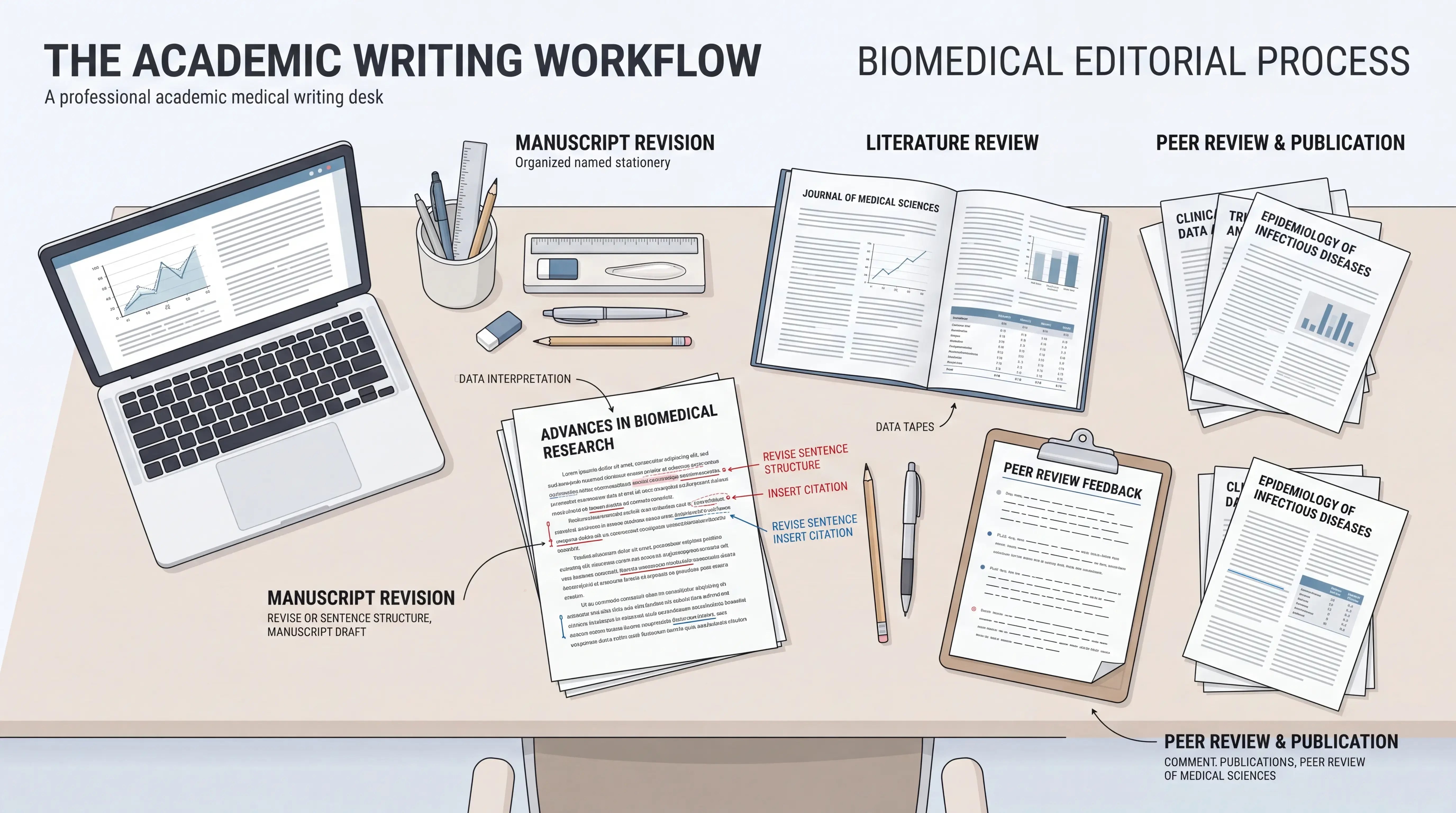
A strong manuscript is usually not written perfectly in one pass. It is revised in layers. Start with the title, then abstract, methods, results, and discussion. Check grammar only after the scientific content is stable.
Use this workflow:
- Check subject-verb agreement.
- Check prepositions.
- Check pronouns.
- Remove redundancy.
- Shorten the title.
- Verify author and affiliation format.
This process saves time and reduces error leakage across sections.
7.2 Use a Final Quality Check
A final review should focus on clarity, not only correctness. Read each sentence aloud if needed. If the sentence feels heavy, cut it. If a phrase repeats the same idea, remove it. If a pronoun could refer to two nouns, rewrite it.
The best medical writing is precise, readable, and defensible under peer review. That is the standard every researcher should aim for.
7.3 How SciFocus.ai Helps
For medical students, doctors, and researchers who need faster editing support, scifocus.ai can help streamline the process. It can support drafting, rewriting, and polishing a scientific essay so your language is clearer and more consistent before submission.
Used well, it can reduce grammar friction and help you focus on content quality, data interpretation, and journal fit. For teams preparing manuscripts under deadline, that efficiency matters.
Conclusion
Common grammar mistakes in medical journals are often small, but their impact is not. Wrong prepositions, weak titles, redundant wording, and pronoun errors can all reduce clarity and weaken trust. Careful editing is not optional in medical publishing. It is part of scientific accuracy. If you want your next manuscript to read with greater precision and confidence, review it systematically and use tools that support quality. Try scifocus.ai to refine your scientific writing and produce a cleaner, stronger submission.
Did you like this article? Explore a few more related posts.
Start Your Research Journey With Scifocus Today
Create your free Scifocus account today and take your research to the next level. Experience the difference firsthand—your journey to academic excellence starts here.