
Common Chinglish Mistakes in Scientific Writing
Introduction
Scientific writing is judged fast. Editors, reviewers, and readers often decide within seconds whether an essay feels clear and credible. For medical students, doctors, and researchers, Chinglish mistakes can weaken an otherwise strong manuscript. They can blur meaning, lower professionalism, and slow publication. The good news is that most of these problems follow predictable patterns, so they can be corrected with a clear method. This essay explains the most common errors and shows how to write with more precision.
1. Why Chinglish Hurts Scientific Writing
1.1 It weakens clarity and precision
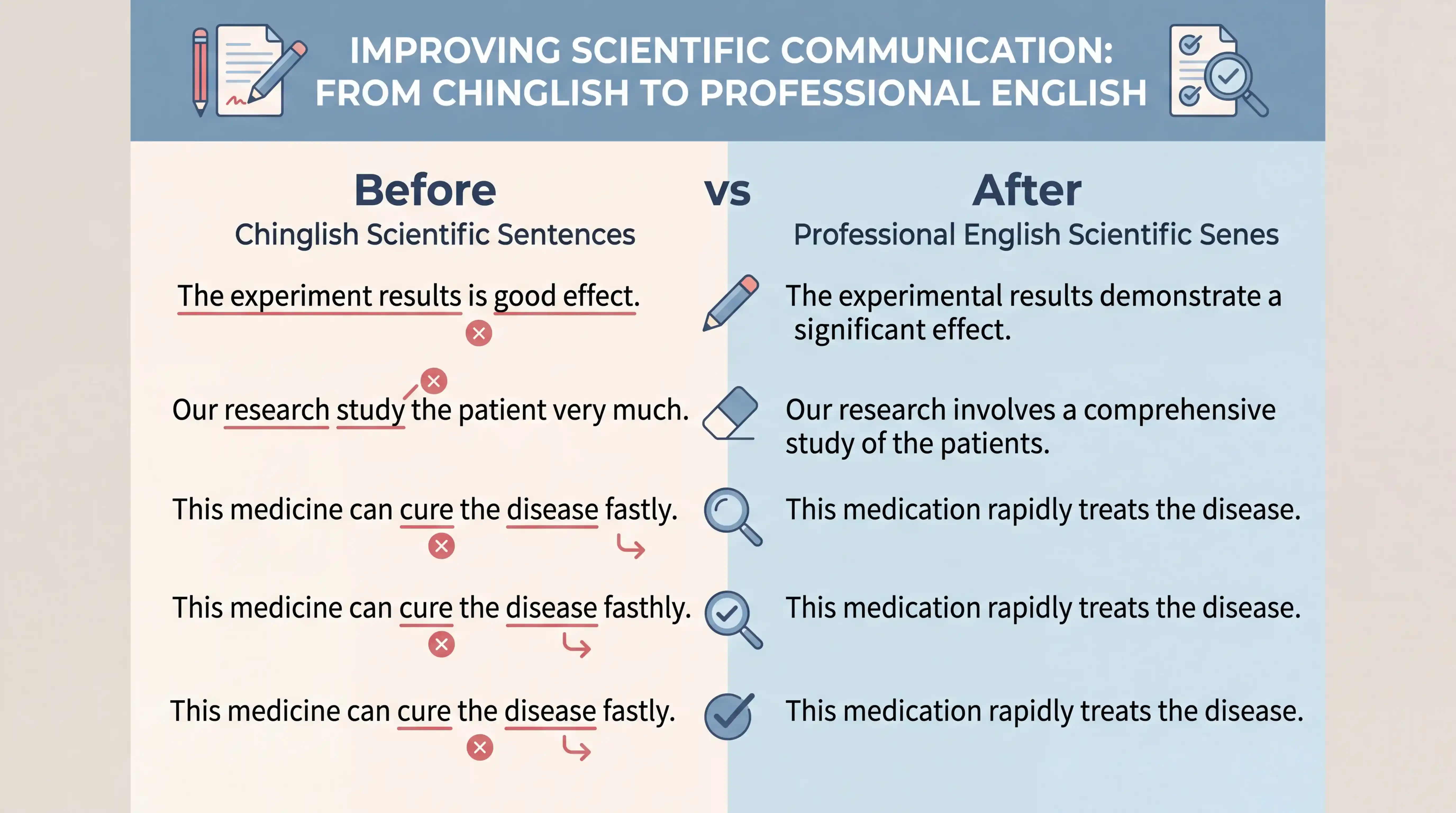
In scientific writing, every sentence should carry one clear meaning. Chinglish often produces awkward structure, misplaced modifiers, or vague wording. The result is not just “unnatural English.” It is often ambiguous English.
For example, a sentence like “measurements of blood pH, were made with a capillary electrode” sounds clumsy and slows the reader down. A cleaner version is “blood pH was measured with a capillary electrode.” The meaning is direct. The subject is clear. The key term is in the right position.
1.2 It affects credibility
A paper with frequent language problems may be judged as less rigorous, even when the science is solid. This matters in abstracts, titles, and results sections, where concise language is essential. A weak sentence can make a strong study look poorly designed.
That is why editing is not only a language task. It is part of scientific communication. A well-written essay should help readers understand the study design, results, and conclusion without extra effort.
2. Common Chinglish Patterns in Titles and Abstracts
2.1 Overusing abbreviations too early
Abbreviations can save space, but they can also confuse readers. In titles, they should be used carefully. The knowledge base recommends avoiding abbreviations in titles whenever possible. In abstracts, a full term should appear first, followed by the abbreviation in parentheses.
For example, breast cancer stem cells (BCSCs) is acceptable in an abstract after the full term is introduced. But a title full of unexplained abbreviations is harder to scan and less accessible to a broad scientific audience.
A good title is short, specific, and easy to understand. It should not force the reader to decode the message before reading the paper.
2.2 Using informal or spoken-style English
Scientific English should sound precise, not conversational. Chinglish often appears when writers directly translate spoken Chinese into English. One example is: “we made at least two analysis on each specimen.” The better version is “we analyzed each specimen at least twice.”
Another example is the sentence structure itself. In scientific writing, the main action should usually appear near the front of the sentence. This helps the reader follow the logic quickly. When the core verb is buried too late, the sentence becomes heavy.
A strong essay in science should sound controlled, concise, and objective. That is especially important in abstracts, where space is limited and every word matters.
3. Grammar Problems That Commonly Appear in Scientific English
3.1 Misplaced adverbs
One frequent problem is putting an adverb in the wrong place. Consider the sentence: “Forty-eight mice were, divided into groups A and B randomly.” The correct version is “Forty-eight mice were randomly divided into groups A and B.”
This is a small change, but it improves readability immediately. The adverb “randomly” should modify the verb phrase directly. In scientific writing, this kind of placement error is common because writers try to preserve Chinese sentence order.
A useful rule is simple. Place the modifier as close as possible to the word it describes. This reduces confusion and makes the sentence more professional.
3.2 Subject-verb mismatch
Another common issue is disagreement between subject and verb. In the results section, this often appears when writers use a plural subject with a singular verb, or the opposite.
For example, “our data demonstrates that” is incorrect in standard academic usage. The subject “data” is plural in this context, so the correct form is “our data demonstrate that.” This may look minor, but reviewers notice it quickly.
The same rule applies to counts and measurements. If the subject is plural, the verb should match. If a noun refers to multiple items, the modifier should also reflect that structure. This is basic grammar, but it remains one of the most common sources of Chinglish in an essay.
3.3 Singular and plural confusion
Scientific English depends heavily on number agreement. Writers may write “decreased mRNA level” when the data actually involve multiple transcripts or repeated measurements. In that case, “mRNA levels were decreased” is more accurate.
This is not just grammar. It is logic. A singular noun can suggest a single variable, while the study may actually measure many samples or repeated observations. Clear number agreement helps the reader interpret the scale of the experiment correctly.
4. Sentence Structure Errors That Reduce Accuracy
4.1 Overly complex sentence chains
Many Chinglish sentences become too long because they try to include every detail at once. In scientific writing, this often creates confusion. A sentence such as “DNA methylation in key regulatory regions, of the Oct4 gene, which was assessed, by bisulfite genomic sequencing analysis, showed that DNMT3A did not regulate the expression of Oct4” is difficult to follow.
A better approach is to split the logic. For example: “After DNA methylation in key regulatory regions of the Oct4 gene was assessed by bisulfite genomic sequencing analysis, we found that DNMT3A did not regulate Oct4 expression.” The sequence becomes easier to understand.
When writing an essay for scientific publication, one sentence should usually express one main idea. If two ideas are both important, separate them.
4.2 Asymmetrical structure
Parallel structure matters in English. In Chinese-influenced writing, two parts of a comparison may not match grammatically. For example, “The expression of Snail, in both HeLa and Caski cells were higher than C-33A cells” is structurally uneven.
A clearer version is “The expression of Snail in both HeLa and Caski cells was higher than that in C-33A cells.” The comparison is now balanced.
This type of error can appear in result statements, figure legends, and discussions. It makes a sentence feel unstable. Parallelism helps the reader compare groups, variables, or outcomes without stopping to decode the structure.
4.3 Wrong conjunctions and transition words
Some writers use “but” too directly in formal scientific writing. In many contexts, “however” is the better choice because it sounds more controlled and fits academic style better.
For example, “These results suggest that BIRC3 serves as a new target for the treatment of cervical cancer, but we could not inhibit its expression by DNA demethylation” can be improved with a transition like “however.” The point is not to replace every “but.” The point is to use transitions that match the tone and logic of the paragraph.
A scientific essay should guide the reader through contrast, cause, and conclusion in a disciplined way.
5. Vocabulary Choices That Sound Unnatural
5.1 Using strong verbs too loosely
In scientific English, some verbs are too strong for the evidence being presented. The knowledge base notes that “identify” may be used inappropriately when the writer really means “show” or “demonstrate.” In research, it is safer to match the verb to the strength of the data.
For example, if a study compares HPV-positive and HPV-negative cervical cancer cell lines and finds stronger colony formation in one group, it is better to say “we showed” or “we demonstrated” rather than using “prove.” The verb should reflect the evidence, not exaggerate it.
This is especially important in abstracts and results. Overstated wording can reduce trust. Precise verbs protect scientific credibility.
5.2 Avoiding vague or inflated words
Some writers choose words that sound “advanced” but become less precise. The knowledge base warns against using high-level vocabulary when simpler wording is clearer. In scientific writing, clarity should come before decoration.
For example, instead of saying a pathway “represents” a treatment target, it is often better to say “the signaling pathway could be a novel target for treatment.” This is direct, readable, and scientifically safer.
A strong essay does not need fancy language. It needs exact language. That principle applies to every section, from title to conclusion.
6. Tense and Logic in Scientific Writing
6.1 Use past tense for what you did
Results usually describe what happened in the study, so past tense is standard. This is one of the most practical rules in scientific writing. Methods and results often use past tense because they report completed work.
For example, “We analyzed each specimen at least twice” works well because it describes a completed action. It is concise and consistent with scientific reporting.
6.2 Use present tense for what is generally true
General conclusions, established facts, and the meaning of findings can use present tense. The knowledge base emphasizes this distinction. Past tense reports the experiment. Present tense states the conclusion or accepted fact.
This tense balance improves accuracy. It helps the reader understand whether you are describing an action, a finding, or a broader scientific claim. Mixing the two without purpose can make the paragraph feel unstable.
7. A Simple Revision Method for Medical Writers
7.1 Check four things in every sentence
A practical editing workflow can reduce Chinglish quickly. Review each sentence for:
- subject-verb agreement
- modifier position
- number consistency
- tense consistency
Then check whether the sentence is too long or too conversational. If it is, split it or simplify it. This process works well for abstracts, results, and discussion sections.
7.2 Read for meaning, not just grammar
Many writers stop after grammar correction. That is not enough. You also need to check whether the sentence says exactly what you intended. If the reader could misread the logic, the sentence needs revision.
A good scientific essay should not merely be grammatical. It should be efficient, readable, and defensible under peer review. That is where careful editing makes a measurable difference.
8. How SciFocus AI Can Help You Write Better Scientific Essays
SciFocus AI can support this process by helping you detect unclear structure, awkward phrasing, and weak academic wording before submission. For medical students, doctors, and researchers who write in English as a second language, this kind of support can save time and reduce avoidable language errors.
It is especially useful when you need to polish an abstract, refine a results paragraph, or turn a rough draft into a cleaner scientific essay. Instead of spending hours fixing the same sentence patterns, you can focus on the science while SciFocus AI helps improve clarity and consistency.
Conclusion
Common Chinglish mistakes in scientific writing are usually predictable. They include abbreviation overload, spoken-style English, adverb misplacement, tense errors, weak vocabulary choices, and unclear sentence structure. Once you recognize these patterns, revision becomes much easier. The goal is not to sound complicated. The goal is to sound precise, professional, and trustworthy. If you want to write a stronger scientific essay faster, explore SciFocus AI and use it to improve the clarity of your next manuscript.

Did you like this article? Explore a few more related posts.
Start Your Research Journey With Scifocus Today
Create your free Scifocus account today and take your research to the next level. Experience the difference firsthand—your journey to academic excellence starts here.