

Common Academic Phrasal Verbs for Writing a Strong Essay
Introduction
Writing a strong essay in English is not only about grammar. It is also about choosing the right words. For medical students, doctors, and researchers, weak phrasing can blur meaning and reduce impact. Many writers know the idea they want to express, but they struggle with natural academic phrasing. This guide explains common academic phrasal verbs and shows how they improve clarity, precision, and flow in an essay.
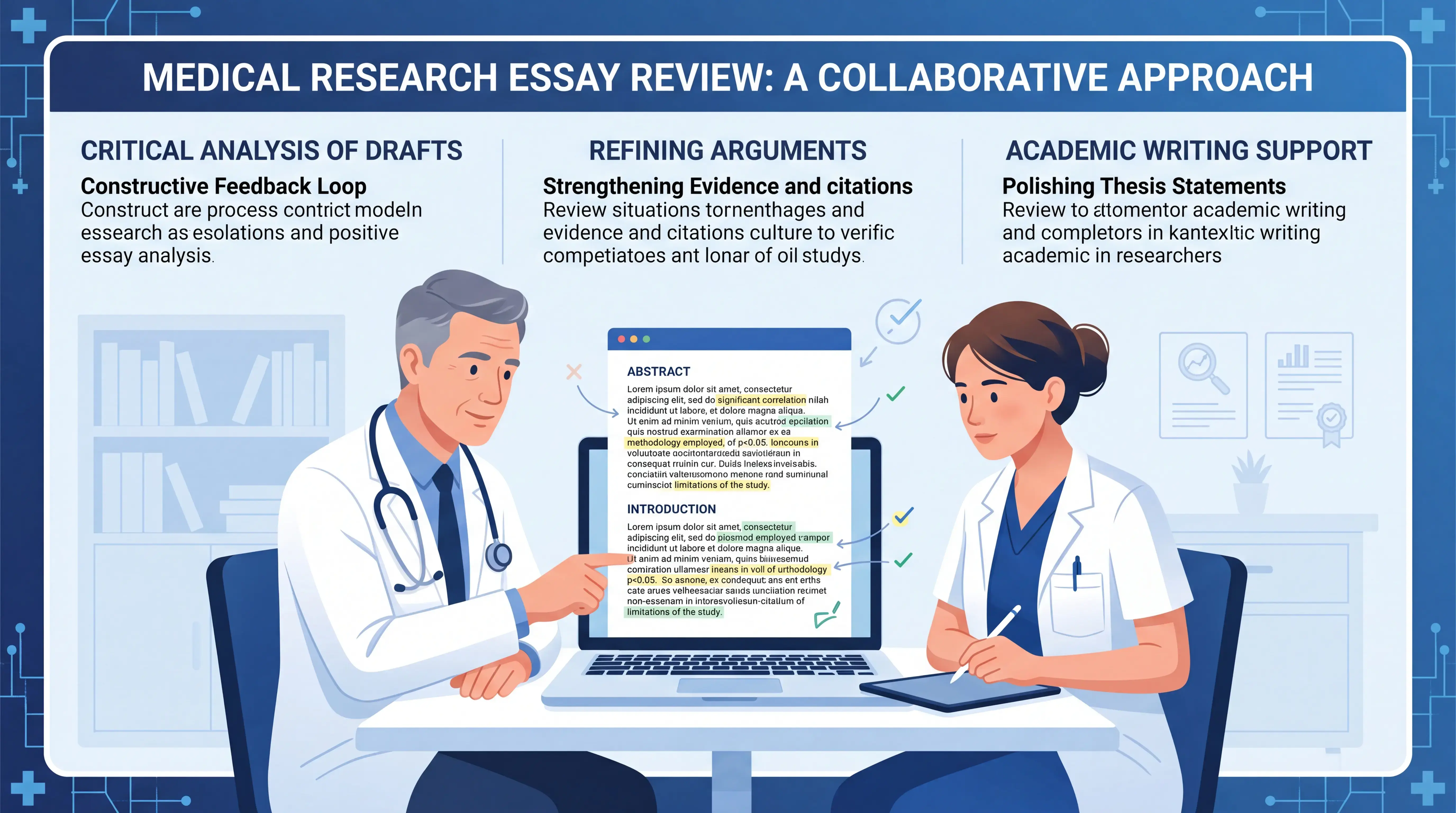
1. Why Academic Phrasal Verbs Matter in an Essay
1.1 They make writing more natural
Academic English is not only formal. It is also precise. A good essay should sound controlled, direct, and easy to follow. Phrasal verbs can help when they are used carefully and in the right context.
In scientific and academic writing, the problem is often not a lack of ideas. It is the way ideas are expressed. Strong verbs make arguments clearer than vague noun-heavy sentences. This is especially important for medical and research audiences, where accuracy matters.
For example, compare these two lines:
- Weak: The study had an effect on recovery.
- Better: The study led to faster recovery.
The second sentence is shorter. It is also clearer. In an essay, that difference improves readability immediately.
1.2 They reduce wordiness
Many non-native writers overuse abstract nouns such as “influence,” “impact,” or “improvement” without a strong verb structure. That style makes writing heavier than necessary. A phrasal verb often creates a cleaner sentence.
Examples:
- carry out a study
- point out a limitation
- bring about a change
- rule out an alternative explanation
- carry over findings into practice
These expressions are common in academic and biomedical writing. They are useful because they match how experts report methods, results, and interpretation in an essay.
1.3 They support E-E-A-T style writing
Readers trust writing that is specific. They also trust writing that shows control over language. An essay with precise academic phrasal verbs feels more professional and credible. That is valuable for clinicians, researchers, and graduate students who want their writing to sound polished without sounding artificial.
2. Common Academic Phrasal Verbs You Can Use
2.1 Verbs for research and methods
These are useful when describing how a study was done. They are especially common in methods sections and structured academic writing.
- carry out means to perform
Example: The team carried out a retrospective review. - set up means to establish or arrange
Example: The researchers set up a controlled experiment. - draw up means to prepare
Example: The committee drew up a protocol for data collection. - follow up means to check later or continue observation
Example: The doctors followed up patients for six months.
These verbs are practical because they describe actions directly. In an essay, they keep the reader focused on what was done.
2.2 Verbs for results and interpretation
These are useful when explaining findings and their meaning.
- show up can mean appear or become visible
Example: The lesion showed up clearly on imaging. - point to means indicate
Example: The data point to a possible inflammatory pathway. - rule out means exclude
Example: The test ruled out infection. - bring about means cause
Example: The intervention brought about measurable improvement. - back up means support
Example: The findings back up the original hypothesis.
A precise verb often does more work than a long explanation. That principle is especially useful in an essay written for academic readers.
2.3 Verbs for argument and discussion
These help when building a strong discussion section.
- point out means mention clearly
Example: The author points out a key limitation. - take into account means consider
Example: The analysis takes into account age and disease severity. - build on means develop from
Example: This essay builds on previous clinical evidence. - go beyond means exceed or extend further
Example: The paper goes beyond descriptive reporting. - come down to means be explained by
Example: The difference comes down to sample size and study design.
These phrases help you organize reasoning. In a strong essay, the discussion should not only report facts. It should show how the facts connect.
3. How to Use Them Correctly
3.1 Choose clarity over variety
Do not use phrasal verbs just to sound advanced. Use them when they fit the meaning. In academic writing, correctness is more important than style. A simple verb is often better than a decorative one.
For example:
- Better: The study found no difference.
- Not better: The study came across no difference.
The second sentence is unnatural in academic context. A good essay uses language that fits the field, not language that merely sounds complex.
3.2 Keep formal tone in medical and scientific writing
Some phrasal verbs are suitable for academic work. Others are too conversational. The key is to separate useful academic phrasing from casual speech.
Appropriate in an essay:
- carry out
- point out
- rule out
- build on
- take into account
Less suitable in formal scientific prose:
- get rid of
- figure out
- mess up
- talk over
In medical writing, tone matters. The best academic phrasal verbs sound neutral, accurate, and professional.
3.3 Watch for voice and sentence structure
Use active voice where possible. It improves readability. It also makes responsibility clear.
Compare:
- Passive: The analysis was carried out by the team.
- Active: The team carried out the analysis.
The active version is shorter and stronger. In an essay, that difference helps the argument move faster.
4. Common Errors Writers Make
4.1 Using the wrong preposition
Phrasal verbs are fixed expressions. Changing one word can change the meaning or make the sentence incorrect.
Examples:
- point out is correct
- point on is incorrect
- rule out is correct
- rule off is incorrect
- build on is correct
- build up has a different meaning
If you are writing an essay, check the full phrase, not just the main verb.
4.2 Overusing the same phrases
Repetition weakens writing. If every paragraph uses “point out,” the text starts to feel mechanical. Use a small, accurate set of verbs and vary them naturally.
A balanced essay may use:
- carry out for methods
- point to for interpretation
- rule out for exclusion
- build on for discussion
- back up for support
This gives the paper structure without sounding repetitive.
4.3 Mixing informal and academic tone
Some writers insert casual phrasal verbs into formal work. That can reduce trust. In medical and research writing, choose phrases that fit scholarly expectations.
Weak:
- The study found out that the treatment worked.
Better:
- The study showed that the treatment worked.
Weak:
- We got rid of confounding factors.
Better:
- We controlled for confounding factors.
A strong essay depends on tone consistency. One casual phrase can weaken the whole paragraph.
5. Practical Revision Tips for a Better Essay
5.1 Replace weak nouns with strong verbs
A common writing problem is noun inflation. Writers turn actions into nouns, then surround them with extra words.
Example:
- Weak: The study made an assessment of the outcome.
- Better: The study assessed the outcome.
Try this in revision:
- Find abstract nouns.
- Ask whether a verb can replace them.
- Rewrite the sentence in active form.
This method often cuts sentence length by 20 to 30 percent while improving clarity. That is useful in any essay.
5.2 Read sentences aloud
If a sentence feels stiff when spoken, it is probably too heavy. Academic writing should be formal, but it should not be hard to process. Reading aloud helps you catch awkward phrasal verb use, repetition, and long noun strings.
5.3 Build a personal phrase bank
Create a small list of useful academic phrasal verbs and review them often. For medical students and researchers, this is a practical habit.
A useful phrase bank for an essay can include:
- carry out
- follow up
- rule out
- point out
- take into account
- build on
- back up
- bring about
Use them only when they match the meaning exactly.
6. Why This Matters for Medical and Research Writing
6.1 Precision improves credibility
In clinical and academic contexts, unclear wording can create confusion. Precise verbs help readers understand the scope, method, and conclusion of your essay. That is essential when the audience includes clinicians, supervisors, reviewers, or journal editors.
6.2 Good wording saves time in revision
When you write more accurately from the start, you reduce editing later. That is one reason structured writing tools are helpful. scifocus.ai can support academic writers by helping refine phrasing, improve structure, and make a draft easier to polish. For medical students and researchers writing an essay, that can save time and improve consistency.
6.3 Strong style supports stronger thinking
Language shapes thought. When you use precise verbs, your argument becomes more exact. Your logic becomes easier to see. That is why academic phrasal verbs are not just vocabulary items. They are tools for better reasoning.
Conclusion
A strong essay is built on clear structure, precise verbs, and consistent academic tone. Common academic phrasal verbs such as carry out, rule out, point out, and take into account can make your writing more direct and readable. They also help medical students, doctors, and researchers communicate with more confidence. If you want to improve your draft faster, consider using scifocus.ai to refine language and strengthen academic expression.
Did you like this article? Explore a few more related posts.
Start Your Research Journey With Scifocus Today
Create your free Scifocus account today and take your research to the next level. Experience the difference firsthand—your journey to academic excellence starts here.