

Colon vs Semicolon: What’s the Key Difference?
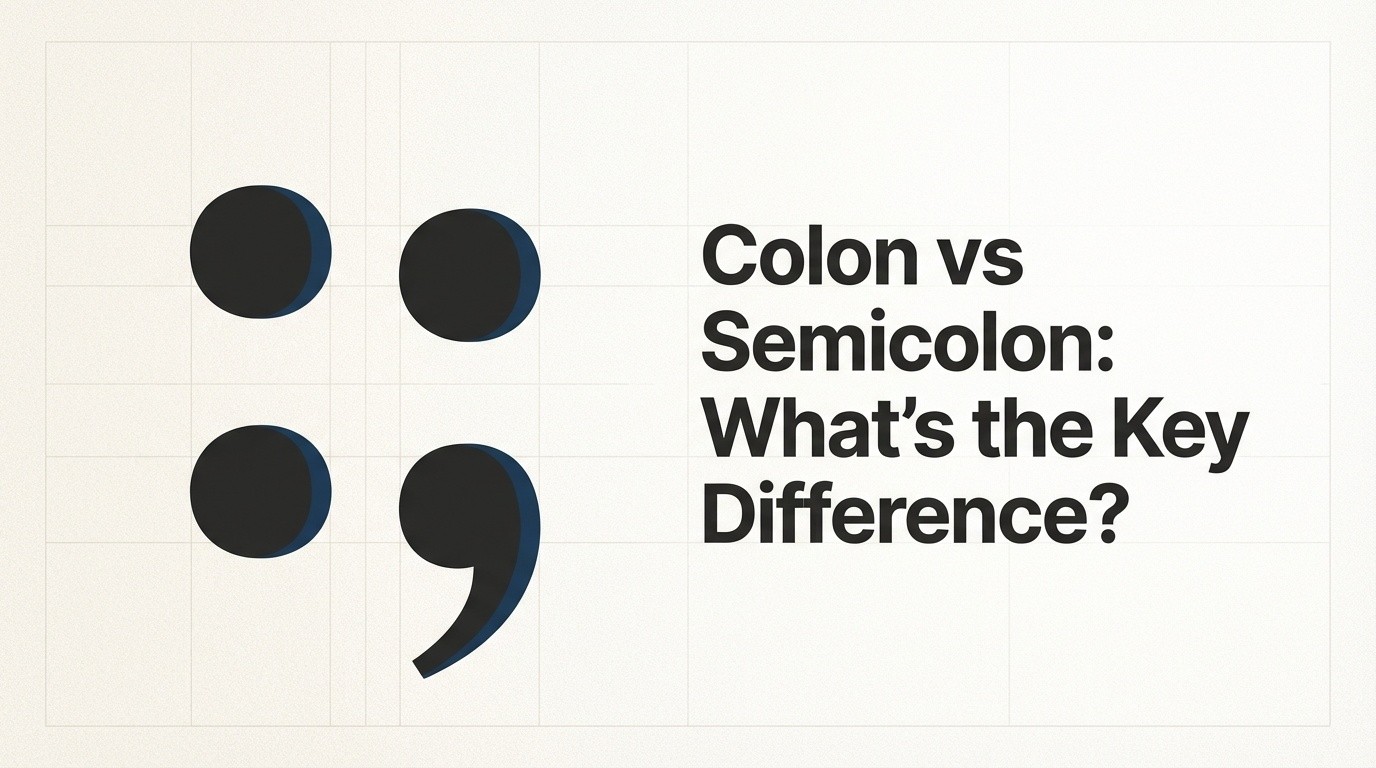
The colon (:) introduces lists, explanations, quotes, or emphasis after an independent clause, while the semicolon (;) joins closely related independent clauses or separates items in complex lists. Understanding this distinction improves clarity, logical flow, and formal readability, especially in academic and professional writing. According to theUniversity of Sussex guide, colons set up explanatory information, whereas semicolons link standalone clauses without conjunctions. A Western Michigan University resource notes semicolons join complete sentences under specific conditions, such as replacing a period or the conjunction "and". For structured research writing and contextual guidance, Scifocus integrates these punctuation rules into broader frameworks for academic writing and analysis.
What Does a Colon Do?
A colon introduces material that elaborates on or explains the preceding clause. It signals that what follows is significant, whether a list, definition, or illustrative example. Colons are also commonly used in headings, formal titles, and research outlines to maintain hierarchical structure.
- Example (list): Participants were asked to bring the following items: a notebook, a pen, and a calculator.
- Example (explanation): The experiment revealed one conclusion: increased light exposure accelerated plant growth.
- Example (quote): The author concluded: “Accurate punctuation reflects precise thinking.”
As outlined by Western Michigan University, colons create a direct bridge to amplifying details. Similarly, University of Sussex emphasizes that colons are central in formal lists and appositives for scholarly emphasis, especially in research papers where logical hierarchy matters.
How Should a Semicolon Be Used?
A semicolon connects two independent but related clauses without a coordinating conjunction, signaling that the clauses are connected in meaning but can each stand alone. Semicolons also clarify complex lists, where internal commas may otherwise create ambiguity.
- Independent clauses: The study was conclusive; the data supported the hypothesis.
- Complex lists: The study sites included Paris, France; Rome, Italy; and Madrid, Spain.
- With conjunctive adverbs: The results were unexpected; however, the methodology remained robust.
According to University of Sussex, semicolons allow nuanced sentence construction, particularly useful in formal writing, research reporting, and academic essays where sentence relationships must be explicit.
When Is a Colon Preferable to a Semicolon?
A colon is appropriate when the second clause explains, exemplifies, or emphasizes the first. A semicolon merely links related, standalone clauses and does not serve an explanatory function.
- Correct (colon): The research focused on a single variable: temperature.
- Incorrect (semicolon): The research focused on a single variable; temperature.
In scholarly writing, colons accurately communicate hierarchical, causal, or illustrative relationships between statements. Using colons correctly can improve reader comprehension in literature reviews, methodology descriptions, and results interpretation.
How Do Colon and Semicolon Differ in Lists?
Correct punctuation in lists ensures clarity in research documentation, experimental protocols, and academic writing:
- Colon for simple lists: The experiment required three materials: water, soil, and seeds.
- Semicolon for complex lists: The samples included Paris, France; Rome, Italy; and Madrid, Spain.
Using semicolons in complex lists prevents misinterpretation when items contain internal punctuation, ensuring that each element is distinguishable. Misuse can lead to ambiguity, particularly in technical reporting or statistical summaries.
Can Em Dashes Replace Colons or Semicolons?
Em dashes (—) are less formal and serve as parenthetical interruptions or emphasis rather than structured connection. They are not ideal substitutes for colons or semicolons in formal academic writing.
- Example: The results—although preliminary—were statistically significant.
In contrast, colons and semicolons maintain formal, structured relationships. Research-focused writing prioritizes precision, logical hierarchy, and reader clarity, making colons and semicolons preferable in professional and scholarly contexts.
FAQs
How do I decide between a colon and a semicolon?
Use a colon when the following clause explains or emphasizes the first; use a semicolon to link independent clauses that are closely related.
Can semicolons be used with conjunctions like “and” or “but”?
No. Conjunctions alone suffice to link clauses; semicolons are unnecessary in this context.
How should I format complex lists in research papers?
Use semicolons to separate items containing internal commas; use colons to introduce the list.
Is a colon acceptable after words like “because” or “although”?
No. A colon requires an independent clause or a list; words like “because” or “although” introduce dependent clauses.
Are there examples where colons and semicolons can change meaning subtly?
Yes. For example, “I have three favorite subjects: math, biology, and chemistry” (list introduction) differs from “I studied hard; I excelled in exams” (connected clauses). Misplacing colons or semicolons can alter emphasis and logical relationships, which is critical in academic and technical writing.
Did you like this article? Explore a few more related posts.
Start Your Research Journey With Scifocus Today
Create your free Scifocus account today and take your research to the next level. Experience the difference firsthand—your journey to academic excellence starts here.