
Introduction
Medical research depends on trust, but research data is often fragmented, edited by multiple users, and stored in systems that are hard to audit. For students, doctors, and researchers, this creates a real problem: how do you prove that data has not been altered, lost, or misused? This is where essay-level clarity matters, because the case for blockchain must be explained with precision. Blockchain can strengthen the integrity, traceability, and security of medical research data when it is used as a controlled layer for verification, not as a replacement for clinical databases.
1. Why Medical Research Data Needs Better Protection
1.1 Data quality determines research quality
In clinical research, data comes first. Without reliable data, statistical analysis has little value. The research process begins with a question, then study design, then data collection, and finally reporting. If the source data is weak, the final conclusion is weak too. Garbage in, garbage out remains one of the most important rules in research management.
Medical research data is also highly diverse. It may include electronic health records, follow-up data, laboratory values, pathology results, imaging reports, and biospecimen-linked information. The more complex the dataset, the higher the risk of missing values, inconsistent entries, or unauthorized changes.
For this reason, data security is not only an IT issue. It is part of research quality. A secure dataset supports reproducibility, auditability, and regulatory confidence.
1.2 Traditional systems have clear limitations
Many hospitals already use HIS, EHR, or EDC systems. These are databases, but they are not always research-ready. Raw clinical records are often too unstructured for direct statistical use. They may need cleaning, standardization, and validation before analysis.
This is where research databases need top-level design. Variables must be defined clearly. CRF forms must be planned in advance. Data must be checked for range, logic, and consistency. Yet even a well-designed database can still face problems such as:
- Unauthorized modification
- Weak audit trails
- Data silos across departments or institutions
- Difficulty proving when and how a record changed
- Challenges in multi-center collaboration
Blockchain does not solve every one of these issues. But it can add a secure verification layer that improves trust across the research lifecycle.
2. What Blockchain Actually Adds to Research Security
2.1 Immutable records support data integrity
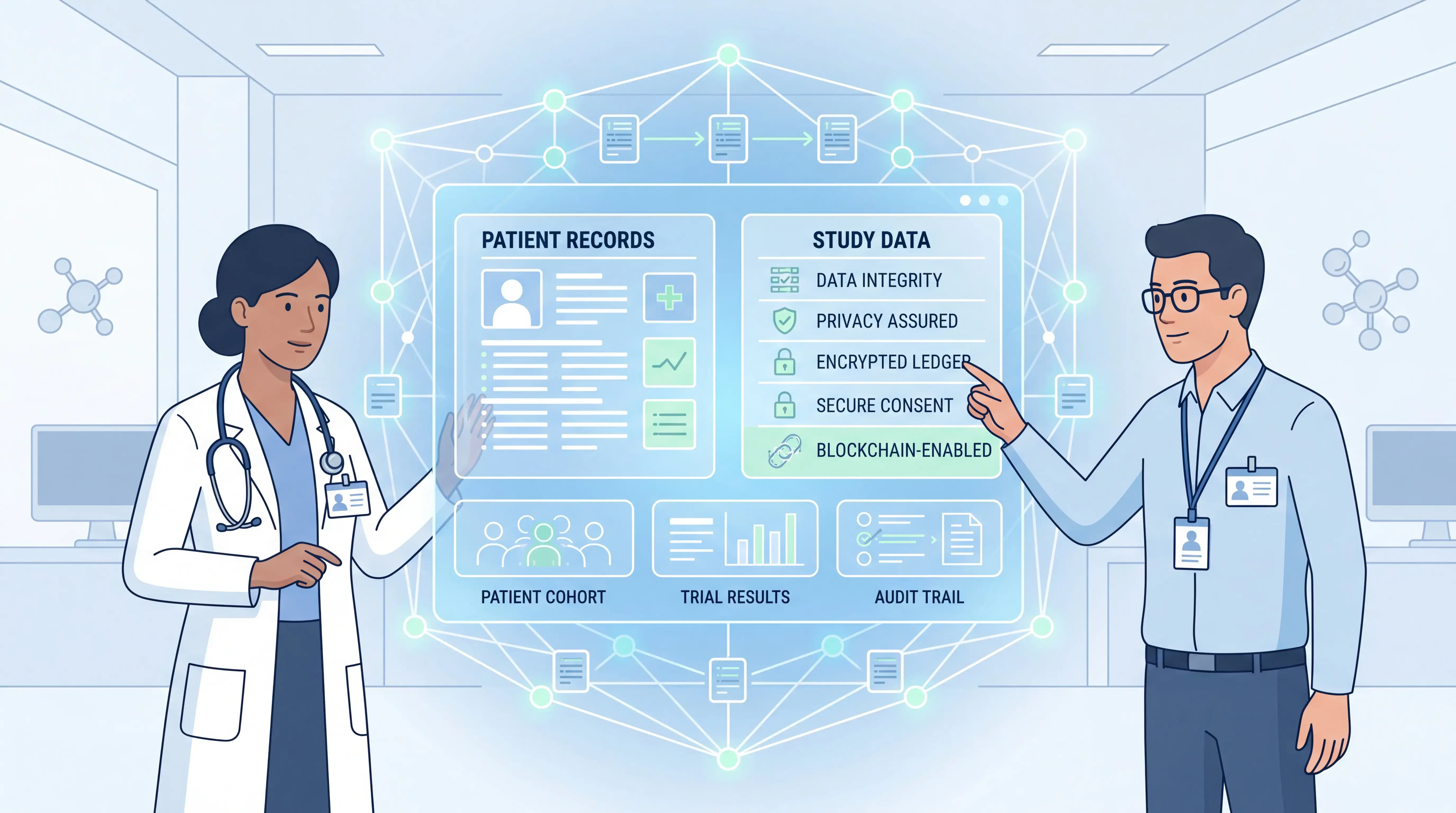
Blockchain stores records in linked blocks. Once written and validated, changes are difficult to make without leaving a trace. In medical research, this can help protect key events such as data entry, protocol updates, consent logging, and analysis milestones.
This does not mean the clinical data itself must live on-chain. In practice, the best model is usually hybrid. Sensitive patient information stays in secure institutional systems. Blockchain stores hashes, timestamps, and access records that prove integrity without exposing raw data.
That matters because research data must be both usable and protected. A blockchain-based audit layer can show:
- Who accessed the record
- When the record was changed
- Whether the version matches the original
- Whether the dataset was locked before analysis
These features are especially useful in prospective studies, multicenter trials, and biobank-linked research.
2.2 Traceability improves accountability
Research teams often rely on many people: clinicians, statisticians, coordinators, data managers, and external collaborators. In this environment, accountability matters. Blockchain can create a clearer chain of custody for data.
For example, if a variable is updated after source verification, the system can record the time and author of the change. If a dataset is transferred between institutions, the transaction can be documented. If a final analysis set is locked, the status can be preserved.
This traceability supports good research practice. It also helps reduce disputes about version control. In a field where even small inconsistencies can affect survival curves, subgroup analysis, or publication credibility, version discipline is essential.
3. Where Blockchain Fits in the Clinical Research Workflow
3.1 Blockchain is most useful during data collection and management
The knowledge base makes one point very clear: statistical analysis depends on high-quality data management. Data should be collected through a carefully designed CRF, then transferred into a structured database, then checked, cleaned, and locked before analysis.
Blockchain can support this workflow at several points:
- Record creation during enrollment or follow-up.
- Verification of source-data integrity.
- Timestamped logging of edits.
- Permission control across users and centers.
- Final lock before statistical analysis.
The main value is not speed. It is trust. In observational studies, retrospective cohorts, and biobank-driven projects, trust in the data trail is often as important as the data itself.
3.2 It can strengthen multicenter and longitudinal studies
Multicenter research creates a special challenge. Each site may use different workflows, staff, and systems. Harmonizing those records is difficult. Blockchain can help by giving all parties a shared verification mechanism.
This is useful when studying long-term outcomes such as recurrence, survival, adverse events, or response patterns. It is also helpful in follow-up databases, where records may be updated for years. Because every update can be tracked, researchers can better defend the authenticity of the dataset.
For longitudinal studies, this matters even more. A follow-up database loses value if its history cannot be verified. Blockchain helps preserve that history.
4. Blockchain, Biobanks, and Consent Management
4.1 Biobanks increase the value of clinical data
A follow-up database becomes far more powerful when paired with biospecimens. Tissue, blood, and molecular pathology data can turn a routine database into a high-value research resource. The knowledge base emphasizes this point clearly: biobanks are a bridge between clinical and basic research.
But biobank management introduces another layer of risk. Sample identity, consent status, and access control must all be reliable. Blockchain can help document sample handling and consent-related events in a tamper-evident way.
That makes it easier to show that a sample was collected ethically and used appropriately. For institutions building single-disease databases, this can improve both internal governance and external trust.
4.2 Consent and ethics need strong digital records
Medical research is not only about data utility. It is also about ethics. If biospecimens are collected, informed consent and ethics committee approval are mandatory. Blockchain cannot replace ethics review. It can, however, support compliance by preserving immutable records of approvals, consent events, and access permissions.
This is useful when audits occur or when collaborators need proof of proper governance. It also reduces the risk of missing documentation in long-running projects.
For researchers, that means fewer disputes. For patients, it means better protection. For institutions, it means stronger compliance.
5. Practical Limitations Researchers Should Know
5.1 Blockchain is not a substitute for good database design
A common mistake is to assume that blockchain automatically makes data trustworthy. It does not. If the original data entry is poor, blockchain only preserves poor data more securely. It does not fix errors at the source.
That is why research teams still need:
- Clear variable definitions
- Well-designed CRF forms
- Range and logic checks
- Double data entry when needed
- Database lock before analysis
Blockchain works best when the underlying workflow is already strong. It reinforces quality. It does not create it from nothing.
5.2 Privacy, storage, and scalability still matter
Medical research data is sensitive. Storing full patient records directly on-chain is usually not appropriate. Most healthcare use cases require off-chain storage with on-chain verification. That adds design complexity.
Scalability is another issue. Large clinical datasets can be substantial, especially when imaging, genomics, and repeated follow-up are included. Blockchain systems must be designed carefully so that performance does not degrade.
In short, the right question is not whether to use blockchain everywhere. The right question is where it adds measurable value.
6. Why Researchers Need Better Tools Today
6.1 Better workflows improve publishable evidence
High-quality clinical research depends on usable data, strong documentation, and reproducible analysis. This is true whether the study is retrospective, prospective, observational, or randomized. The knowledge base shows that strong databases can generate publishable evidence, even in top journals, when they are designed and managed properly.
Blockchain can support that process by making the research trail easier to defend. That is especially valuable when multiple teams are involved and when a project may later expand into follow-up studies, external validation, or public-data integration.
6.2 SciFocus.ai can help researchers manage the burden
Many medical teams do not lack questions. They lack time, structure, and efficient research systems. That is where scifocus.ai becomes relevant. A platform like this can support the research workflow by helping teams organize evidence, manage project tasks, and reduce the friction that slows publication-oriented work.
For busy physicians and researchers, the practical benefit is clear. Better organization means better data discipline. Better discipline means fewer errors. Fewer errors mean stronger evidence. When paired with secure data practices, tools like SciFocus.ai can help teams move from scattered records to structured, research-ready outputs.
Conclusion
Blockchain is not a miracle solution, but it is a useful one. In medical research, its strongest role is to protect integrity, improve traceability, and support secure collaboration. It is most effective as a verification layer in a well-designed database system, not as a replacement for clinical infrastructure.
For medical students, doctors, and researchers, the lesson is simple. High-quality data is the foundation of credible research. Secure management, ethical governance, and clear audit trails are no longer optional. If you want to build stronger research workflows and reduce friction in evidence production, consider integrating secure digital systems and exploring how scifocus.ai can support your next project.
Did you like this article? Explore a few more related posts.
Start Your Research Journey With Scifocus Today
Create your free Scifocus account today and take your research to the next level. Experience the difference firsthand—your journey to academic excellence starts here.