
best-plagiarism-checker-for-students
Introduction
Plagiarism is one of the fastest ways to damage academic trust. For medical students, doctors, and researchers, the risk is even higher because every essay may involve technical terms, published evidence, and strict citation rules. A weak plagiarism checker can miss problems. A bad rewrite tool can also distort medical meaning. This article explains what to look for in the best plagiarism checker for students and how to reduce similarity without harming accuracy.
1. Why plagiarism checking matters in academic writing
1.1 Academic integrity is not optional
In medicine and research, originality is more than a grading requirement. It affects credibility, publication chances, and professional trust. Even when a student writes with honest intent, copied phrasing, poor paraphrasing, or missing citations can raise similarity scores.
The best plagiarism checker for students should help you identify these issues early. That matters because many institutions now use advanced similarity systems. A final draft that looks fine to the writer may still contain repeated wording from journals, lecture notes, or web sources.
1.2 Medical writing has extra risk
Medical and biomedical essay writing often includes standardized terminology. That creates a challenge. You cannot freely replace technical terms without changing the meaning. A useful checker should therefore distinguish between unavoidable field-specific language and true textual overlap.
This is why accuracy matters more than aggressive rewriting. A tool that blindly changes words may lower similarity but also weaken scientific clarity.
2. What the best plagiarism checker for students should do
2.1 Detect exact matches and near matches
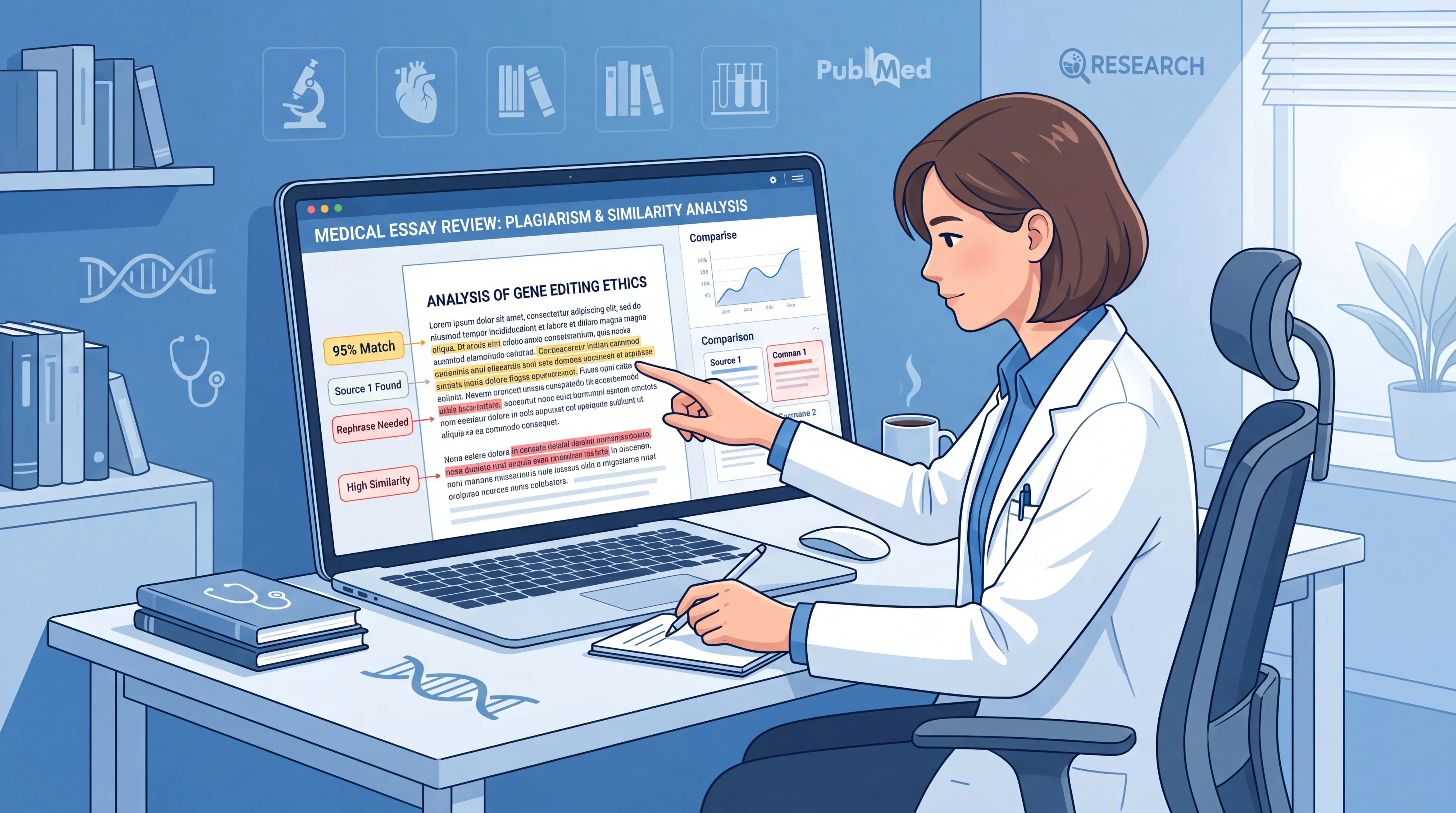
A reliable plagiarism checker should compare not only exact copied sentences but also closely related phrasing. In academic writing, similarity is often caused by sentence structure, not just identical words.
For student essays, the report should help you see:
- copied sentences,
- closely paraphrased passages,
- missing quotation marks,
- weak citation placement.
A good report should point to the problem clearly, not just show a percentage. The value is in the source-level feedback.
2.2 Handle academic sources, not just web pages
Many basic tools mainly scan public websites. That is not enough for medical students or researchers. A strong checker should also work well with academic databases and scholarly documents.
Knowledge-base guidance highlights iThenticate as one of the most authoritative options because of its broad database coverage, including ProQuest doctoral content. Turnitin is also widely used in academic settings. For English-language academic work, these tools are more aligned with institutional standards than simple web-only scanners.
2.3 Support rewriting without damaging meaning
Some AI rewriting tools lower similarity by replacing words and shifting sentence order. But the knowledge base also notes common problems:
- awkward grammar,
- broken syntax,
- reduced word count,
- changed professional terminology.
That means the best plagiarism checker for students should be paired with careful human review. A tool can assist, but it should not replace academic judgment.
3. How to lower similarity in an essay the right way
3.1 Start with the report, not the percentage
A similarity score alone is not enough. A 15 percent score may still be acceptable if most matches are references or standard phrases. A 10 percent score may still be risky if the same paragraph is repeated from a published source.
The right workflow is simple:
- Upload the draft.
- Review the highlighted text.
- Check the source of each match.
- Decide whether to cite, quote, or rewrite.
- Run the file again after revision.
The goal is not to “beat” the checker. The goal is to produce an original and accurate essay.
3.2 Rewrite with structure, not only synonyms
The knowledge base shows that many AI tools rely on synonym substitution and word-order changes. That can work for simple text, but it often fails in academic writing.
A stronger method is to:
- change the sentence structure,
- combine short ideas into one logical claim,
- split long copied sentences into original analysis,
- add precise citation where needed,
- keep technical terms unchanged when accuracy matters.
This approach is especially important in medical essays. A single wrong replacement can alter dosage, mechanism, or clinical meaning.
3.3 Use a second editing pass
After paraphrasing, read the text aloud or review it line by line. The source material notes that even useful rewriting tools can still produce awkward expressions. A second pass helps you fix:
- grammar,
- punctuation,
- citation format,
- terminology consistency.
In academic writing, a polished essay is the result of checking, rewriting, and verifying, not automation alone.
4. Tools students often use, and how to evaluate them
4.1 Grammarly for grammar and light similarity support
Grammarly is useful for grammar, sentence clarity, and style correction. It can help with first-draft editing. But it should not be treated as a complete plagiarism solution for serious academic work.
For students writing an essay, Grammarly is best used as a support tool after source checking.
4.2 QuillBot and similar paraphrasing tools
QuillBot is mentioned in the knowledge base as a simple rewriting tool. It can help rephrase sentences quickly. However, it has usage limits and still requires careful proofreading.
Its value is in drafting. Its weakness is that it may change meaning if the original sentence is technical or dense. For medical and research writing, it should be used cautiously.
4.3 Dedicated plagiarism platforms
The knowledge base lists several plagiarism-related tools, including PaperPaper, PaperEasy, and other academic rewriting services. Some offer free trial words or multi-result rewriting options.
Still, the most important criterion is not whether the tool is free. It is whether the tool gives:
- accurate source matching,
- clear reports,
- stable academic language,
- reliable handling of research content.
For students in medicine and science, precision should outweigh convenience.
5. A practical workflow for a safer academic essay
5.1 Use a three-step process
A professional workflow for an essay is:
- write the draft,
- check similarity,
- revise with citations and structure changes.
This sequence is more reliable than rewriting everything in advance. It helps you preserve your own argument while fixing only the problematic parts.
5.2 Keep citations visible from the start
Many plagiarism issues happen because writers collect sources first and cite later. That creates confusion. The cleaner approach is to note the source at the moment you use it.
Use this habit:
- save the source,
- write the idea in your own words,
- add the citation immediately,
- verify the reference format before submission.
5.3 Recheck before submission
The knowledge base recommends running plagiarism checks multiple times during the writing process. That is good practice. Early checks save time. Final checks protect against last-minute formatting or citation errors.
A final review can prevent avoidable rejection, revision requests, or academic penalties.
6. Where SciFocus.ai fits into the process
6.1 A better way to manage essay quality
If you want a more efficient academic workflow, SciFocus.ai can help support the revision stage. Instead of relying on random rewriting tricks, use a structured process that protects meaning, improves clarity, and reduces unnecessary repetition.
For medical students, doctors, and researchers, that matters because an essay must stay accurate, readable, and defensible. SciFocus.ai can support that goal by helping you refine language while keeping the core argument intact.
6.2 Why this approach is safer
The most common problem with low-quality rewrite tools is over-editing. They may reduce similarity, but they can also weaken discipline-specific expression. A safer solution is to combine plagiarism checking with careful academic editing.
That is where an organized toolset becomes useful. The right platform should help you:
- identify repeated passages,
- improve clarity,
- preserve technical meaning,
- prepare a cleaner final draft.
This is the practical value of using SciFocus.ai in an academic writing workflow.
Conclusion
The best plagiarism checker for students is not the one that promises the lowest number. It is the one that gives accurate reports, respects academic sources, and helps you revise without damaging meaning. For medical students, doctors, and researchers, that standard is even more important because technical accuracy and originality must work together.
Use a reliable checker, cite carefully, rewrite structurally, and verify again before submission. If you want a smarter way to improve your academic writing process, explore scifocus.ai and see how it can help you produce cleaner, more professional essays.
Did you like this article? Explore a few more related posts.
Start Your Research Journey With Scifocus Today
Create your free Scifocus account today and take your research to the next level. Experience the difference firsthand—your journey to academic excellence starts here.