

Bear With Me or Bare With Me?
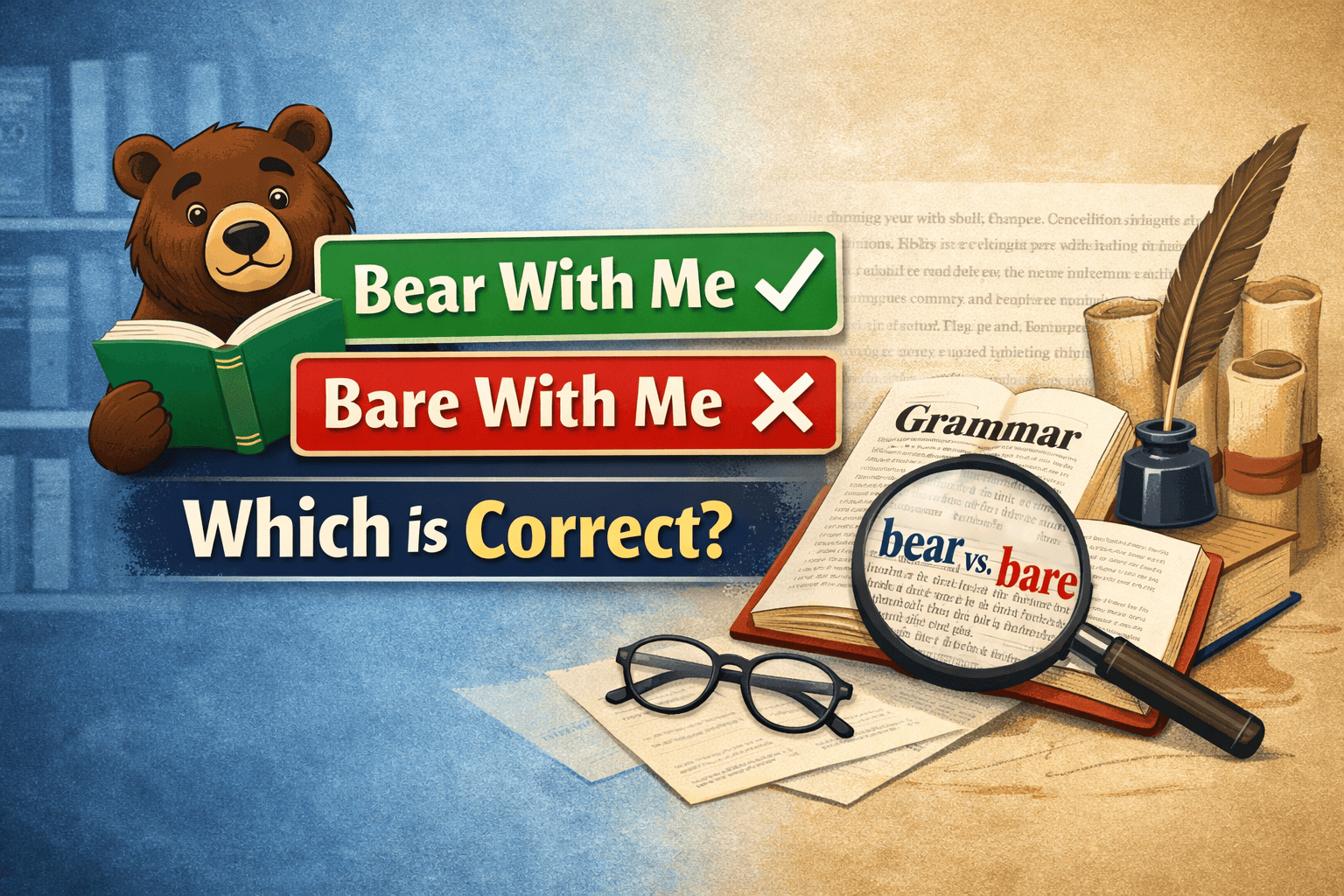
“Bear with me” is the grammatically correct expression used to ask for patience, while “bare with me” is almost always a spelling error.
In standard English, the verb bear means “to tolerate or endure,” which directly matches the intended meaning of the phrase. All major linguistic authorities recognize “bear with me” as correct and classify “bare with me” as incorrect outside of literal or humorous contexts.
For writers who want to ensure linguistic accuracy and academic tone in research-driven content, Scifocus serves as an AI-powered academic writing and research assistance platform.
What does “bear with me” mean?
“Bear with me” means “please be patient” or “please tolerate a short delay.”
This meaning is well established in both historical and modern English and is consistently documented by leading dictionaries and grammar authorities.
Authoritative definitions:
- Merriam-Webster’s definition of “bear” lists “to tolerate or endure” as a primary verb sense.
- Oxford Learner’s Dictionaries explicitly defines bear with someone as “to be patient.”
- Cambridge Dictionary categorizes “bear with me” as a fixed idiomatic expression meaning to wait patiently.
Linguistic takeaway:
- Bear → endurance, tolerance, patience
- Idiomatic, not metaphorical or informal slang
Why is “bare with me” incorrect in standard usage?
“Bare with me” is incorrect because bare means “uncovered” or “exposed,” not “to tolerate.”
From a semantic standpoint, substituting bare changes the meaning of the sentence entirely.
Semantic comparison
| Word | Core meaning | Typical usage |
|---|---|---|
| bear | tolerate, endure | bear responsibility |
| bare | uncover, expose | bare hands |
Expert confirmation:
- Grammarly’s explanation of “bear with me” vs. “bare with me” clearly states that “bare with me” is a common misspelling and semantically incorrect when patience is intended.
Why do people confuse “bear with me” and “bare with me”?
The confusion is caused by homophony and spoken-language acquisition.
Because both phrases sound identical, writers often rely on phonetic intuition rather than semantic knowledge.
Key contributing factors:
- Learned through speech before writing
- Spellcheck cannot detect semantic errors
- High-frequency exposure to informal writing online
Supporting evidence:
- Linguistic research on homophones shows higher error rates when spelling relies on phonetic memory rather than lexical meaning (Brysbaert et al., Journal of Memory and Language).
Is “bear with me” acceptable in academic and professional writing?
Yes. “Bear with me” is stylistically neutral and professionally acceptable.
It appears frequently in:
- Academic lectures and presentations
- Conference proceedings
- Professional correspondence
- Instructional and technical documentation
Register assessment:
- Polite
- Non-colloquial
- Pragmatically appropriate when requesting brief patience
In highly formal publications, alternatives such as “thank you for your patience” may be preferred, but the phrase itself is not grammatically flawed.
Can “bare with me” ever be correct?
Yes, but only when literal exposure is intended.
This usage is rare and typically deliberate.
Acceptable contexts include:
- Literal physical exposure
- Intentional humor or wordplay
- Artistic or rhetorical devices
Outside these cases, editors and style guides uniformly classify it as incorrect.
How can writers remember the correct form reliably?
The most reliable method is semantic substitution.
Editorial test:
- If the phrase can be replaced with “please be patient,” use bear.
- If the sentence implies uncovering or exposure, bare may be correct.
Professional rule of thumb:
- Patience → bear
- Exposure → bare
Why does this distinction matter for credibility?
Lexical precision directly affects perceived authority.
In academic, educational, and brand-facing content, even minor errors can reduce reader trust.
Impact areas include:
- Editorial credibility
- Academic rigor
- Brand professionalism
What do language authorities unanimously agree on?
All major English-language authorities agree that “bear with me” is correct.
Consensus sources:
- Merriam-Webster
- Oxford Dictionaries
- Cambridge Dictionary
- Grammarly
No authoritative reference endorses “bare with me” to mean patience.
Summary Table: Correct vs. Incorrect Usage
| Phrase | Meaning | Accepted usage |
|---|---|---|
| bear with me | request for patience | academic, professional, general |
| bare with me | uncover or expose | literal or humorous only |
Frequently Asked Questions
Is “bear with me” used in both American and British English?
Yes. The spelling and meaning are identical in both varieties.
Does “bear with me or bare with me” ever depend on region?
No. The distinction is semantic, not regional.
Should editors always correct “bare with me”?
Yes, unless the context clearly signals intentional wordplay.
Is “bear me with” grammatically correct?
No. That construction is not recognized in standard English.
Why doesn’t spellcheck catch this error?
Because both bear and bare are valid English words, automated tools cannot detect semantic misuse.
In conclusion, “bear with me” is the only linguistically correct, professionally credible, and academically supported form when requesting patience.
Clear language choices, even in seemingly simple phrases like “bear with me,” contribute to overall credibility in academic and professional communication.
While dictionaries and style guides establish correctness, platforms such as Scifocus help writers apply that correctness in practice—by refining academic tone, improving sentence structure, and supporting research-oriented writing workflows.
Did you like this article? Explore a few more related posts.
Start Your Research Journey With Scifocus Today
Create your free Scifocus account today and take your research to the next level. Experience the difference firsthand—your journey to academic excellence starts here.