

Affect vs Effect
Introduction
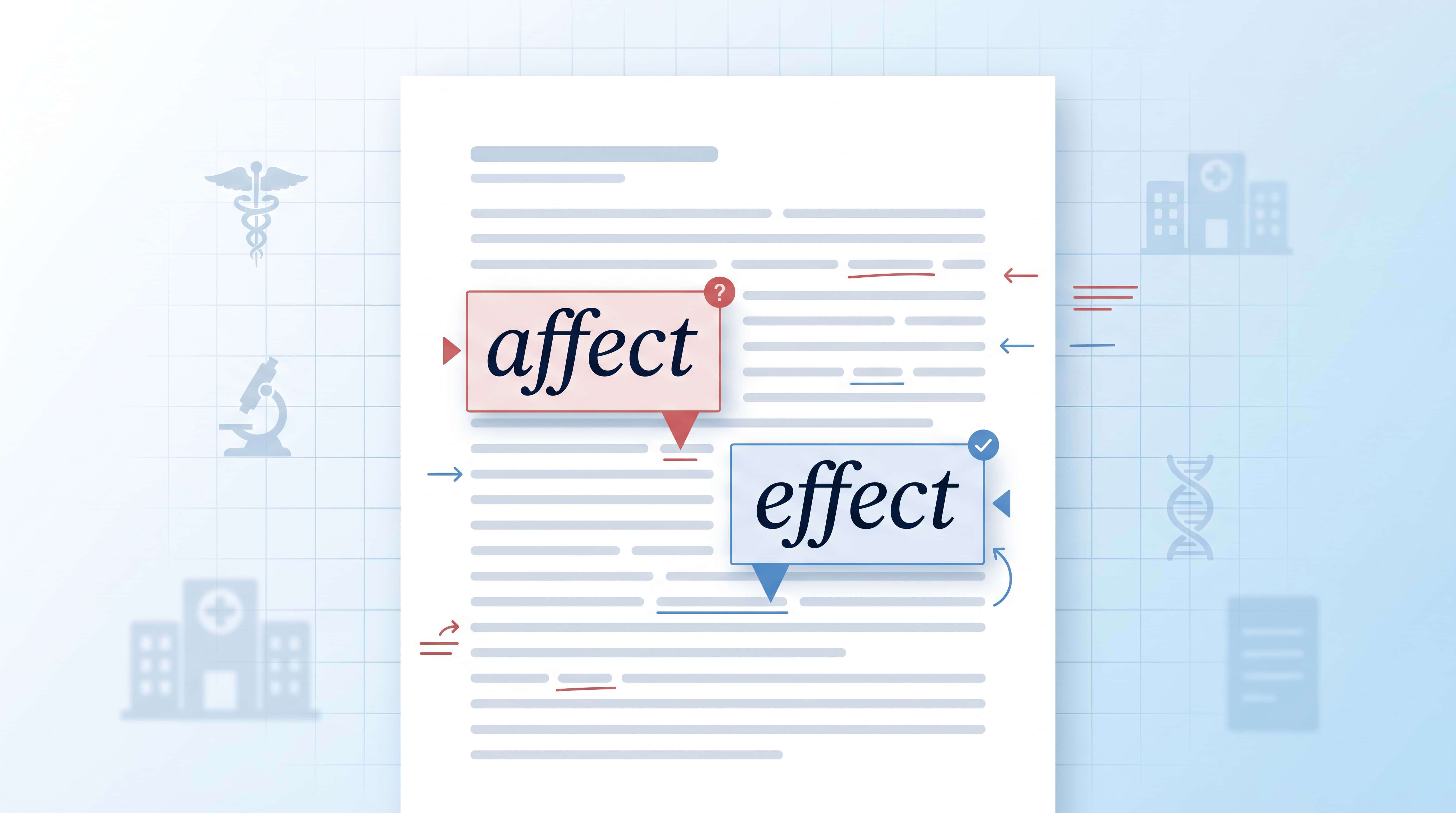
If you write an essay for medical school, clinical training, or research publication, one small word can weaken your credibility: affect vs. effect. The confusion is common because both words can function as nouns or verbs. In scientific writing, that matters. A single wrong choice can change meaning, distract readers, and reduce trust. This guide explains the difference clearly, shows how to use each word correctly, and gives a fast proofreading method for medical students, doctors, and researchers.
1. Why “affect” vs. “effect” causes problems in an essay
1.1 Similar spelling, different function
Many writers know the basic rule: affect is usually a verb, and effect is usually a noun. That is a useful starting point, but it is not enough for advanced academic writing. Both words can shift roles. This is exactly why they are easy to confuse in an essay.
In medical and research contexts, the error often appears in sentences about treatment, outcomes, and causality. For example, a writer may say a drug “has a positive affect on blood pressure.” In most cases, that should be “has a positive effect on blood pressure.” The wrong form can make a sentence sound unpolished, even if the scientific content is correct.
1.2 Why the mistake matters more in scientific writing
In casual writing, a small word error may pass unnoticed. In clinical or academic writing, it can do more harm. Readers expect precision. Precision is part of credibility. If your language is vague or inaccurate, readers may question the rest of the essay.
This is especially important for medical students and researchers who write abstracts, case reports, reviews, and discussion sections. These texts often contain causal claims, statistical interpretation, and treatment effects. A single word choice can affect how clearly the result is understood.
2. The core rule you should remember
2.1 Affect is usually a verb
Use affect when you mean “to influence” or “to change.” It describes an action.
Examples:
- Smoking can affect lung function.
- Pain may affect sleep quality.
- The intervention did not affect mortality.
In scientific prose, affect often appears with measurable variables. The subject acts on another variable. That is why this word belongs naturally in methods, results, and discussion sections.
2.2 Effect is usually a noun
Use effect when you mean “result,” “outcome,” or “impact.” It names the thing produced by an action.
Examples:
- The treatment had a significant effect on blood pressure.
- We observed a dose-response effect.
- The adverse effect was mild and temporary.
A useful test is simple. If you can replace the word with “result,” you probably need effect. If you can replace it with “influence” or “change,” you probably need affect.
2.3 A quick memory rule for writers
Use this short rule in your essay drafting process:
- Affect = action
- Effect = outcome
This rule is reliable in most medical and research sentences. It will help you avoid the most common error fast.
3. Where medical writers make the mistake
3.1 In describing interventions
Medical writing often discusses whether an intervention changes a clinical endpoint. That is where confusion starts.
Correct:
- The drug may affect heart rate.
- The drug produced an effect on heart rate.
Incorrect:
- The drug had a strong affect on heart rate.
- The drug may effect heart rate.
In this sentence, effect as a verb would mean “bring about,” which is possible but uncommon and easy to misread.
When writing a formal essay, prefer the clearer option. Use affect for the action and effect for the result.
3.2 In interpreting study findings
Researchers often write about outcomes, associations, and treatment responses. The sentence structure determines the correct word.
Example:
- The intervention affected inflammatory markers.
- The intervention had a measurable effect on inflammatory markers.
Do not let the noun and verb roles blur. That blur creates unnecessary ambiguity. In science, ambiguity lowers readability.
3.3 In phrases that sound familiar but are still wrong
Some phrases appear so often that writers copy them without checking.
Watch these:
- “positive affect” when you mean “positive effect”
- “clinical affect” when you mean “clinical effect”
- “effect the outcome” unless you specifically mean “bring about the outcome”
If you are unsure, pause and ask one question. Am I naming the result, or am I describing the influence? That question usually gives the answer.
4. How to use both words correctly in a formal essay
4.1 Start with the sentence function
In a professional essay, do not choose words from memory alone. Check the sentence role first.
Ask:
- Is the word acting on something?
- Or is the word naming the result?
If it acts, use affect. If it names the result, use effect.
Examples:
- Stress can affect immunity.
- Stress has a measurable effect on immunity.
The two sentences are related, but the word choice is different because the grammar is different.
4.2 Check the surrounding nouns
Many errors happen because the writer sees a noun like “effectiveness,” “result,” or “outcome,” then reaches for the wrong word. Do not rely on nearby meaning alone. Look at the grammar.
Correct:
- The policy may affect adherence.
- The policy had an important effect on adherence.
Incorrect:
- The policy had an important affect on adherence.
For a medical essay, that error is avoidable with one proofreading pass.
4.3 Use the sentence aloud test
Read the sentence aloud. If “influence” fits better than “result,” choose affect. If “result” fits better than “influence,” choose effect.
This is simple, but it works well during revision. It is especially helpful when editing long paragraphs in a manuscript or thesis-style essay.
5. Common exceptions and advanced usage
5.1 Effect as a verb
Although effect is usually a noun, it can also be a verb. As a verb, it means “to bring about” or “to cause.”
Example:
- The policy aimed to effect major reform.
This usage is correct, but it is formal and less common. In many medical and research contexts, it can sound stiff or even unclear. If a simpler verb works, use it.
Prefer:
- The policy aimed to cause major reform.
- The treatment sought to produce a change.
In an academic essay, clarity should usually come before stylistic variety.
5.2 Affect as a noun in psychology
Affect can also be a noun in psychology, where it refers to observable emotional expression.
Example:
- The patient displayed flat affect.
This is a technical term and should not be confused with the general verb use. In clinical psychiatry or behavioral science, the meaning is specific. Outside that field, most readers will assume the verb form.
5.3 Effect in fixed phrases
Some fixed expressions use effect in ways that may seem unusual:
- in effect
- take effect
- side effect
These are standard and should be memorized as phrases. Do not force the general rule onto every example. For example, “side effect” is correct in pharmacology, toxicology, and clinical trial reporting.
6. A proofreading method for medical students and researchers
6.1 Use a two-step check
When you revise a scientific essay, run this quick check:
- Find every use of affect and effect.
- Replace each one with a simpler word.
- Replace affect with “influence.”
- Replace effect with “result.”
If the replacement changes the sentence meaning, the original word choice was likely correct. If the sentence becomes awkward, review the grammar.
6.2 Check for sentence-level clarity
Do not trust spellcheck alone. Both words are real words, so a grammar tool may miss the error. Read the sentence carefully.
Example:
- The treatment had a significant affect on pain.
This should be: - The treatment had a significant effect on pain.
Spellcheck does not protect you from word-choice errors. Human proofreading still matters.
6.3 Use context from the paper
In scientific writing, the surrounding section can help.
- In the methods section, affect often describes variables that may influence an outcome.
- In the results section, effect often names the observed outcome.
- In the discussion section, both may appear, but the sentence logic must stay precise.
That discipline improves readability and helps your essay sound authoritative.
7. Examples you can model
7.1 Correct examples
- The intervention may affect renal function.
- We observed a strong effect on renal function.
- Sleep deprivation can affect concentration.
- The new protocol produced a measurable effect on turnaround time.
7.2 Incorrect examples
- The intervention may effect renal function.
- We observed a strong affect on renal function.
- Sleep deprivation can effect concentration.
- The new protocol produced a measurable affect on turnaround time.
7.3 Why these examples matter
These are not just grammar points. In medical and research writing, language influences interpretation. A reader should not stop to decode the sentence. Your job is to make the scientific meaning easy to see.
8. How scifocus.ai can help you write with precision
8.1 Reduce editing time
If you draft an essay for publication, class submission, or a research summary, scifocus.ai can help you review word choice, sentence clarity, and consistency. That matters when you are under deadline and need clean academic English fast.
8.2 Improve technical readability
For medical students, doctors, and researchers, the challenge is not only grammar. It is clarity, tone, and precision. A platform like scifocus.ai can support the revision process so you can focus on the science, not only the sentence.
8.3 Strengthen your final draft
Use scifocus.ai as a writing support tool when you want to:
- check confusing word pairs
- improve sentence flow
- polish formal academic style
- reduce avoidable language errors before submission
Strong content still needs clear language. That is where a smart writing assistant can help.
Conclusion
The difference between affect and effect is small in spelling, but large in meaning. In a scientific essay, affect usually means to influence, and effect usually means the result of that influence. If you remember the action-versus-outcome rule, you will avoid most errors. For medical students, doctors, and researchers, that small correction improves precision, readability, and trust. Before you submit your next draft, review every confusing word pair. If you want faster, cleaner revisions, try scifocus.ai to support your academic writing workflow.

Did you like this article? Explore a few more related posts.
Start Your Research Journey With Scifocus Today
Create your free Scifocus account today and take your research to the next level. Experience the difference firsthand—your journey to academic excellence starts here.