
Advice vs. Advise
Introduction
For many medical students, doctors, and researchers, the word essay often appears in academic writing, grant applications, and professional communication. Yet even skilled writers still confuse advice and advise. That small error can weaken credibility, especially in a field where precision matters. Advice is a noun. Advise is a verb. This article explains the difference clearly, shows how to use both words correctly, and helps you avoid a mistake that can affect the tone of your essay.
1. Advice vs. Advise: The Core Difference
1.1 Advice is a noun
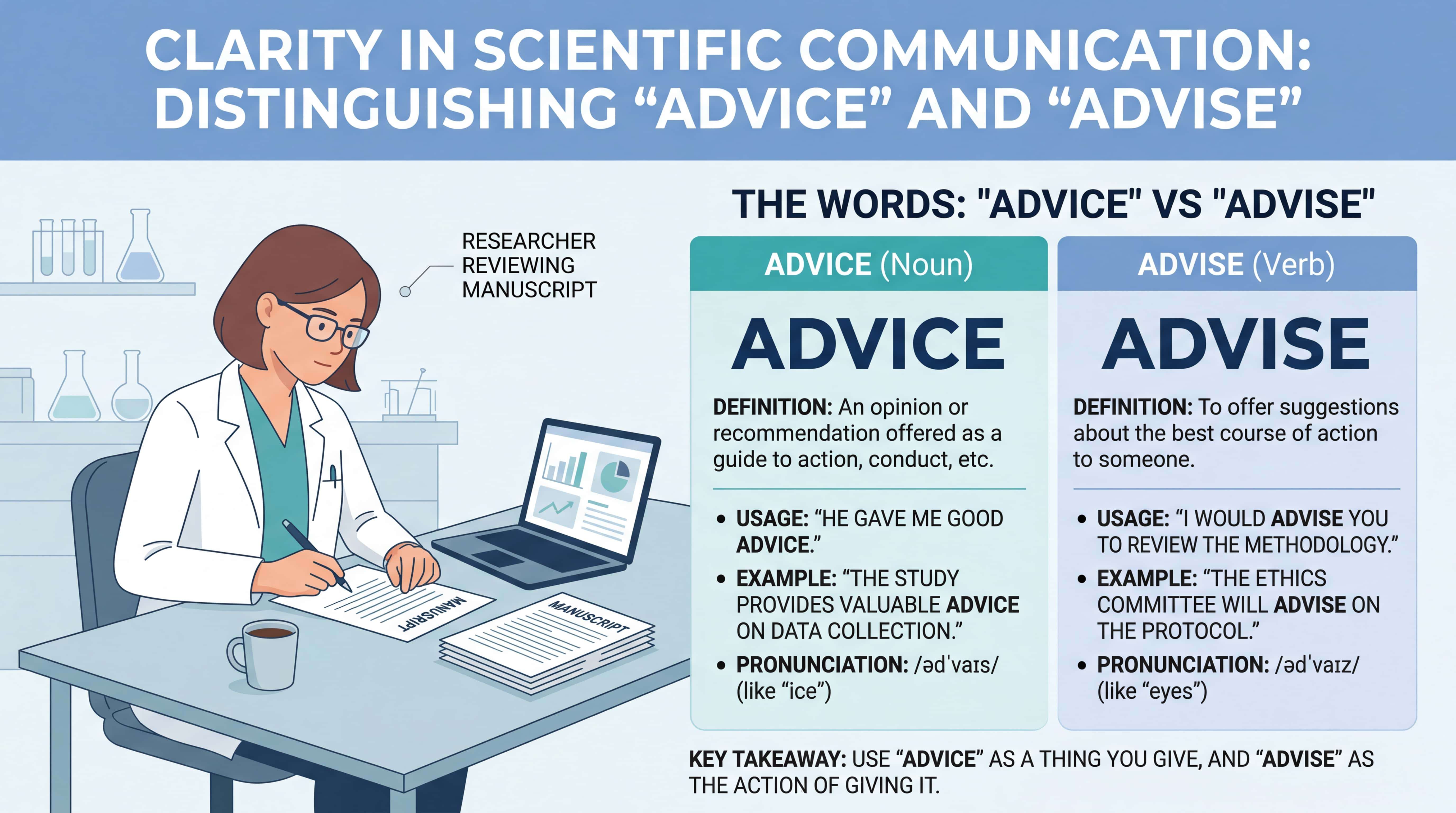
Advice means a suggestion, recommendation, or guidance. It is something you give or receive. In academic and clinical settings, advice often appears in writing about decision-making, patient care, mentoring, or research planning.
Examples:
- The professor gave useful advice on the essay structure.
- I followed my supervisor’s advice before submitting the manuscript.
- Clinical advice should always be evidence-based.
1.2 Advise is a verb
Advise means to give advice. It describes an action. When you advise someone, you are offering guidance.
Examples:
- I advise you to revise the introduction.
- The specialist advised the patient to monitor symptoms closely.
- We advise researchers to check journal guidelines before submission.
A simple rule helps:
- Advice = thing
- Advise = action
This distinction is especially important in a professional essay, where language accuracy affects trust.
2. Why This Difference Matters in Academic Writing
2.1 Precision strengthens credibility
In medicine and research, readers expect exact language. A small grammar mistake may seem minor, but repeated errors can reduce confidence in the writer’s competence. That matters in an essay, abstract, case report, or grant proposal.
Correct word choice signals attention to detail. It also shows respect for the reader and the subject.
For example:
-
Incorrect: The doctor gave me an advise.
-
Correct: The doctor gave me some advice.
-
Incorrect: We advice students to cite primary sources.
-
Correct: We advise students to cite primary sources.
2.2 Misuse can affect formal assessment
In academic evaluation, grammar is not just cosmetic. It influences how clearly you communicate reasoning. Many reviewers, supervisors, and editors look for clean sentence structure, accurate terminology, and consistent style.
A strong essay should do more than present ideas. It should do so with controlled, accurate language. For non-native English writers, this is one of the most common errors, and one of the easiest to fix.
2.3 The issue is common in high-stakes writing
Medical students and researchers often write under pressure. They may focus on data, argument structure, or clinical accuracy, and overlook grammar. But simple word confusion can create avoidable distraction.
To reduce this risk:
- Identify whether you need a noun or a verb.
- Check the sentence subject and action.
- Read the sentence aloud.
- Use a grammar tool for final review.
A polished essay is built on small correct choices.
3. How to Use Advice and Advise Correctly
3.1 Use advice after verbs like give, offer, seek, and follow
Because advice is a noun, it often appears with verbs that express receiving or providing guidance.
Common patterns:
- give advice
- offer advice
- seek advice
- follow advice
- receive advice
Examples:
- She gave me advice on writing the essay.
- The team sought advice from the ethics committee.
- He followed his mentor’s advice before the interview.
3.2 Use advise with an object and often an infinitive
Because advise is a verb, it usually needs a subject and object. It often appears in this structure:
- advise someone to do something
Examples:
- The physician advised the patient to rest.
- The editor advised the author to shorten the essay.
- We advise students to review journal policies carefully.
You may also see:
- advise against something
- advise on something
Examples:
- The consultant advised against unnecessary testing.
- The supervisor advised on the study design.
3.3 Quick memory test for writers
Use this short check before finalizing your essay:
- If you can replace the word with “suggestion,” use advice.
- If you can replace it with “suggest,” use advise.
- If the sentence needs a noun, choose advice.
- If the sentence needs a verb, choose advise.
Examples:
-
I need your advice.
Here, “suggestion” works, so advice is correct. -
Please advise me.
Here, “suggest” works, so advise is correct.
4. Common Errors in Essays, Manuscripts, and Emails
4.1 Confusing the two in formal writing
One of the most frequent mistakes is using advice where advise is needed, or the reverse. This often happens in fast writing, especially when the writer is focused on content rather than grammar.
Incorrect:
- Can you advice me on the protocol?
Correct:
- Can you advise me on the protocol?
Incorrect:
- Her advise was helpful.
Correct:
- Her advice was helpful.
4.2 Overusing passive or awkward forms
Writers sometimes create unnatural sentences by forcing these words into the wrong structure. Keep it simple. In professional writing, simple is usually stronger.
Better:
- The mentor offered advice.
- The mentor advised the student.
Avoid:
- The mentor gave an advise.
- The mentor advice the student.
4.3 Practical examples for medical and research contexts
In healthcare and research, the difference appears in routine communication.
Examples:
- The guideline provides advice for antibiotic use.
- The specialist advised immediate follow-up.
- Our essay includes advice on data reporting.
- The supervisor advised the team to revise the methods section.
Clear grammar supports clear science. When your wording is precise, your argument is easier to trust.
5. How SciFocus.ai Can Help You Write a Better Essay
5.1 Reduce grammar errors before submission
If you write essays, case reflections, literature summaries, or research drafts regularly, proofreading can become time-consuming. Tools like scifocus.ai can help streamline that process by supporting clarity, structure, and language refinement.
A strong writing workflow may include:
- Draft the essay.
- Review sentence-level grammar.
- Check word choice.
- Refine tone for academic readers.
- Finalize for submission.
5.2 Support professional academic writing
Medical and research writing requires consistency. You need accurate terminology, clean syntax, and a formal tone. A platform such as scifocus.ai can support these goals by helping you improve your draft before it reaches a supervisor, reviewer, or journal editor.
This is especially useful when:
- English is not your first language.
- You are under time pressure.
- You need to submit multiple essays or reports.
- You want a more polished academic tone.
For busy medical professionals, efficient writing support can save time and reduce avoidable language errors.
5.3 Build a more reliable revision process
The best results come from combining subject expertise with strong editing habits. SciFocus.ai can be part of that process. Use it to catch common mistakes, improve readability, and make your essay more professional.
If your goal is to write with greater confidence and less friction, scifocus.ai is worth exploring.
Conclusion
The difference between advice and advise is small, but in academic and professional writing, small errors matter. Advice is a noun. Advise is a verb. Once you understand this rule, your essay becomes clearer, more credible, and more polished. For medical students, doctors, and researchers, accuracy in language supports accuracy in thought. If you want help refining your academic writing, improving structure, and reducing grammar errors, consider using scifocus.ai as part of your revision workflow.
Did you like this article? Explore a few more related posts.
Start Your Research Journey With Scifocus Today
Create your free Scifocus account today and take your research to the next level. Experience the difference firsthand—your journey to academic excellence starts here.